%22%3E%0A%3Cpath%20d%3D%22M0%205.37646H8.15061L17.4195%2016.8819V5.37646H26.0647V31.4412H18.3227L8.64523%2019.4196V31.4412H0V5.37646Z%22%20fill%3D%22white%22%2F%3E%0A%3Cpath%20d%3D%22M29.2041%205.37649H43.8064C47.4193%205.37649%2049.6989%206.1937%2051.2258%207.72059C52.1505%208.64533%2052.8172%2010.0002%2052.8172%2011.7851V11.8497C52.8172%2014.9465%2050.9462%2016.8389%2048.172%2017.8067C51.5269%2018.7744%2053.6774%2020.5594%2053.6774%2024.1293V24.1938C53.6774%2028.3659%2050.258%2031.4197%2043.6558%2031.4197H29.2041V5.35498V5.37649ZM44.258%2013.7637C44.258%2012.6024%2043.3333%2011.9787%2041.4623%2011.9787H37.6988V15.6346H41.5053C43.3763%2015.6346%2044.258%2015.011%2044.258%2013.8497V13.7852V13.7637ZM42.0859%2020.9895H37.6988V24.8605H42.0644C43.9569%2024.8605%2044.9247%2024.0863%2044.9247%2022.968V22.9035C44.9247%2021.7852%2043.9999%2021.011%2042.0859%2021.011V20.9895Z%22%20fill%3D%22white%22%2F%3E%0A%3Cpath%20d%3D%22M64.8174%205.18286H73.4627L84.452%2031.4411H74.9896L73.6132%2027.9357H64.4949L63.1615%2031.4411H53.8496L64.8389%205.18286H64.8174ZM71.4412%2021.7636L69.054%2015.441L66.6669%2021.7636H71.4412Z%22%20fill%3D%22white%22%2F%3E%0A%3Cpath%20d%3D%22M95.2695%205.37646H105.248C115.592%205.37646%20120.775%2010.4733%20120.775%2018.1938V18.2583C120.775%2025.9788%20115.485%2031.4412%20104.947%2031.4412H95.2695V5.37646ZM104.001%2012.9679V23.8497H105.463C109.442%2023.8497%20112.022%2022.2153%20112.022%2018.4518V18.3873C112.022%2014.6239%20109.463%2012.9894%20105.463%2012.9894H104.001V12.9679Z%22%20fill%3D%22white%22%2F%3E%0A%3Cpath%20d%3D%22M123.098%2011.1182H131.549V15.2258C132.711%2012.4731%20134.56%2010.6881%20137.915%2010.8387V19.8065H137.012C133.442%2019.8065%20131.528%2021.785%20131.528%2026.2797V31.4625H123.076V11.1182H123.098Z%22%20fill%3D%22white%22%2F%3E%0A%3Cpath%20d%3D%22M137.808%2025.6772V25.6127C137.808%2021.5482%20140.818%2019.2901%20145.55%2019.2901C147.27%2019.2901%20149.464%2019.6557%20150.345%2020.0428V19.6987C150.345%2017.8277%20149.184%2016.7524%20146.582%2016.7524C144.496%2016.7524%20142.754%2017.204%20140.969%2017.9137L139.485%2012.3008C141.829%2011.3975%20144.517%2010.8169%20148.044%2010.8169C152.173%2010.8169%20154.862%2011.6771%20156.646%2013.4621C158.173%2014.989%20158.776%2016.9675%20158.776%2019.9137V31.5052H150.324V29.4622C148.904%2030.9891%20147.012%2031.9999%20144.474%2031.9999C140.56%2031.9999%20137.808%2029.7633%20137.808%2025.7417V25.6772ZM150.431%2023.9138V23.0536C149.937%2022.86%20149.206%2022.7095%20148.496%2022.7095C146.818%2022.7095%20145.894%2023.7202%20145.894%2024.9891V25.0536C145.894%2026.2364%20146.754%2027.0321%20147.829%2027.0321C149.313%2027.0321%20150.431%2025.8493%20150.431%2023.9138Z%22%20fill%3D%22white%22%2F%3E%0A%3Cpath%20d%3D%22M162.883%2017.6345H160.496V11.1183H162.883C162.926%208.96778%20163.442%207.20433%20164.711%205.9355C166.088%204.55915%20167.872%204%20170.668%204C173.163%204%20174.69%204.21506%20175.851%204.55914V9.84951C175.034%209.65596%20174.217%209.54843%20173.141%209.54843C171.83%209.54843%20171.163%2010.0646%20171.163%2011.1829V11.3334H175.851V17.6345H171.335V31.4411H162.883V17.6345Z%22%20fill%3D%22white%22%2F%3E%0A%3Cpath%20d%3D%22M178.883%2024.6238V17.613H176.496V11.0968H178.883V6H187.335V11.0968H192.023V17.613H187.335V22.7528C187.335%2024.2797%20188.045%2024.8389%20189.378%2024.8389C190.152%2024.8389%20191.055%2024.6238%20191.937%2024.2152V30.7314C190.604%2031.4411%20188.582%2031.8927%20186.539%2031.8927C181.55%2031.8927%20178.862%2029.5916%20178.862%2024.6238H178.883Z%22%20fill%3D%22white%22%2F%3E%0A%3Cpath%20fill-rule%3D%22evenodd%22%20clip-rule%3D%22evenodd%22%20d%3D%22M201.368%204.36764C207.191%20-1.45588%20216.632%20-1.45588%20222.456%204.36764C228.279%2010.1912%20228.279%2019.6324%20222.456%2025.4559L211.912%2036L201.368%2025.4559C195.544%2019.6324%20195.544%2010.1912%20201.368%204.36764ZM204.009%207.55761C203.948%207.86849%20203.916%208.39718%20203.916%209.14566V10.4189C203.916%2011.1832%20203.948%2011.7198%20204.013%2012.0267C204.078%2012.3317%20204.278%2012.6168%20204.617%2012.8762C204.956%2013.1376%20205.403%2013.3316%20205.958%2013.4623C206.512%2013.593%20207.1%2013.6583%20207.837%2013.6583C208.573%2013.6583%20209.217%2013.591%20209.769%2013.4524C210.322%2013.3158%20210.761%2013.1178%20211.086%2012.8604C211.411%2012.6029%20211.605%2012.3178%20211.666%2012.0069C211.728%2011.6961%20211.759%2011.1674%20211.759%2010.4189V9.14566C211.759%208.38134%20211.728%207.84473%20211.662%207.53781C211.597%207.23287%20211.397%206.94972%20211.058%206.68834C210.72%206.42696%20210.272%206.23291%20209.718%206.10223C209.163%205.97154%20208.536%205.90619%20207.839%205.90619C207.102%205.90619%20206.459%205.97352%20205.906%206.11213C205.352%206.24875%20204.914%206.44677%20204.589%206.70418C204.265%206.9616%20204.071%207.24673%20204.009%207.55761ZM209.276%2024.8638C212.876%2024.8638%20214.557%2024.2064%20214.557%2021.862V21.858V21.3155C214.557%2019.6581%20213.516%2018.971%20210.252%2018.3136C209.278%2018.1136%20208.908%2017.9136%20208.908%2017.3136V16.9414C208.908%2016.6543%20209.177%2016.5117%20209.413%2016.5117C209.749%2016.5117%20209.918%2016.7137%20209.918%2016.9414V18.1136H214.391V17.3988C214.391%2015.4563%20213.347%2014.4266%20209.177%2014.4266C206.15%2014.4266%20203.896%2015.3414%20203.896%2017.3711V17.7433C203.896%2019.5155%20204.805%2020.3155%20208.201%2021.0303C208.28%2021.0472%20208.355%2021.063%20208.427%2021.0781C209.329%2021.2674%20209.647%2021.3341%20209.647%2021.9174V22.2897C209.647%2022.6619%20209.546%2022.8045%20209.142%2022.8045C208.67%2022.8045%20208.637%2022.5471%20208.637%2022.262V21.2897H203.894V21.7471C203.894%2024.149%20205.476%2024.8638%20209.276%2024.8638ZM215.424%2024.5569H219.925V14.7355H215.424V24.5569ZM216.955%2013.5019H219.925V6.06064H217.092V9.411L215.193%206.06064H212.359V13.5019H215.193V10.1199L216.955%2013.5019ZM208.269%2012.152C208.204%2012.2688%20208.055%2012.3262%20207.825%2012.3262L207.827%2012.3282C207.604%2012.3282%20207.459%2012.2767%20207.398%2012.1757C207.336%2012.0748%20207.305%2011.8074%20207.305%2011.3758V7.90068C207.305%207.51852%20207.352%207.28684%20207.445%207.20962C207.538%207.13239%20207.675%207.09279%20207.851%207.09279C208.059%207.09279%20208.198%207.14031%20208.265%207.23734C208.332%207.33239%20208.366%207.55416%20208.366%207.90068V11.3203C208.366%2011.7579%20208.334%2012.0352%20208.269%2012.152Z%22%20fill%3D%22white%22%2F%3E%0A%3C%2Fg%3E%0A%3Cdefs%3E%0A%3CclipPath%20id%3D%22clip0_15247_3640%22%3E%0A%3Crect%20width%3D%22227%22%20height%3D%2236%22%20fill%3D%22white%22%2F%3E%0A%3C%2FclipPath%3E%0A%3C%2Fdefs%3E%0A%3C%2Fsvg%3E%0A)
NBA Draft Scouting Report: Houston Forward Chris Cenac Jr.
In this story:
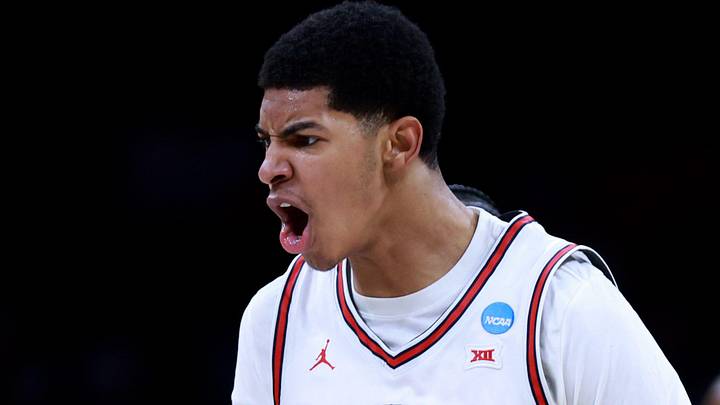
Chris Cenac Jr. entered the college season as one of the top prospects in the incoming class, ranking the best among Houston’s five-star trio and No. 6 as a whole per RSCI, behind only Dybantsa, Peterson, Boozer, Wilson and Ament.
Despite that, he didn’t fully live up to the hype in his freshman season with the Cougars, even accounting for the team’s overall success. Across 37 games he averaged 9.5 points, 7.9 rebounds, 0.8 steals and 0.5 blocks while shooting 49% overall and 33% from three.
He still offers immensely high upside, rightfully still managing first-round looks despite pedestrian numbers.
Cenac’s major strengths include his physical tools and athleticism, face up and play-finishing upside, his defensive upside, as well as his rebounding.
Strengths:
Physical Tools and Athleticism
Most of the draw behind Cenac is due to his outlier size, length and athleticism, which does offer the perfect template to build on as far as modern bigs go.
Cenac was one of the biggest winners out of the draft combine, coming in at 6-foot-10-and-a-quarter barefoot, with a ridiculous 7-foot-5 wingspan and a 9-foot standing reach. Additionally, he came in solidly in terms of weight at just shy of 240.
Those are prototypical big measurements, with solid height but more significantly the wingspan and standing reach to contend with true NBA fives. When you pair that with his ability to eat up ground and move with coordinated fluidity, you can see where scouts and decision-makers could value his upside.
On the athleticism front, Cenac has more vertical pop than your typical near-7-footer, consistently able to play above the rim. He posted 37 dunks on 40 tries across 37 games. His 93% dunk conversion massively boosted his at-rim finishing as a whole, taking it to 75% despite paltry layup numbers. If Cenac has an open dunker spot or lane, there’s a pretty good chance he’ll be able to convert given his length and leaping ability.
There’s a ton of different improvement areas we’ll point to with Cenac, but his believers will look to his tools and athleticism as reasons that nearly everything will can and will come around.
Play-Finishing and Face-Up Upside
Chris Cenac’s offense, to this point, is likely the most theoretical part of his game, but the template of a nearly 7-foot face-up shooter and play-finisher is there for teams that can develop.
At 9.5 points per game on 49% shooting, there was some to be desired in terms of both volume and efficiency, but there were some high moments in 90 threes taken and the tools showcased in play-finishing.
The bulk of Cenac’s points came via cutting and spotting-up, accounting for 64% of his points off field goals. That highlights his play-finishing and spot-up upside, but also points to why Houston wasn’t a seamless offensive fit, with him moreso being thrown in to simply figure things out opposed to being featured in the offense.
The play-finishing side is presently Cenac’s most complete offensive skill, with him using his frame and athleticism to finish effectively around the rim when set up. His hands aren’t 99th percentile, but he can corral plenty of passes with his long arms. Again, as a whole he shot 74% at the rim, much more effective when put in position to simply dunk the ball.
He shot 64% cutting, far-and-away his best at-rim skill, navigating space and finishing effectively. Everything else was super limited volume: 12 transition two attempts, just seven rolls to the basket and just one make. There’s a case to be made that the NBA’s best play-makers could unlock Cenac, but the flip-side of that is one of the toolsiest players in the class who simply couldn’t produce at a high enough rate.
Cenac’s face-up prowess is also going to be among the more coveted skills in the draft, with him offering an essential wing profile in a big man frame. He literally doubled up his at-rim production jump-shooting, taking 151 jumpers across 37 games. He shot an OK 36% on those attempts, but the pure volume is sure to entire NBA organizations.
Cenac was startlingly consistent across 3-point play types, shooting 33% on catch-and-shoot shots, 33% guarded and 33% unguarded. He also hit on 34% of his spot-up shots and 31% pick-and-popping. The pure volume and workable shot form says that Cenac could still see improvement, but detractors will point to so-so current numbers and a 62% free throw mark.
There’s tons of improvement points for Cenac to become a viable offensive player that we’ll get into, but there’s no question there’s upside here regarding his mobility, play-finishing radius, and potential jump-shooting.
Defensive Upside
Defense is effectively the same story for Cenac, with all the tools in his arsenal to eventually become an impactful defender, without the stats or film to necessarily back that up from the Houston season.
Across his 37 games, he averaged just 0.8 steals and 0.5 blocks per game, posting a 1.9 steal percentage, a 2.6 block percentage and a defensive box-plus-minus of 3.8. Houston’s always been a supremely talented defensive system, and while Cenac’s pure numbers were hurt in playing alongside veteran defender Joseph Tugler somewhat, he was still a big part of one of the best defenses in basketball when on the floor.
Despite prototypical big measurements, Cenac is likely going to be best suited to playing the four defensively and guarding bigger forwards. At this point, he simply doesn’t offer the level of rim protection needed to play the five, and his mobility and athleticism should lend itself to more to the four.
The high-end flashes of Cenac’s defense offer aggressive and well-timed weak-side shot-blocking, crisp rotations, some stellar recovery tools, moving his feet on the perimeter and putting his long arms in passing lanes. He can be a really huge presence in the middle of the floor, hard to get passes around.
The issue is that they’re just that: flashes. He hasn’t yet been consistent enough on the weak-side, and his general team defense in terms of consistent double and rotations needs work.
Still, the vision of a lengthy, roving play-maker who can switch and make a difference on defense is there for those who have patience.
Rebounding
For all of the needed improvement across Cenac’s game, his rebounding stands out as an immediately translatable and impactful skill.
With his combination of size and length, he brought down 7.9 per game across just under 25 minutes, 5.6 being defensive and 2.2 being offensive. That projected to 12.7 boards per 40 minutes, with a strong rebounding percentage of 18%, 26% on the defensive end, rounding everything out.
Cenac’s blend of leaping and ranginess gives him grace in bringing down the ball on both ends. He doesn’t have ultra magnetic hands, but does have moments here and there where he’ll come down with a surprising ball. He’s especially good as a defensive glass cleaner, erasing second-chance opportunities before they can get off the runway. His 9-foot standing reach is also useful in tipping the ball to back up, to himself or out.
Cenac isn’t the strongest big, still needing to work on his developing his body as a whole, but he can anchor down and root himself at 240, and there shouldn’t be any real worry about his rebounding carrying over to the NBA.
Putting the ball back was one of Cenac’s best offensive options, with him shooting 74% on those chances.
As we’ve already touched on and will continue to touch on, there’s plenty of ways that Cenac can get traditionally better as a big, but this is at least an area that teams should be able to project immediate and long-term impact.
Areas of Improvement:
Force and Physicality
There’s effectively two lenses to view Chris Cenac’s draft case through: he’s prototypically sized with a sky-high ceiling, but on the other side that didn’t necessarily play into real production with Houston.
I would largely attribute that to his general force and physicality, which just wasn’t where it needed to be for a player who could’ve dominated physically. And that’s especially going to be a factor as he enters a league that is going to be much closer to him from a tools perspective.
It’s somewhat hard to describe force, different than motor which I think Cenac has. It’s more so just the level of physicality being exerted on a play-to-play basis, the decisiveness, the aggressiveness. I think statistically this can be seen in a low free throw rate at .19, doubling rim attempts with jump-shooting at 6-11, sub 50% shooting for a big even accounting for a lack of seamless offense, struggles against matchups with similar size and length.
Schematically and developmentally there will be ways Cenac can improve his game, but adding force is going to be a must for him to stick in the NBA rotationally, and unfortunately that’s usually a case-by-case basis rather than easily added.
Scoring Efficiency
The last area of improvement is a pretty broad one in scoring efficiency, but there’s really just leaps that need to be taken for Cenac across the board offensively.
As a whole, he ranked average per Synergy as a cutter and spot-up player, below average as the roll-man, below average posting up. And all the ways he was effective was one lesser volume. There’s just not really a bread-and-butter way for him to be massively effective right now.
On the interior I think the force and physicality aspect plays into it. He needs to go up stronger, be more decisive in choosing his spots and picking when to attack, when to rise high, get into the body and more. And a team using him a little more effectively with NBA spacing could certainly help.
On the perimeter it’s continuing to work on the jumpshot — given his lack of rim protection plenty of his value will be tied to his ability to stretch the floor and play alongside another big, so that’s going to be a must as well.
Again, I think the spaced out NBA, and star play-makers are set to really boost Cenac’s game as a whole. But there’s also still tons of individual work needing to be done before he’s ready for consistent time.
Outlook:
Chris Cenac Jr. is clearly one of the top upside gambles in the 2026 draft class, with enviable physical tools, top-tier pedigree, flashes of highly-impactful play and joining an NBA that could prop all of that up.
Still, there’s tons of ways he’ll need to tangibly improve, and any NBA team that takes him in 2026 will have to have an understanding of his strengths, weaknesses and pathway toward that. For now, he’s likely looked at as a mid-to-late first-round pick, offering an interesting stretch big that can join a rotation in the next few seasons.
The Nuggets, Lakers and Hornets feel like teams in the mid-to-late first round that have play-makers that could be capable of maximizing Cenac’s offensive strengths, that also need some length and defensive prowess in the frontcourt.
Range: Mid-First to Late-First
Role: Stretch Big
Impact: Rotation
Swing Skills: Physicality, Efficiency
Teams: Nuggets, Hornets, Lakers
 Add us as a preferred source on Google
Derek Parker covers the National Basketball Association, and has brought On SI five seasons of coverage across several different teams. He graduated from the University of Central Oklahoma in 2020, and has experience working in print, video and radio.
Follow DParkOK