%22%3E%0A%3Cpath%20d%3D%22M0%205.37646H8.15061L17.4195%2016.8819V5.37646H26.0647V31.4412H18.3227L8.64523%2019.4196V31.4412H0V5.37646Z%22%20fill%3D%22white%22%2F%3E%0A%3Cpath%20d%3D%22M29.2041%205.37649H43.8064C47.4193%205.37649%2049.6989%206.1937%2051.2258%207.72059C52.1505%208.64533%2052.8172%2010.0002%2052.8172%2011.7851V11.8497C52.8172%2014.9465%2050.9462%2016.8389%2048.172%2017.8067C51.5269%2018.7744%2053.6774%2020.5594%2053.6774%2024.1293V24.1938C53.6774%2028.3659%2050.258%2031.4197%2043.6558%2031.4197H29.2041V5.35498V5.37649ZM44.258%2013.7637C44.258%2012.6024%2043.3333%2011.9787%2041.4623%2011.9787H37.6988V15.6346H41.5053C43.3763%2015.6346%2044.258%2015.011%2044.258%2013.8497V13.7852V13.7637ZM42.0859%2020.9895H37.6988V24.8605H42.0644C43.9569%2024.8605%2044.9247%2024.0863%2044.9247%2022.968V22.9035C44.9247%2021.7852%2043.9999%2021.011%2042.0859%2021.011V20.9895Z%22%20fill%3D%22white%22%2F%3E%0A%3Cpath%20d%3D%22M64.8174%205.18286H73.4627L84.452%2031.4411H74.9896L73.6132%2027.9357H64.4949L63.1615%2031.4411H53.8496L64.8389%205.18286H64.8174ZM71.4412%2021.7636L69.054%2015.441L66.6669%2021.7636H71.4412Z%22%20fill%3D%22white%22%2F%3E%0A%3Cpath%20d%3D%22M95.2695%205.37646H105.248C115.592%205.37646%20120.775%2010.4733%20120.775%2018.1938V18.2583C120.775%2025.9788%20115.485%2031.4412%20104.947%2031.4412H95.2695V5.37646ZM104.001%2012.9679V23.8497H105.463C109.442%2023.8497%20112.022%2022.2153%20112.022%2018.4518V18.3873C112.022%2014.6239%20109.463%2012.9894%20105.463%2012.9894H104.001V12.9679Z%22%20fill%3D%22white%22%2F%3E%0A%3Cpath%20d%3D%22M123.098%2011.1182H131.549V15.2258C132.711%2012.4731%20134.56%2010.6881%20137.915%2010.8387V19.8065H137.012C133.442%2019.8065%20131.528%2021.785%20131.528%2026.2797V31.4625H123.076V11.1182H123.098Z%22%20fill%3D%22white%22%2F%3E%0A%3Cpath%20d%3D%22M137.808%2025.6772V25.6127C137.808%2021.5482%20140.818%2019.2901%20145.55%2019.2901C147.27%2019.2901%20149.464%2019.6557%20150.345%2020.0428V19.6987C150.345%2017.8277%20149.184%2016.7524%20146.582%2016.7524C144.496%2016.7524%20142.754%2017.204%20140.969%2017.9137L139.485%2012.3008C141.829%2011.3975%20144.517%2010.8169%20148.044%2010.8169C152.173%2010.8169%20154.862%2011.6771%20156.646%2013.4621C158.173%2014.989%20158.776%2016.9675%20158.776%2019.9137V31.5052H150.324V29.4622C148.904%2030.9891%20147.012%2031.9999%20144.474%2031.9999C140.56%2031.9999%20137.808%2029.7633%20137.808%2025.7417V25.6772ZM150.431%2023.9138V23.0536C149.937%2022.86%20149.206%2022.7095%20148.496%2022.7095C146.818%2022.7095%20145.894%2023.7202%20145.894%2024.9891V25.0536C145.894%2026.2364%20146.754%2027.0321%20147.829%2027.0321C149.313%2027.0321%20150.431%2025.8493%20150.431%2023.9138Z%22%20fill%3D%22white%22%2F%3E%0A%3Cpath%20d%3D%22M162.883%2017.6345H160.496V11.1183H162.883C162.926%208.96778%20163.442%207.20433%20164.711%205.9355C166.088%204.55915%20167.872%204%20170.668%204C173.163%204%20174.69%204.21506%20175.851%204.55914V9.84951C175.034%209.65596%20174.217%209.54843%20173.141%209.54843C171.83%209.54843%20171.163%2010.0646%20171.163%2011.1829V11.3334H175.851V17.6345H171.335V31.4411H162.883V17.6345Z%22%20fill%3D%22white%22%2F%3E%0A%3Cpath%20d%3D%22M178.883%2024.6238V17.613H176.496V11.0968H178.883V6H187.335V11.0968H192.023V17.613H187.335V22.7528C187.335%2024.2797%20188.045%2024.8389%20189.378%2024.8389C190.152%2024.8389%20191.055%2024.6238%20191.937%2024.2152V30.7314C190.604%2031.4411%20188.582%2031.8927%20186.539%2031.8927C181.55%2031.8927%20178.862%2029.5916%20178.862%2024.6238H178.883Z%22%20fill%3D%22white%22%2F%3E%0A%3Cpath%20fill-rule%3D%22evenodd%22%20clip-rule%3D%22evenodd%22%20d%3D%22M201.368%204.36764C207.191%20-1.45588%20216.632%20-1.45588%20222.456%204.36764C228.279%2010.1912%20228.279%2019.6324%20222.456%2025.4559L211.912%2036L201.368%2025.4559C195.544%2019.6324%20195.544%2010.1912%20201.368%204.36764ZM204.009%207.55761C203.948%207.86849%20203.916%208.39718%20203.916%209.14566V10.4189C203.916%2011.1832%20203.948%2011.7198%20204.013%2012.0267C204.078%2012.3317%20204.278%2012.6168%20204.617%2012.8762C204.956%2013.1376%20205.403%2013.3316%20205.958%2013.4623C206.512%2013.593%20207.1%2013.6583%20207.837%2013.6583C208.573%2013.6583%20209.217%2013.591%20209.769%2013.4524C210.322%2013.3158%20210.761%2013.1178%20211.086%2012.8604C211.411%2012.6029%20211.605%2012.3178%20211.666%2012.0069C211.728%2011.6961%20211.759%2011.1674%20211.759%2010.4189V9.14566C211.759%208.38134%20211.728%207.84473%20211.662%207.53781C211.597%207.23287%20211.397%206.94972%20211.058%206.68834C210.72%206.42696%20210.272%206.23291%20209.718%206.10223C209.163%205.97154%20208.536%205.90619%20207.839%205.90619C207.102%205.90619%20206.459%205.97352%20205.906%206.11213C205.352%206.24875%20204.914%206.44677%20204.589%206.70418C204.265%206.9616%20204.071%207.24673%20204.009%207.55761ZM209.276%2024.8638C212.876%2024.8638%20214.557%2024.2064%20214.557%2021.862V21.858V21.3155C214.557%2019.6581%20213.516%2018.971%20210.252%2018.3136C209.278%2018.1136%20208.908%2017.9136%20208.908%2017.3136V16.9414C208.908%2016.6543%20209.177%2016.5117%20209.413%2016.5117C209.749%2016.5117%20209.918%2016.7137%20209.918%2016.9414V18.1136H214.391V17.3988C214.391%2015.4563%20213.347%2014.4266%20209.177%2014.4266C206.15%2014.4266%20203.896%2015.3414%20203.896%2017.3711V17.7433C203.896%2019.5155%20204.805%2020.3155%20208.201%2021.0303C208.28%2021.0472%20208.355%2021.063%20208.427%2021.0781C209.329%2021.2674%20209.647%2021.3341%20209.647%2021.9174V22.2897C209.647%2022.6619%20209.546%2022.8045%20209.142%2022.8045C208.67%2022.8045%20208.637%2022.5471%20208.637%2022.262V21.2897H203.894V21.7471C203.894%2024.149%20205.476%2024.8638%20209.276%2024.8638ZM215.424%2024.5569H219.925V14.7355H215.424V24.5569ZM216.955%2013.5019H219.925V6.06064H217.092V9.411L215.193%206.06064H212.359V13.5019H215.193V10.1199L216.955%2013.5019ZM208.269%2012.152C208.204%2012.2688%20208.055%2012.3262%20207.825%2012.3262L207.827%2012.3282C207.604%2012.3282%20207.459%2012.2767%20207.398%2012.1757C207.336%2012.0748%20207.305%2011.8074%20207.305%2011.3758V7.90068C207.305%207.51852%20207.352%207.28684%20207.445%207.20962C207.538%207.13239%20207.675%207.09279%20207.851%207.09279C208.059%207.09279%20208.198%207.14031%20208.265%207.23734C208.332%207.33239%20208.366%207.55416%20208.366%207.90068V11.3203C208.366%2011.7579%20208.334%2012.0352%20208.269%2012.152Z%22%20fill%3D%22white%22%2F%3E%0A%3C%2Fg%3E%0A%3Cdefs%3E%0A%3CclipPath%20id%3D%22clip0_15247_3640%22%3E%0A%3Crect%20width%3D%22227%22%20height%3D%2236%22%20fill%3D%22white%22%2F%3E%0A%3C%2FclipPath%3E%0A%3C%2Fdefs%3E%0A%3C%2Fsvg%3E%0A)
NBA Draft Scouting Report: Houston's Kingston Flemings
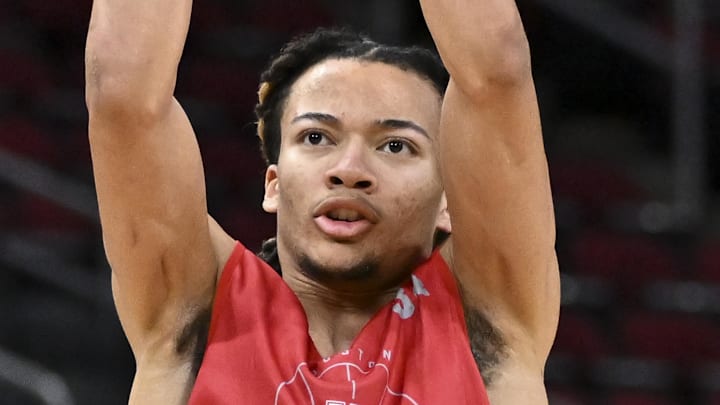
Houston guard Kingston Flemings didn’t enter the 2026 NBA Draft cycle as a bonafide one-and-done prospect, but quickly established himself as one of the top guards in the county, commanding the floor for Kelvin Sampson’s Houston system as a true freshman, which is a feat in itself.
Flemings came in as the No. 15 player per RSCI, joining fellow five-stars in Chris Cenac Jr. and Isaiah Harwell at Houston. He stands at 6-foot-4, likely just slightly under that mark, with no official wingspan measurement, though he does seemingly have slightly plus length. Across 37 games and starts, he averaged 16.1 points, 5.3 assists, 4.1 rebounds and 1.5 steals per game, shooting 48% overall, 39% from three and 85% from the line.
His major strengths include his rim pressure and driving, three-level scoring upside, passing and play-making and defensive play-making and upside.
Strengths:
Rim Pressure and Driving
Flemings’ case to be the top guard in the the ’26 class is largely built around his good size at 6-4, mixed with his combination of blazing speed in the open or half-court, a first step that can consistently leave first-line defenders in the dust, elite footwork, balance, change of speed and more.
Flemings is very much of the speed-guard mold, not using overwhelming strength or physical tools, but instead relying in his ability to advantage create with speed and quickness. He can put immense pressure on the rim, easily generating paint touches by rapidly attacking in the open court, able to simply blow by defenders in both isolation or in ball-screen situations, accelerate quickly off the catch and plenty more.
He’s truly shot out of a cannon in both long and short-range situations, going A-to-B quickly with plenty of adaptability in between. Flemings is a very twitchy athlete, and his less bulky frame allows him to really slide by defense, angularly working his way in as a slippery handler. Even more, he’s pretty composed while on the move, able to hit other gears, pass and process while moving — which is great given he can get to top-speed consistently. He has a controlled handle, rarely getting out of sync from a handling perspective and able to use dribble-moves on the fly.
And perhaps most importantly, Flemings isn’t a choppy player, despite his speed. He still has a level of smoothness and glide-y motion to him that is reminiscent of the some of the game’s best guards. In terms of traditional athleticism, Flemings’ leaping ability is pretty solid, able to elevate quickly and contort with great body control.
Flemings saw plenty of work at other levels, but his rim attempts did account for the biggest chunk of field goals taken at about 39%. Once actually at the rim, there were some pretty mixed results, with him finishing 55% of his at-rim shots — 53% on layups and 85% on dunks — both average per Synergy. Those aren’t damning numbers, but I think given the level of separation he was able to create it does raise questions.
There’s going to be some finishing and foul-drawing concerns that we’ll touch on in later sections, but in the least, Flemings is going to be able to put pressure on the rim and access his spots. Which, can sometimes be the bigger part of the battle, if the finishing and shot-making continue to develop.
Three Level-Scoring Upside
It’s clear Flemings’ downhill game is already serviceable with even more room for growth, but he also parlayed that into success at the other levels, projecting himself out as a three-level scorer in the NBA.
The mid-range was a real weapon for Flemings, with him leaning on it time and again for the Cougars. He combined all of the aforementioned tools — speed, handling, composure — to create a really potent off-the-dribble shot-maker, able to find creases in the defense all over and knock down shots. He largely utilized simple stop-and-pop moves, able to go from breakneck downhill speed to his high-rising shot form lightning-quick.
Dribble-jumpers accounted for the vast majority of Flemings’ jump-shots — a whopping 83% — which speaks to both Houston’s need of his creation ability, and the staff’s trust in letting him use this ability. Flemings shot 42% on dribble-jumpers in general, hitting on a really great 46% of his two-pointers off-the-dribble. Regardless of his reliance on these shots, which can come into play, he was mightily effective here all season long and projects to continue to be a real threat to pull-up at any time, just adding to his danger and optionality as a driver.
Flemings’ 3-point numbers are the upside part of this equation, though he showed plenty of beyond-the-arc prowess with the Cougars. He hit on 39% of his triples, a great mark, but took just 2.9 per game, far less than most of his guard counterparts in the 26’ class. The good news here is that Flemings was a really elite in catch-and-shoot situations, hitting on 46% of limited attempts. He shot 56% on uncontested catch-and-shoot threes, but just 29% on guarded.
Even Flemings’ 31% mark on off-the-dribble threes is fairly solid, and he took 64 of those to just 44 catch-and-shoot threes, pointing to a pretty tough shot diet that could see his numbers boosted a little more with NBA space, play-makers and gravity. Still, the volume remains some of the issue here, with Flemings simply not showing enough from an attempts standpoint to really justify an elite 3-point outlook.
Regardless, Flemings is certainly going to have a development path toward three-level scoring, and there are some other general offensive numbers that speak to that. He shot 49% in the pick-and-roll, where ball screens freed up even more space to carve pathways to the rim or pull-up. He shot 47% spotting up, decimating closeouts with speed or simply knocking down open shots in limited capacity. He also shot 37% in isolation and 63% in transition, with the ability to just make things happen for a Houston offense that really needed it.
There’s work to be done at all three levels, though the bones are there for a potentially potent three-level scorer who can access every spot on the floor, and advantage create at the drop of a hat.
Passing and Play-Making
Given Flemings’ ability to break down the first line of defense and draw attention as a scorer, an adept passing and play-making skillset is essentially a must, and he added that exact punch as Houston’s primary play-maker in his lone season.
Flemings averaged 5.2 assists to just 1.8 turnovers, good for 192 to just 66 in total, and an elite 2.8 assist-to-turnover ratio. Flemings saw an absurd 32.6% assist percentage, shattering the necessary mark to project as a lead guard at the NBA level, and the eye test more than backs up his poised play-making chops.
Flemings’ passing and play-making game is largely simplistic, with his combination of movement tools able to put him in position time and again to simply make easy reads: hitting open shooters and cutters after a straight-line drive, the open man in transition, the correct pick-and-roll read and more.
Flemings has a really keen understanding of game-flow, offensive positioning and how his own gravity is affecting it. He’ll draw doubles flying downhill, or draw defenders out with a live-dribble, only to capitalize with a quick reads all over the court. He’s a very quick processor who could stand to quicken the actual decision-making just a hair. But given his pure speed, he’s still working ahead of the defensive curve a lot of the time, creating open looks with consistency.
Flemings is at his best doing the easy stuff, but can certainly wow you as well, with plenty of advanced passing in his arsenal. He loves to put zip on the ball with strong, two handed pushes, overhead outlets and baseball passes. He had his fair share of really notable live-dribble bounce-passes to rollers and cutters in the pick-and-rolls, with really good interior vision in general. And he’s not limited to one-away with the ability to go cross-court in a variety of situations.
Even more, Flemings takes care of the ball, a real feather in his cap at less than two turnovers per game on 26% usage, which clears the top group of point guards in the class.
Lastly, there’s a few contextual reasons why Flemings’ already-good passing could stand to get an NBA boost. Firstly, Houston was a defensive-minded roster that, while it had some OK offensive weapons, just wasn’t geared to fill it up game after game. Flemings had some alright offensive options with the Cougars, but basically any iteration of any NBA team is likely to be better suited to his strengths.
Additionally, given his speed and vision, NBA spacing is set to help Flemings' game tremendously, giving him ample room to operate.
Defensive Play-Making and Upside
A real separator for Flemings’ stock in general is his defensive play-making and the upside that comes with it. He’s one of the better equipped guards in the entire class from a defensive perspective, with both immediate impact and some room for growth.
Flemings used his combination of positional size, twitchy movement and really active hands to pester and play-make as a defender this season, which is essentially a must for a Houston product. He averaged 1.5 steals and 0.3 blocks on the season, going for 56 and 12 in total across 37 games. He also finished with a great 3% steal percentage and a 1.3% block percentage, with a stellar defensive box-plus minus of 6.0.
Flemings’ numbers were solid, but the tape moreso backs up his commitment to this end of the floor, offering a really instinctual, competitive defender who can really impact the game. At his size, he should be able to effectively guard either guard spot at the height of his power. He has claim to the best hands in the class, just constantly poking and prodding with accuracy, stealing the ball altogether or making just enough contact to muck things up and deflect.
Off the ball, Flemings is attentive and sneaky, reading the game like a safety when decision-makers telegraph things: jumping lanes, getting hands on the ball, adding timely doubles and more.
Flemings’ defensive upside lies in his ability to defend at the point of attack, which was good at the college level, and projects to be useable in the NBA level too. He can really put pressure on the ball with his twitchiness and active hands. He, like many guard defenders his age, needs to get better about navigating screens, but he is a pretty sticky defender, not always staying in front but usually hanging in the play in some form or fashion.
Flemings’ lack of strength, which we’ll get into momentarily, would be the primary reason for a lack of success at the point of attack. Though it’s clear he’s going to have some level of plus defensive chops at the NBA level.
Areas of Improvement:
Strength and Physicality
As mentioned, strength and physicality is the No. 1 area of improvement for Flemings as it stands right now, with this bleeding into both sides of his game.
While Flemings’ frame is great from a length perspective, he’s very thin, with Houston listing him at just 190 pounds. His speedy style can mitigate some of the lack of size and strength, though there’s sure to be a learning curve in the bigger-faster-stronger NBA.
This rears its head the most on offense, playing into some of the lesser rim finishing numbers and the reliance on tougher pull-up shots. Added strength would almost certainly help him to power through contact around the rim, see shots through at a higher rate and deal with stronger matchups. Additionally, with added strength he wouldn’t be bumped off spots as much, able to get past the first line even more and keep his composure.
From a physicality perspective, Flemings could really stand to just add some comfortability in seeking and absorbing contact in general. He can be pretty avoidant altogether, leading to tough high-off-the-glass finishes and out-of-control drives. For some, this is the biggest area of concern in Flemings’ overall profile, with him posting just a .27 free throw rate on the season, and shooting just 3.5 free throws per game. Those are some pretty concerning numbers, with Flemings unable to really draw or sell contact, and get to the line when things get slow.
Defensively, added strength would help him to deal with bigger, stronger matchups, potentially allowing him to tap into more of the point-of-attack upside.
Flemings just naturally stands to bulk up some with NBA strength and conditioning and natural development, and his size and length give him a pretty nice floor and ceiling. Though adding these things will be pretty important for his outlook.
Shot Profile and Consistency
Secondary and related to some of the strength concerns was Flemings’ general shot profile and consistency, some of which we’ve already touched on to this point.
Flemings projects to be a three-level down the line, but there isn’t massive amount of confidence behind any singular level. His rim finishing numbers were worsened by the lack of strength and aversion to contact, and he didn’t have much of a counter to simple finishes, with no real float or runner-game. His mid-range numbers were great, but simply aren’t the most efficient shots in basketball, and his 3-point profile is largely hindered back a lack of volume.
Concerning the jumper both mid and long-range, Flemings’ mechanics leave a ton to be desired. He has a catapult like motion, with tons of left-to-right motion that fails to generate much spin on the ball at all. And this is seen across his general inconsistency as a ranged scorer.
All of this sort’ve culminated in a pretty slow stretch to end the season. In his final 15 games across Big 12 play, the Big 12 Tournament and the NCAA Tournament, Flemings shot just 41% from the field, hitting on 40% of just over two threes per game. That points to some real struggles inside the arc, with his effective field goal percentage sitting at just 45%.
A lot of his late-season numbers were a far cry from his first 15 games, where he shot 54% overall, 43% on a higher volume of threes, and nabbed over two steals per game.
The truth evened out somewhat in his overall line. He’s a talented offensive player, but there’s also plenty of room for growth in tons of areas, all of which can happen given his feel for the game.
Outlook:
Kingston Flemings stands as the inverse of some of his 2026 NBA Draft peers. Where others succeeded in spite of a lack of elite tools, Flemings instead has everything in his toolkit — size, speed, shot-making, play-making, feel and two-way instincts.
He only needs to continue refining those tools, adding some strength, figuring out how to welcome and play though contact at the rim and upping his perimeter shooting prowess. And given his feel and impact, we’ve certainly seen crazier development stories, making him a worthy top-10 pick.
Flemings’ range is likely to start around five and end around 10, with those in between spots as the most likely landing spots.
Some fits for Flemings are the Mavericks, who continue to be the top guard landing spot, as well as the Hawks, who have 3-point shooting shored up, and could use a well-sized point guard to build around. I also have the Kings here — if they slip out of the top-five, I think they could do worse than kicking off a rebuild with a do-it-all, clean decision-making point guard.
Range: Top-5 to Top-10
Role: Lead Guard, Secondary Creator
Impact: High-End Starter, Starter
Swing Skills: Strength
Best Fits: Mavericks, Hawks, Kings
 Add us as a preferred source on Google
Derek Parker covers the National Basketball Association, and has brought On SI five seasons of coverage across several different teams. He graduated from the University of Central Oklahoma in 2020, and has experience working in print, video and radio.
Follow DParkOK