%22%3E%0A%3Cpath%20d%3D%22M0%205.37646H8.15061L17.4195%2016.8819V5.37646H26.0647V31.4412H18.3227L8.64523%2019.4196V31.4412H0V5.37646Z%22%20fill%3D%22white%22%2F%3E%0A%3Cpath%20d%3D%22M29.2041%205.37649H43.8064C47.4193%205.37649%2049.6989%206.1937%2051.2258%207.72059C52.1505%208.64533%2052.8172%2010.0002%2052.8172%2011.7851V11.8497C52.8172%2014.9465%2050.9462%2016.8389%2048.172%2017.8067C51.5269%2018.7744%2053.6774%2020.5594%2053.6774%2024.1293V24.1938C53.6774%2028.3659%2050.258%2031.4197%2043.6558%2031.4197H29.2041V5.35498V5.37649ZM44.258%2013.7637C44.258%2012.6024%2043.3333%2011.9787%2041.4623%2011.9787H37.6988V15.6346H41.5053C43.3763%2015.6346%2044.258%2015.011%2044.258%2013.8497V13.7852V13.7637ZM42.0859%2020.9895H37.6988V24.8605H42.0644C43.9569%2024.8605%2044.9247%2024.0863%2044.9247%2022.968V22.9035C44.9247%2021.7852%2043.9999%2021.011%2042.0859%2021.011V20.9895Z%22%20fill%3D%22white%22%2F%3E%0A%3Cpath%20d%3D%22M64.8174%205.18286H73.4627L84.452%2031.4411H74.9896L73.6132%2027.9357H64.4949L63.1615%2031.4411H53.8496L64.8389%205.18286H64.8174ZM71.4412%2021.7636L69.054%2015.441L66.6669%2021.7636H71.4412Z%22%20fill%3D%22white%22%2F%3E%0A%3Cpath%20d%3D%22M95.2695%205.37646H105.248C115.592%205.37646%20120.775%2010.4733%20120.775%2018.1938V18.2583C120.775%2025.9788%20115.485%2031.4412%20104.947%2031.4412H95.2695V5.37646ZM104.001%2012.9679V23.8497H105.463C109.442%2023.8497%20112.022%2022.2153%20112.022%2018.4518V18.3873C112.022%2014.6239%20109.463%2012.9894%20105.463%2012.9894H104.001V12.9679Z%22%20fill%3D%22white%22%2F%3E%0A%3Cpath%20d%3D%22M123.098%2011.1182H131.549V15.2258C132.711%2012.4731%20134.56%2010.6881%20137.915%2010.8387V19.8065H137.012C133.442%2019.8065%20131.528%2021.785%20131.528%2026.2797V31.4625H123.076V11.1182H123.098Z%22%20fill%3D%22white%22%2F%3E%0A%3Cpath%20d%3D%22M137.808%2025.6772V25.6127C137.808%2021.5482%20140.818%2019.2901%20145.55%2019.2901C147.27%2019.2901%20149.464%2019.6557%20150.345%2020.0428V19.6987C150.345%2017.8277%20149.184%2016.7524%20146.582%2016.7524C144.496%2016.7524%20142.754%2017.204%20140.969%2017.9137L139.485%2012.3008C141.829%2011.3975%20144.517%2010.8169%20148.044%2010.8169C152.173%2010.8169%20154.862%2011.6771%20156.646%2013.4621C158.173%2014.989%20158.776%2016.9675%20158.776%2019.9137V31.5052H150.324V29.4622C148.904%2030.9891%20147.012%2031.9999%20144.474%2031.9999C140.56%2031.9999%20137.808%2029.7633%20137.808%2025.7417V25.6772ZM150.431%2023.9138V23.0536C149.937%2022.86%20149.206%2022.7095%20148.496%2022.7095C146.818%2022.7095%20145.894%2023.7202%20145.894%2024.9891V25.0536C145.894%2026.2364%20146.754%2027.0321%20147.829%2027.0321C149.313%2027.0321%20150.431%2025.8493%20150.431%2023.9138Z%22%20fill%3D%22white%22%2F%3E%0A%3Cpath%20d%3D%22M162.883%2017.6345H160.496V11.1183H162.883C162.926%208.96778%20163.442%207.20433%20164.711%205.9355C166.088%204.55915%20167.872%204%20170.668%204C173.163%204%20174.69%204.21506%20175.851%204.55914V9.84951C175.034%209.65596%20174.217%209.54843%20173.141%209.54843C171.83%209.54843%20171.163%2010.0646%20171.163%2011.1829V11.3334H175.851V17.6345H171.335V31.4411H162.883V17.6345Z%22%20fill%3D%22white%22%2F%3E%0A%3Cpath%20d%3D%22M178.883%2024.6238V17.613H176.496V11.0968H178.883V6H187.335V11.0968H192.023V17.613H187.335V22.7528C187.335%2024.2797%20188.045%2024.8389%20189.378%2024.8389C190.152%2024.8389%20191.055%2024.6238%20191.937%2024.2152V30.7314C190.604%2031.4411%20188.582%2031.8927%20186.539%2031.8927C181.55%2031.8927%20178.862%2029.5916%20178.862%2024.6238H178.883Z%22%20fill%3D%22white%22%2F%3E%0A%3Cpath%20fill-rule%3D%22evenodd%22%20clip-rule%3D%22evenodd%22%20d%3D%22M201.368%204.36764C207.191%20-1.45588%20216.632%20-1.45588%20222.456%204.36764C228.279%2010.1912%20228.279%2019.6324%20222.456%2025.4559L211.912%2036L201.368%2025.4559C195.544%2019.6324%20195.544%2010.1912%20201.368%204.36764ZM204.009%207.55761C203.948%207.86849%20203.916%208.39718%20203.916%209.14566V10.4189C203.916%2011.1832%20203.948%2011.7198%20204.013%2012.0267C204.078%2012.3317%20204.278%2012.6168%20204.617%2012.8762C204.956%2013.1376%20205.403%2013.3316%20205.958%2013.4623C206.512%2013.593%20207.1%2013.6583%20207.837%2013.6583C208.573%2013.6583%20209.217%2013.591%20209.769%2013.4524C210.322%2013.3158%20210.761%2013.1178%20211.086%2012.8604C211.411%2012.6029%20211.605%2012.3178%20211.666%2012.0069C211.728%2011.6961%20211.759%2011.1674%20211.759%2010.4189V9.14566C211.759%208.38134%20211.728%207.84473%20211.662%207.53781C211.597%207.23287%20211.397%206.94972%20211.058%206.68834C210.72%206.42696%20210.272%206.23291%20209.718%206.10223C209.163%205.97154%20208.536%205.90619%20207.839%205.90619C207.102%205.90619%20206.459%205.97352%20205.906%206.11213C205.352%206.24875%20204.914%206.44677%20204.589%206.70418C204.265%206.9616%20204.071%207.24673%20204.009%207.55761ZM209.276%2024.8638C212.876%2024.8638%20214.557%2024.2064%20214.557%2021.862V21.858V21.3155C214.557%2019.6581%20213.516%2018.971%20210.252%2018.3136C209.278%2018.1136%20208.908%2017.9136%20208.908%2017.3136V16.9414C208.908%2016.6543%20209.177%2016.5117%20209.413%2016.5117C209.749%2016.5117%20209.918%2016.7137%20209.918%2016.9414V18.1136H214.391V17.3988C214.391%2015.4563%20213.347%2014.4266%20209.177%2014.4266C206.15%2014.4266%20203.896%2015.3414%20203.896%2017.3711V17.7433C203.896%2019.5155%20204.805%2020.3155%20208.201%2021.0303C208.28%2021.0472%20208.355%2021.063%20208.427%2021.0781C209.329%2021.2674%20209.647%2021.3341%20209.647%2021.9174V22.2897C209.647%2022.6619%20209.546%2022.8045%20209.142%2022.8045C208.67%2022.8045%20208.637%2022.5471%20208.637%2022.262V21.2897H203.894V21.7471C203.894%2024.149%20205.476%2024.8638%20209.276%2024.8638ZM215.424%2024.5569H219.925V14.7355H215.424V24.5569ZM216.955%2013.5019H219.925V6.06064H217.092V9.411L215.193%206.06064H212.359V13.5019H215.193V10.1199L216.955%2013.5019ZM208.269%2012.152C208.204%2012.2688%20208.055%2012.3262%20207.825%2012.3262L207.827%2012.3282C207.604%2012.3282%20207.459%2012.2767%20207.398%2012.1757C207.336%2012.0748%20207.305%2011.8074%20207.305%2011.3758V7.90068C207.305%207.51852%20207.352%207.28684%20207.445%207.20962C207.538%207.13239%20207.675%207.09279%20207.851%207.09279C208.059%207.09279%20208.198%207.14031%20208.265%207.23734C208.332%207.33239%20208.366%207.55416%20208.366%207.90068V11.3203C208.366%2011.7579%20208.334%2012.0352%20208.269%2012.152Z%22%20fill%3D%22white%22%2F%3E%0A%3C%2Fg%3E%0A%3Cdefs%3E%0A%3CclipPath%20id%3D%22clip0_15247_3640%22%3E%0A%3Crect%20width%3D%22227%22%20height%3D%2236%22%20fill%3D%22white%22%2F%3E%0A%3C%2FclipPath%3E%0A%3C%2Fdefs%3E%0A%3C%2Fsvg%3E%0A)
NBA Draft Scouting Report: Santa Clara's Allen Graves
In this story:
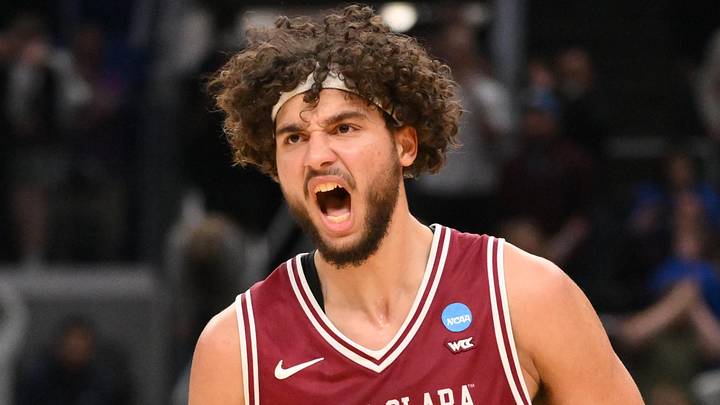
Santa Clara forward Allen Graves was one of the biggest surprises of the 2026 NBA Draft cycle, coming off the bench for the Broncos in the WCC, but posting a draft-worthy season behind a blend of counting and impact stats.
Graves came back with good measurements at the NBA Draft Combine standing at 6-foot-7-and-three-quarters, with a predicable 7-foot wingspan, size he used to carve out 11.8 points, 6.5 rebounds, 1.8 assists and 1.9 steals per game.
We’ll also just get it right out of the way, Graves is considered one of the top “analytics darlings” in some time, with deep basketball analytics really favoring the way he plays. He posted the sixth-best box-plus-minus in the class — a sort’ve all-encompassing impact stat — behind only Cameron Boozer, Yaxel Lendeborg, Caleb Wilson, Zuby Ejiofor and Darryn Peterson. A pretty good list to be on.
Graves’ top strengths include his defensive play-making, floor-spacing and versatility, connective passing and decision-making, as well as rebounding and screening.
Allen Graves scouting report
Strengths:
Defensive Play-Making:
We’ll go ahead and lead with the fact that Allen Graves did not start for Santa Clara, and played in the West Coast Conference, which relative to leagues like the Big 12, SEC and Big Ten, is just going to be a little bit behind the competitive eight-ball.
But, Graves has truly remarkable defensive play-making instincts for any size and position — especially forward — showcasing solid film, counting stats and especially advanced stats.
Graves played in just 22.6 minutes as Santa Clara’s essential sixth-man, but remained atop the team in most statistical categories, especially steals and blocks. He garnered 1.9 steals and 0.9 blocks per game, good for 67 and 33 total, which rounded out to about 3.4 steals and 1.7 blocks per game per 40. The encapsulating statistic here are his steal and block percentages, which both stand at 4.9, which is nearly uncharted waters when paired together.
At first glance, Graves doesn’t seem to have the necessary fast-twitch athleticism or lateral mobility to make that level of impact stealing the ball. But within just a few clips you can recognize just how elite a floor-reader and anticipatory player he is. He is constantly reading the decision-maker like a free safety, able to stunt, blitz and rotate while doing so.
His athleticism certainly isn’t woeful, with him able to slide his feet, bow up with strength, and having a level of coordination that allows him to make such impact.
Graves’ hands are likely the very best in the class. He is so precise with his ability to rip and dislodge the ball, and his 7-foot wingspan help him back into plays that his athleticism doesn’t quite afford.
And again, his defensive awareness is just second-to-none. He is constantly putting himself in the right position to make plays, and there’s zero question he’ll do well as a team defender. He’s hyper-engaged regardless of situation, able to zero in on the basketball while pressuring the ball or sliding around away from it.
Now, it’s not all totally sparkling with Graves’ defensively, especially when projecting him to the NBA. His athleticism and size can get him in trouble with the biggest or fastest of players, and he did foul three times per game in his 22 minutes, projecting to nearly foul out per 40.
Opposing players also shot 54% overall near Graves, rated ‘poor’ per Syngery, pointing to a need to improve when he isn’t simply play-making.
Still, his disruption is undeniable, and should pair well as a sort’ve non-traditional style in tandem with shot-blocking bigs. Especially considering he’s a strong weak-side rotator and shot-alterer.
Graves’ natural athleticism will turn some off, but this is the exact type of feel for the game that should translate regardless.
Floor-Spacing and Versatility:
Offensively, Graves’ most translatable skills will be his ability to space the floor and provide outside shooting, as well as his general versatility inside the arc.
Graves came off the bench for the Broncos, but was third on the team in points per game at 11.8 per game. He shot 51% overall, 41% from three and 75% from the line, showing fine efficiency all over.
His ability to space the floor at 6-foot-9 with a 7-foot wingspan is likely the biggest selling point for NBA teams looking for a complimentary offensive piece. He took only 2.6 triples per game, but was able to convert at a good enough rate — and showing enough touch elsewhere — to project as a useable big shooter. That’s especially important given he’ll be able to play alongside true fives, especially given his uniqueness as a defender.
Graves is a purely stationary shooter, having only taken two dribble jumpers all season long. On his catch-and-shoot attempts he shot 42%, notably shooting a better 44% on guarded threes than his 39% mark on unguarded threes, with quite a bit more volume on the former.
The vast majority of his threes were taken pick-and-popping after good screens, or simply spotting up. He shot 43% and 37%, respectively.
Graves was a versatile player inside the arc, spreading his production across a variety of play-types: rolling after screens, getting out in transition, crashing the offensive glass, cutting and posting up. His long-term case as a scorer in general will be built on his activity and basketball IQ, with him constantly flowing within offense, reading and reacting with plenty of success.
His inside work was largely built on keen floor navigation — naturally gravitating toward space and making quick decisions — along with some right place, right time tendencies. He did the bulk of the work as the roll man, shooting 48% on rolls, which makes him a clear PnR threat given his popping.
Everything else was lower volume, though 79% as a cutter stands out a further exemplifies his basketball IQ.
Graves’ higher-end selling points won’t be based around offense, but his combination of size, IQ and floor-spacing should make him a viable option.
Connective Passing and Decision-Making:
One of Graves’ more coveted skills relative to his size and position are his connective passing skills, which are highlighted by quick decision-making, and more generally just his feel for the game.
Across his 22.6 minutes per game, Graves posted 1.8 assists to 0.7 turnovers, good for 63 to 25 in total, and a really stellar 2.6 assist-to-turnover ratio. He posted a near-14% assist percentage and 6.9% turnover percentage.
The most immediate things that jump out about Graves’ passing are his quickness and correctness in making decisions, and the way that it connects the offense as a whole. As a player who will largely be filling roles at the next level, that’s exactly what teams will be looking for on the passing front.
As previously touched on, Graves is just a blur of activity, constantly screening, rolling, roving around the floor, able to make decisions and pass at the same rapid rate. He’s a really keen floor-reader, seemingly knowing where all 10 players are at on the floor at all times. That makes him a dangerous play-maker in several situations: posting up, in the short roll and especially with space in the middle of the floor.
And the connectivity portion comes in the way that he weaves his own passing skill into the flow of the offense, never dominating the ball but making the plays all the same. He runs dribble-handoffs with effectiveness, hits cutters, sprays in the short-roll. The only way he shades ball-dominant is his post-up passing, which is likely to be less viable at the NBA level realistically, but will still be useable in motion-heavy offense.
One of the more impressive aspects of his game is simply his aversion to turning the ball over. He’s really strong with the ball in his hands, seldomly letting players rip it, and his accuracy and touch lends itself to less turnovers as well. He had just 25 in 35 games, a great mark regardless of his minute totals.
Graves’ passing won’t be the singularly most flashy skill in the 2026 draft class, but again, is one that each team has need for in a role player.
Rebounding and Screening:
The last of Graves’ ancillary skills is his rebounding and screening, which are sure to be a major boost to whatever team he lands with.
Graves averaged 6.5 rebounds off the bench for the Broncos, good for 2.8 offensive and 3.7 defensive. Per 40, that rounded out to 11.5 per game, a blistering five of which were offensive. His total rebounding percentage of 16.7 and offensive rebounding percentage of 13.8 are a large part of what makes him a strong analytical bet.
He’s great at using his size to displace opposing players and box out, continually using long arms and great hands to corral rebounds on both ends. He can vacuum anything in his orbit, or tip it to himself from further away. Some of his most impactful play was done of the offensive glass, where he constantly move the scoreboard in the right direction with gritty play.
Graves wasn’t handcuffed to any singular decision after coming down with an offensive board, able to spray back out and reset, but he was a viable scorer. Put-backs were tied for his second-most points per play-type, with him shooting 59% on 52 possessions.
As seen across his film to this point, Graves is a weapon-esque screener, able to make consistent contact and put his wider frame and root-able size in the way.
His crashing the glass and screening continues to highlight his motor and ability to impact the game without being a ball-dominant, scoring slanted player. Again, another reason why NBA teams could look to him in the first round.
Areas of Improvement:
Finishing
For all of Allen Graves’ feel for the game and touch spread across his game, his finishing is likely not where it needs to be for a four-man right now, needing some improvement as he makes his way to the NBA.
Graves’ is largely a below-the-rim paint scorer, not incapable of flushing the ball, but operating without explosion all the same. In fact, his dunks brought up his finishing numbers somewhat, with him capitalizing on 24 of 25 dunk attempts, but shooting just 52% on layups, good for an ‘average’ grade per Synergy.
That’s a number that’s simply going to have to get better for Graves to be a reliable offensive player, and it certainly could given his projectable touch elsewhere, mixed with the fact he could be operating with some space and favorable matchups.
Continuing to work on his strength and physicality will be a big step toward this, especially as the NBA ramps up in those areas massively.
If Graves can find a reliable inside game, it will be an easy step toward finding himself on the floor far more often.
Shooting Improvement and Consistency
This isn’t a massive negative on Graves’ overall profile considering that floor-spacing was one of his key strengths on the offensive end. But continued shooting improvement and consistency will be really key to him continuing to be an effective offensive option and playable role filler. Important enough to deem it a needed area of improvement.
Graves is going to have some level of impact on several areas: defense, passing, rebounding, screening. But his viability as an offensive player right now does feel pretty connected to how well he’s spacing the floor. His season-long numbers are pretty indicative that the shooting will hang around, but to what degree is likely to shift where he lands impact-wise.
Volume is far-and-away the biggest way he can prove himself in this regard, simply taking more threes. His 2.6 per game is a relatively low number, even accounting for the great 41% overall. This did see a slight boost as the season wore on, with him adding about an attempt per game down the stretch on even better shooting. Past the mid-way point of the season, he also saw three games of six-plus triples taken.
Graves never saw massively cold shooting spells, but did start off his season with two different three-game stints where he didn’t even attempt a triple. He did see an upward trend, capping his season with 44% 3-point shooting in his last 17 games, but still never quite hit great volume.
Again, this isn’t necessarily some DEFCON for Graves, just an area to monitor as looks to make an early impact in the NBA.
Outlook:
Allen Graves is one of the more incredibly unique draft cases I’ve seen while doing this. A bench big in the WCC without eye-popping athleticism, though one who on a play-to-play impact can’t help but make positive additions to the game with his quick thinking and motor.
Graves will be a player that analytically slanted teams and scouts will be all in on, or one that others will puzzle over why he’s being mentioned for this class at all. I won’t ever put a cap on smart basketball players, usually erring on the side of them figuring out how to put their fingerprints on the game.
Some fits I like for Allen Graves include the Spurs, who could use a steal-generating, 3-point shooting big next to Victor Wembanyama, as well as the Grizzlies and Thunder, who sometimes favor smart, possession-winning prospects.
Range: Mid-First to Early-Second
Role: Floor-Spacer, Disruptor
Impact: Rotation
Swing Skills: Finishing, Shooting Consistency
Teams: Spurs, Grizzlies, Thunder
 Add us as a preferred source on Google
Derek Parker covers the National Basketball Association, and has brought On SI five seasons of coverage across several different teams. He graduated from the University of Central Oklahoma in 2020, and has experience working in print, video and radio.
Follow DParkOK