%22%3E%0A%3Cpath%20d%3D%22M0%205.37646H8.15061L17.4195%2016.8819V5.37646H26.0647V31.4412H18.3227L8.64523%2019.4196V31.4412H0V5.37646Z%22%20fill%3D%22white%22%2F%3E%0A%3Cpath%20d%3D%22M29.2041%205.37649H43.8064C47.4193%205.37649%2049.6989%206.1937%2051.2258%207.72059C52.1505%208.64533%2052.8172%2010.0002%2052.8172%2011.7851V11.8497C52.8172%2014.9465%2050.9462%2016.8389%2048.172%2017.8067C51.5269%2018.7744%2053.6774%2020.5594%2053.6774%2024.1293V24.1938C53.6774%2028.3659%2050.258%2031.4197%2043.6558%2031.4197H29.2041V5.35498V5.37649ZM44.258%2013.7637C44.258%2012.6024%2043.3333%2011.9787%2041.4623%2011.9787H37.6988V15.6346H41.5053C43.3763%2015.6346%2044.258%2015.011%2044.258%2013.8497V13.7852V13.7637ZM42.0859%2020.9895H37.6988V24.8605H42.0644C43.9569%2024.8605%2044.9247%2024.0863%2044.9247%2022.968V22.9035C44.9247%2021.7852%2043.9999%2021.011%2042.0859%2021.011V20.9895Z%22%20fill%3D%22white%22%2F%3E%0A%3Cpath%20d%3D%22M64.8174%205.18286H73.4627L84.452%2031.4411H74.9896L73.6132%2027.9357H64.4949L63.1615%2031.4411H53.8496L64.8389%205.18286H64.8174ZM71.4412%2021.7636L69.054%2015.441L66.6669%2021.7636H71.4412Z%22%20fill%3D%22white%22%2F%3E%0A%3Cpath%20d%3D%22M95.2695%205.37646H105.248C115.592%205.37646%20120.775%2010.4733%20120.775%2018.1938V18.2583C120.775%2025.9788%20115.485%2031.4412%20104.947%2031.4412H95.2695V5.37646ZM104.001%2012.9679V23.8497H105.463C109.442%2023.8497%20112.022%2022.2153%20112.022%2018.4518V18.3873C112.022%2014.6239%20109.463%2012.9894%20105.463%2012.9894H104.001V12.9679Z%22%20fill%3D%22white%22%2F%3E%0A%3Cpath%20d%3D%22M123.098%2011.1182H131.549V15.2258C132.711%2012.4731%20134.56%2010.6881%20137.915%2010.8387V19.8065H137.012C133.442%2019.8065%20131.528%2021.785%20131.528%2026.2797V31.4625H123.076V11.1182H123.098Z%22%20fill%3D%22white%22%2F%3E%0A%3Cpath%20d%3D%22M137.808%2025.6772V25.6127C137.808%2021.5482%20140.818%2019.2901%20145.55%2019.2901C147.27%2019.2901%20149.464%2019.6557%20150.345%2020.0428V19.6987C150.345%2017.8277%20149.184%2016.7524%20146.582%2016.7524C144.496%2016.7524%20142.754%2017.204%20140.969%2017.9137L139.485%2012.3008C141.829%2011.3975%20144.517%2010.8169%20148.044%2010.8169C152.173%2010.8169%20154.862%2011.6771%20156.646%2013.4621C158.173%2014.989%20158.776%2016.9675%20158.776%2019.9137V31.5052H150.324V29.4622C148.904%2030.9891%20147.012%2031.9999%20144.474%2031.9999C140.56%2031.9999%20137.808%2029.7633%20137.808%2025.7417V25.6772ZM150.431%2023.9138V23.0536C149.937%2022.86%20149.206%2022.7095%20148.496%2022.7095C146.818%2022.7095%20145.894%2023.7202%20145.894%2024.9891V25.0536C145.894%2026.2364%20146.754%2027.0321%20147.829%2027.0321C149.313%2027.0321%20150.431%2025.8493%20150.431%2023.9138Z%22%20fill%3D%22white%22%2F%3E%0A%3Cpath%20d%3D%22M162.883%2017.6345H160.496V11.1183H162.883C162.926%208.96778%20163.442%207.20433%20164.711%205.9355C166.088%204.55915%20167.872%204%20170.668%204C173.163%204%20174.69%204.21506%20175.851%204.55914V9.84951C175.034%209.65596%20174.217%209.54843%20173.141%209.54843C171.83%209.54843%20171.163%2010.0646%20171.163%2011.1829V11.3334H175.851V17.6345H171.335V31.4411H162.883V17.6345Z%22%20fill%3D%22white%22%2F%3E%0A%3Cpath%20d%3D%22M178.883%2024.6238V17.613H176.496V11.0968H178.883V6H187.335V11.0968H192.023V17.613H187.335V22.7528C187.335%2024.2797%20188.045%2024.8389%20189.378%2024.8389C190.152%2024.8389%20191.055%2024.6238%20191.937%2024.2152V30.7314C190.604%2031.4411%20188.582%2031.8927%20186.539%2031.8927C181.55%2031.8927%20178.862%2029.5916%20178.862%2024.6238H178.883Z%22%20fill%3D%22white%22%2F%3E%0A%3Cpath%20fill-rule%3D%22evenodd%22%20clip-rule%3D%22evenodd%22%20d%3D%22M201.368%204.36764C207.191%20-1.45588%20216.632%20-1.45588%20222.456%204.36764C228.279%2010.1912%20228.279%2019.6324%20222.456%2025.4559L211.912%2036L201.368%2025.4559C195.544%2019.6324%20195.544%2010.1912%20201.368%204.36764ZM204.009%207.55761C203.948%207.86849%20203.916%208.39718%20203.916%209.14566V10.4189C203.916%2011.1832%20203.948%2011.7198%20204.013%2012.0267C204.078%2012.3317%20204.278%2012.6168%20204.617%2012.8762C204.956%2013.1376%20205.403%2013.3316%20205.958%2013.4623C206.512%2013.593%20207.1%2013.6583%20207.837%2013.6583C208.573%2013.6583%20209.217%2013.591%20209.769%2013.4524C210.322%2013.3158%20210.761%2013.1178%20211.086%2012.8604C211.411%2012.6029%20211.605%2012.3178%20211.666%2012.0069C211.728%2011.6961%20211.759%2011.1674%20211.759%2010.4189V9.14566C211.759%208.38134%20211.728%207.84473%20211.662%207.53781C211.597%207.23287%20211.397%206.94972%20211.058%206.68834C210.72%206.42696%20210.272%206.23291%20209.718%206.10223C209.163%205.97154%20208.536%205.90619%20207.839%205.90619C207.102%205.90619%20206.459%205.97352%20205.906%206.11213C205.352%206.24875%20204.914%206.44677%20204.589%206.70418C204.265%206.9616%20204.071%207.24673%20204.009%207.55761ZM209.276%2024.8638C212.876%2024.8638%20214.557%2024.2064%20214.557%2021.862V21.858V21.3155C214.557%2019.6581%20213.516%2018.971%20210.252%2018.3136C209.278%2018.1136%20208.908%2017.9136%20208.908%2017.3136V16.9414C208.908%2016.6543%20209.177%2016.5117%20209.413%2016.5117C209.749%2016.5117%20209.918%2016.7137%20209.918%2016.9414V18.1136H214.391V17.3988C214.391%2015.4563%20213.347%2014.4266%20209.177%2014.4266C206.15%2014.4266%20203.896%2015.3414%20203.896%2017.3711V17.7433C203.896%2019.5155%20204.805%2020.3155%20208.201%2021.0303C208.28%2021.0472%20208.355%2021.063%20208.427%2021.0781C209.329%2021.2674%20209.647%2021.3341%20209.647%2021.9174V22.2897C209.647%2022.6619%20209.546%2022.8045%20209.142%2022.8045C208.67%2022.8045%20208.637%2022.5471%20208.637%2022.262V21.2897H203.894V21.7471C203.894%2024.149%20205.476%2024.8638%20209.276%2024.8638ZM215.424%2024.5569H219.925V14.7355H215.424V24.5569ZM216.955%2013.5019H219.925V6.06064H217.092V9.411L215.193%206.06064H212.359V13.5019H215.193V10.1199L216.955%2013.5019ZM208.269%2012.152C208.204%2012.2688%20208.055%2012.3262%20207.825%2012.3262L207.827%2012.3282C207.604%2012.3282%20207.459%2012.2767%20207.398%2012.1757C207.336%2012.0748%20207.305%2011.8074%20207.305%2011.3758V7.90068C207.305%207.51852%20207.352%207.28684%20207.445%207.20962C207.538%207.13239%20207.675%207.09279%20207.851%207.09279C208.059%207.09279%20208.198%207.14031%20208.265%207.23734C208.332%207.33239%20208.366%207.55416%20208.366%207.90068V11.3203C208.366%2011.7579%20208.334%2012.0352%20208.269%2012.152Z%22%20fill%3D%22white%22%2F%3E%0A%3C%2Fg%3E%0A%3Cdefs%3E%0A%3CclipPath%20id%3D%22clip0_15247_3640%22%3E%0A%3Crect%20width%3D%22227%22%20height%3D%2236%22%20fill%3D%22white%22%2F%3E%0A%3C%2FclipPath%3E%0A%3C%2Fdefs%3E%0A%3C%2Fsvg%3E%0A)
NBA Draft Scouting Report: Jayden Quaintance
In this story:
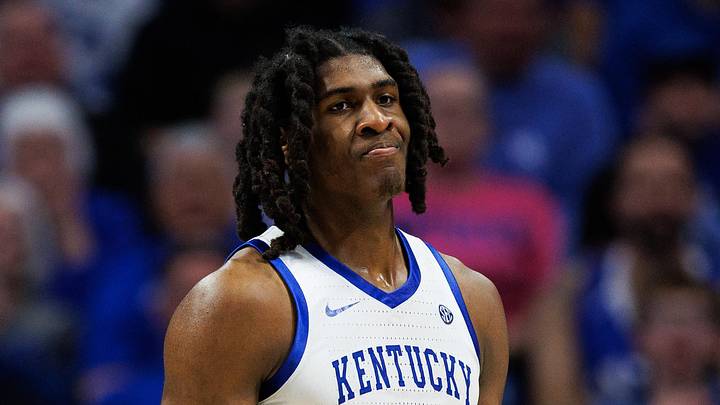
Kentucky big Jayden Quaintance offers one of the most unique scouts ever seen in the draft space, having played 24 games of college basketball at 17-years-old, unable to even be a one-and-done due to youth.
He would suffer an ACL injury with Arizona State, then transferring to Kentucky, where he would rush back and play in just four games, not quite looking himself before shutting it down and focusing on the draft.
Due to that, we’re going to be rolling mostly with Arizona State tape and statistics, as the season at Kentucky just did not give us much to work with. Across his 28 collegiate games, Quaintance averaged 8.8 points, 7.5 rebounds, 1.4 assists, 1.0 steals and 2.4 blocks, shooting 53% overall, 19% from three and 45% from the free throw line.
His major strengths include his physical tools and athleticism, rim protection and defensive impact, play-finishing and offensive upside, as well as rebounding.
Strengths:
Physical Tools and Athleticism
This section will obviously be contingent on Quaintance fully coming back from the knee injury, but his physical tools and high-level athleticism were both the reason for his great production at Arizona State, as well as the potential that most tag him with.
Quaintance has prototypical size for a big, confirmed via the combine to be standing at 6-foot-9 barefoot, with an enormous 7-foot-5-and-a-quarter wingspan, and a wide frame at 250 pounds. He has enormous hands that he utilizes well, and is light on his feet with real bounce and explosion vertically.
Quaintance is really impressive as a mover, roving around quickly, eating up ground, playing with both a fluidity but also some real explosiveness both horizontally and vertically. As a pure leaper, he’s got a massive radius, able to corral the ball all over, and is exceptionally quick off the floor with great second and third jumps. He dunked the ball 34 times in 24 games, essentially unstoppable with space around the rim or an open lane. He also powers through contact well.
With that pure size and athleticism he should be best suited to playing a slightly undersized five, though the bulky frame, long arms and stellar standing reach all more than bridge the gap in my mind. And given the nimbleness and some upside, he could be a little more positionally versatile down the line.
Again, all of these things will be directly impacted by Quaintance’s ability to return to the level of athleticism he showed at Arizona State. But there’s no question that if he can, he’s a snug fit in the NBA from a tools and athleticism standpoint.
Rim Protection and Defensive Impact
Given the size, mobility and explosion, Quaintance was a monster defender as a freshman, showcasing elite rim-protection, defensive play-making and positive impact as a whole.
Across his 24 games and 29.5 minutes per at ASU, Quaintance averaged 2.6 blocks per game and 1.1 steals, good for 63 and 27 in total. He posted a good steal percentage of 2.2, and a blistering block percentage of 9.8, finishing with a 4.9 defensive box-plus minus.
Right away, Quaintance’s ability to put a lid on the rim and alter shots with his lengthy arms stands out. His blend of athletic tools combine with aggressiveness on the defensive end, leading to what was a pretty special defensive prospect relative to age at 17.
Firstly, his mobility allows him to close ground really quickly, sliding over in front of drivers, quickly shuffling for doubles and even closing gaps in transition. Once in position, his leaping ability affords him some real hang-time in terms of contests, and his massive wingspan pairs well with great block timing, which led to the absurd numbers. Additionally he’s very strong, able to anchor down and root himself into position.
Quaintance might not be in the S-tier, upper echelon of NBA shot-blockers, but teams should feel fairly comfortable with his ability to make a difference on the interior.
In addition to his rim protection is his impact as a whole, which spans to defending in space as well. He’s highly switch-able, capable of moving his feet and hounding on the perimeter. Sometimes he’ll toggle between the interior and perimeter, quickly doubling and stunting before re-establishing himself inside. He’s very handsy for a big in general, able to poke the ball away, and very effective at denying and capitalizing on post-entry.
At Arizona State, Quaintance’s hip flexibility and directional movement really stood out, with him offering a pretty elastic mover overall. His recovery tools especially are notable, with him able to continue to make a difference even when taken out of advantageous positioning. His ability to shrink the court and close gaps is such a strength that helps him to feel reminiscent of some really great defensive players. He can feel like a one-man wrecking crew.
There’s a lot to like about Quaintance if he can return to his athletic peak, but I don’t know that anything’s as special as the defensive highs.
Play-Finishing and Offensive Upside
On the offensive side, Quaintance projects to be a use-able play-finisher, with some interesting upside attached in far-off floor-spacing and interesting ball-handling for his size.
With size, athleticism and motor, Quaintance in the least feels projectable in a traditional rim-runner role, able to clean plays up as a lob threat, roller and dunker-spot big. His leaping ability allows him to get to spots others can’t, and he was good about bringing down the ball regardless of situation due to his hands.
Quaintance was kind’ve left to his own devices as a scorer at Arizona State, with cutting, put-backs and transition play largely making up his total offensive production — just getting in where he could fit in. He hung around the dunker spot or just generally navigated toward space, crashed the offensive glass and ran hard in transition. He was very aggressive in trying to get open, constantly moving around and getting out quickly.
Quaintance shot 74% as a cutter, an average 53% on put-backs and an elite 74% in transition, where he was fairly unguardable with a head of steam. He wasn’t used much in the pick-and-roll, but did shoot a great 75% on rolls to the basket on extremely limited volume. Given his overall toolkit, he should project just fine as a pick-and-roll threat.
The upside part of the equation lies mostly in Quaintance’s ball-handling, which was used in moderation in spot-up and transition situations. While it’s not yet a fully refined skill, sometimes featuring some out-of-control tendencies, Quaintance does have more dribbling juice than your average big, able to carve his way to the basket in simple ways. Even simple dribbling saw him speed by slow-footed matchups, and if he can continue to improve his handle overall it could very well make him a matchup nightmare. He shot 60% on spot-up two-pointers.
Quaintance could stand to refine his post-game as a whole, as he shot just 32% there on limited volume, though he isn’t afraid to bang around on the inside and grapple for positioning. He likely won’t be used much as a pure post-up player anyways.
The other part of Quaintance’s upside lies in some fine passing ability, but mostly his potential floor-stretching ability, which we’ll touch on shortly.
Rebounding
In looking at Quaintance’s impact, one has to touch on the rebounding, which was really stellar across his limited collegiate time, especially on the offensive glass.
Quaintance brought down 7.9 rebounds per game across his time with the Sun Devils, 4.9 of which were defensive and a blistering 3.0 of which were offensive. He posted a total rebound percentage of 16.7, a defensive rebound percentage of 19.6, and a ridiculous offensive rebounding percentage of 13.7.
The same aggressiveness and force that Quaintance brings as both a rim-protector and play-finisher carries over to glass-cleaning, where he can be a real handful in simply erasing defensive boards and grappling for offensive ones.
Again, he is far from contact averse, not shy about putting a body on opposing players and making something happen. Much like his shot-blocking, his verticality allows him to hang in the air a tad longer than expected and snatch the ball just a split-second before others. His skill in hanging around the offensive glass will especially be one that possession-driven teams will covet.
Like the rest of his game, he’s not necessarily a technique-driven player, and that carries over to rebounding, but his physical tools bridge the gap more often than not similar to both defense and at-rim scoring. As previously mentioned, Quaintance shot just 53% on put-backs per Synergy, which graded out average. But you’d much rather a player be able to bring the ball down firstly and clean-up the scoring secondarily.
From a rebounding perspective, teams should have no issues banking on Quaintance on the interior, regardless of position, should be return to form athletically.
Areas of Improvement:
Two-Way Refinement
The first and biggest area of improvement that we’ll touch on for Jayden Quaintance is just the overall refinement needed on his game, or a general level of polish, technique and fundamentals added overall.
Quaintance’s production at 17 due to his immense physical tools was stellar and to be applauded, but it was also just that: dominating via raw size and athleticism, showing a lot more freneticism than adept control over his game. And that’s to be expected of a young player still figuring out how to leave his fingerprints on the game.
Still, there’s plenty to be cleaned up. First, limiting offensive mistakes will be crucial to playing a rim-runner role. Teams won’t have massive amounts of patience for some of the inconsistency that showed itself in Quaintance’s game on a play-to-play and game-to-game basis, with things like poor post game, turnovers, general decision-making and overaggressiveness on offense.
Defensively, there’s a level of polish needed overall, especially as the NBA catches up from a tools and athleticism perspective. He needs to stay down more, get better conceptually opposed to the massive amounts of ball-watching he was doing at Arizona State, as well as hone in on footwork in general.
NBA teams will certainly know that more growth is needed before Quaintance reaches his potential, though there’s certainly varying degrees of outcomes based on how much shine he can add to these things as he develops.
Shooting
In speaking on refinement, Quaintance offers some interesting stretch big potential, though it feels pretty far away both statistically and via the eye test right now.
Quaintance wasn’t a complete and total non-shooter with Arizona State — though the numbers say he likely should’ve been — as he shot 19% from beyond the arc on 1.3 triples attempted per game. All in all, he took 54 jump-shots, grading out poor per Synergy in shooting 26%. He did show some malleability in terms of taking both twos and threes, but his numbers across the board were paltry: 17% on catch-and-shoot, 14% unguarded and 22% guarded.
Mechanically, things are in a great place — he has a very inconsistent base — and there are plenty of bad misses across low volume.
There are some eye-squinting moments of touch and hope, which are all but erased via his free throw numbers. He shot an abysmal 48% on three free throw attempts per game at Arizona State, not only putting the shooting majorly in question, but causing general playability issues as well. It was extremely limited volume at Kentucky, just 13 total attempts across four games, but he shot just 31% there too, not pointing to any off-time shooting leap.
Quaintance won’t need to be some knock-down shooter, or really even a floor-stretcher at all to be an impactful player. But he is going to have to find a way to shoot a manageable number from the free throw line, or he’ll be at risk of having a tangible way to play him off the floor.
Outlook:
Kentucky forward Jayden Quaintance is obviously going to be a very medically dependent prospect, with teams weighing just how much they’re willing to bank on a raw big coming off a major knee injury. Still, the vision of Quaintance as one of the best center prospects in the class persists in his athletic upside and defensive impact.
Due to that, if he comes back clear on the knee injury, there’s a world where teams look to add their big of the future in the late-top-10. The floor though feels like a player who could slip to the end of the first round as teams bank on sure things in a great class. The truth will likely end somewhere in the middle.
Some mid-first teams that to my eye could use a versatile defensive big include the Raptors, Bulls and Hornets.
Range: Late-Lottery to Late-First
Role: Rim-Runner, Disruptor
Impact: Starter Upside, Rotation
Swing Skills: Polish, Shooting
Teams: Raptors, Bulls, Hornets
 Add us as a preferred source on Google
Derek Parker covers the National Basketball Association, and has brought On SI five seasons of coverage across several different teams. He graduated from the University of Central Oklahoma in 2020, and has experience working in print, video and radio.
Follow DParkOK