%20%20--%3E%0A%3Csvg%20version%3D%221.1%22%20id%3D%22Layer_1%22%20xmlns%3D%22http%3A%2F%2Fwww.w3.org%2F2000%2Fsvg%22%20xmlns%3Axlink%3D%22http%3A%2F%2Fwww.w3.org%2F1999%2Fxlink%22%20x%3D%220px%22%20y%3D%220px%22%0A%09%20width%3D%2239px%22%20height%3D%2240px%22%20viewBox%3D%220%200%2039%2040%22%20enable-background%3D%22new%200%200%2039%2040%22%20xml%3Aspace%3D%22preserve%22%3E%0A%3Cpath%20fill%3D%22%23FFFFFF%22%20d%3D%22M38.5%2C7H28.2v26h10.3V7z%22%2F%3E%0A%3Cpath%20fill-rule%3D%22evenodd%22%20clip-rule%3D%22evenodd%22%20fill%3D%22%23FFFFFF%22%20d%3D%22M26.1%2C25.5c0%2C5.8-4.1%2C7.5-12.9%2C7.5C3.9%2C33%2C0%2C31.2%2C0%2C25.2v-1.1h11.6%0A%09v2.4c0%2C0.7%2C0.1%2C1.4%2C1.2%2C1.4c1%2C0%2C1.2-0.4%2C1.2-1.3v-0.9c0-1.6-0.9-1.6-3.5-2.2C2.2%2C21.7%2C0%2C19.7%2C0%2C15.3v-0.9C0%2C9.3%2C5.5%2C7%2C12.9%2C7%0A%09c10.2%2C0%2C12.8%2C2.6%2C12.8%2C7.4v1.8h-11v-2.9c0-0.6-0.4-1.1-1.2-1.1c-0.6%2C0-1.2%2C0.4-1.2%2C1.1v0.9c0%2C1.5%2C0.9%2C2%2C3.3%2C2.5%0A%09c8%2C1.6%2C10.5%2C3.3%2C10.5%2C7.5V25.5z%22%2F%3E%0A%3C%2Fsvg%3E%0A)
Fixing the QBs: How Russell Wilson can succeed in a high-volume offense
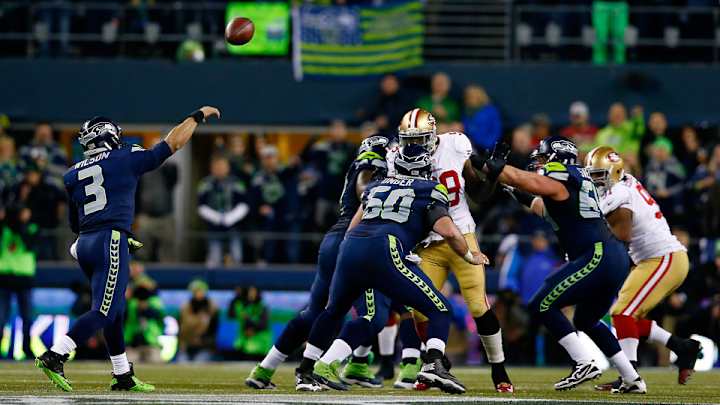

The NFL has turned into a passing league. That's a modern-day fact ... and yet, it's no more than a rumor to what may be the league's two best teams. No teams have thrown the ball less in the last two seasons than the Seattle Seahawks and San Francisco 49ers, the NFC West arch-rivals who prefer to beat their opponents (and each other) into submission with old-school, blunt-force game plans that include heaping helpings of power running and strong, aggressive defense.
Fixing The QBs: Is Colin Kaepernick ready for more responsibility?
That paradigm might be shifting on the West Coast, though. The 49ers' recent decision to give quarterback Colin Kaepernick a lucrative (if year-to-year) contract extension implies more responsibility, and Seattle's Russell Wilson will get a similar deal sometime in the beginning of the 2015 league year, if not earlier. In his first two seasons, Wilson has thrown 800 passes in 32 regular-season starts; his quarterback counterpart in Super Bowl XLVIII (that Peyton Manning guy) attempted 659 regular-season passes in 2013 alone. There's no doubt that Wilson has been tremendously efficient within the limitations of the offensive structure he's been given -- and that's smart play design -- but at some point, with his mobility, intelligence and ability to make every throw, Wilson will be tasked to open it up and take off the training wheels. That point may not be in the 2014 season, but it will be soon, to be sure. In stats both traditional and sabermetric, Wilson has proved to be one of the most consistent and reliable young quarterbacks in the game.
DIVISION PREVIEWS: AFC East | AFC West | AFC North
So, maybe it's not as much about "fixing" Wilson and more about how the Seahawks can expand a passing game that's been tailored to Wilson's strengths and aligned away from his weak points. Say we add 100 passing attempts to the 407 regular-season throws he made last year, take some pressure off the run game and the defense, and see how Seattle rolls. A straight extrapolation of a Wilson season with 100 more attempts leads us to 320 completions out of those 507 attempts for 4,182 yards, 32 touchdowns and 11 interceptions. However, the increasing frequency with which Wilson would throw the ball, and the effect that defenses' increased focus would have on him, would certainly skew those numbers to some degree -- and most likely in a negative fashion.
Jags want to take it slow with Bortles, but he's making the case to start now
The best quarterbacks overcome this regression by improving their mechanics and technique, allowing them to take advantage of every possible opportunity. Wilson is close to the mark in some ways, but there are other ways in which he still needs a bit of sharpening.
"Just in general, commanding the whole game more consistently," head coach Pete Carroll said this week when asked how Wilson can be more consistent at a higher level. "He’s good at it, and he’ll get better at it. I would like to see us protect him better and get the football out of his hand so he doesn’t get banged around. He’s tough and he hangs in there. I’d like to get the ball out quicker just to get us moving and keep him clean. But it’s just a general awareness that he’s going to continue to grow. He’s elevated his ability to see what’s going on and anticipate and read defenses. He’s real excited about that because he’s seeing things better than he has before. That’ll continue -- just more command, more control where the game just really slows down for him."
By the numbers
As I wrote when recently reviewing Andy Dalton's NFL development, the league's best quarterbacks are able to be consistently successful when forced to be spectacular. There are areas where Wilson's already there, but in others ... not quite yet. Last season, Wilson completed 78-of-132 passes on third or fourth down for 985 yards, with eight touchdowns and four interceptions. In the fourth quarter, he was 45-of-73 for 635 yards, with seven touchdowns and five picks. Not horrid by any means, but not noticeably better than the league average.
MORE: All-Overrated Offense, Defense | All-Underrated Offense, Defense
Nickel defenses on the rise as NFL's critical battles move to the slot
When throwing passes over 20 yards, Wilson was 27-of-60 for 927 yards, nine touchdowns and five picks -- again, not bad, but Nick Foles threw 14 touchdown passes and one interception on such passes last year and Foles was a second-year player as well. Drew Brees, Wilson's idol and ultimate archetype in many ways, threw 15 touchdowns and two picks on those types of throws. Wilson was better under pressure, per Pro Football Focus, which is good -- because Wilson was pressured a lot. He led the league with a 43.8 pressure percentage on his dropbacks, and he completed 73 of 148 passes with 10 touchdowns and five interceptions. Here, he was slightly better than Brees, who threw 10 touchdowns and six picks under pressure -- but with far more passing attempts.
So, where must Wilson hit another level before he'll reach his full (and impressive) potential?
Discipline in the pocket
Play action is where Wilson really shines as a player, and it's clear the Seahawks know this -- in 2013, no quarterback threw from play action at a higher percentage than Wilson's 34.1%. Most of his shot plays came from play action, which explains his higher yards per attempt rate (9.5 to 7.5) and lower completion percentage (58.7 to 65.5). Play action is also how Wilson mitigates the one issue he'll never be able to overcome, no matter how hard he works -- he's 5-foot-10 3/4, and that's sort of irreversible. Play action allows Wilson to draw defenders out of the passing lanes they'd prefer to obstruct. This is a vital weapon in his arsenal, and he threw 13 touchdowns to just three interceptions when using it.
MORE: The case for Brian Hoyer to start in Cleveland, more camp notes
Still, those three picks do present cause for pause. Take, for example, his interception in Seattle's 34-28 loss to the Colts in Week 5 of the 2013 season. Wilson completed 15 of 31 passes for 210 yards, two touchdowns and this one big blunder that, with less than two minutes left in the game, did a lot to decide the outcome.
This was a three-way go out of trips left on fourth-and-15, so the Colts didn't respect the play-fake to Marshawn Lynch at all -- they brought pressure from everywhere. Wilson was forced to bail out of the pocket and he missed Doug Baldwin wide open at the first down marker. Instead, he tried to hit Sidney Rice on a deeper route, with cornerback Darius Butler right in the way. Many NFL quarterbacks would fail on this throw, yes, but quarterbacks at the level Wilson aspires to reach are still able to read and react under pressure. The mechanics of the throw didn't help, but there are times when Wilson either has to make jump throws or believes that he has to, and the results aren't often good -- one of his two picks against the Texans last year was a jump pass in the red zone.
Wilson led the NFL in pass plays outside the pocket -- 163 in 2012 and 152 in 2013, per Football Outsiders' metrics -- and he was knocked down on 19.9 percent of his overall pass plays. He's a spectacular player outside the pocket for the most part, but Wilson and the Seahawks must find ways in which Wilson can stay in the pocket and process with less pressure. Carroll's comment about getting the ball out quicker -- and ostensibly leaving more hot reads and first reads open in the process -- would be a good place to start. As Clint Eastwood once said, "Dyin' ain't much of a livin'." Ask Mike Vick how throwing that often under pressure turns out. It's a short shelf life.
The random element of Wilson's game really shows up when he throws deep. It's the situation in which he improvises the most (to good and bad ends), and it's where his footwork and ball placement are the most suspect. This is in part because he's so good at extending plays under pressure while waiting for deep targets to get open, and in part because he has an absolute belief in his ability to hit targets in some fairly precarious positions. There's an element of this daredevil nature in every great quarterback throughout NFL history, but Wilson needs to slow his roll on some of the stuff that travels 20 yards in the air or longer.
This deep interception in Seattle's 23-0 win over the Giants in Week 15 was hardly a desperation situation -- the Seahawks led 16-0, and there were 43 seconds left in the third quarter. Wilson had first-and-10 at his own 47, and he threw deep to receiver Ricardo Lockette with the Giants converging in a deep 2-on-1 look. Wilson can make these types of deep stick throws -- he certainly did so in the postseason -- but this one was just weird. Situationally, schematically, mechanically ... it never should have happened. Wilson threw this ball flat-footed, limiting his torque, Lockette was boxed out easily, and safety Antrel Rolle had an easy jump-ball as an early Christmas present.
That game against the Giants happened at MetLife Stadium, where less than two months later, Wilson helped his team win its first Super Bowl title in franchise history. In that game, Wilson went 7-of-9 for 82 yards and six first-down conversions on third or fourth down, completed all three deep passes he threw, and displayed an impressive composure all the way through. It's performances like that which makes any "Fixing the QBs" concept trained on Wilson more of a series of minor tweaks than any major overhaul or doomsday prophecy regarding his NFL future. Wilson has already shown that he can make great things happen in crucial moments -- now, he needs to do that more often, and in a higher volume of overall plays.
Seahawks' Pete Carroll remembers high school classmate Robin Williams
Pretty exciting, indeed. And with those minor adjustments, Wilson could light up the Emerald City like never before.

SI.com contributing NFL writer and Seattle resident Doug Farrar started writing about football locally in 2002, and became Football Outsiders' West Coast NFL guy in 2006. He was fascinated by FO's idea to combine Bill James with Dr. Z, and wrote for the site for six years. He wrote a game-tape column called "Cover-2" for a number of years, and contributed to six editions of "Pro Football Prospectus" and the "Football Outsiders Almanac." In 2009, Doug was invited to join Yahoo Sports' NFL team, and covered Senior Bowls, scouting combines, Super Bowls, and all sorts of other things for Yahoo Sports and the Shutdown Corner blog through June, 2013. Doug received the proverbial offer he couldn't refuse from SI.com in 2013, and that was that. Doug has also written for the Seattle Times, the Washington Post, the New York Sun, FOX Sports, ESPN.com, and ESPN The Magazine. He also makes regular appearances on several local and national radio shows, and has hosted several podcasts over the years. He counts Dan Jenkins, Thomas Boswell, Frank Deford, Ralph Wiley, Peter King, and Bill Simmons as the writers who made him want to do this for a living. In his rare off-time, Doug can be found reading, hiking, working out, searching for new Hendrix, Who, and MC5 bootlegs, and wondering if the Mariners will ever be good again.