
Kirk Cousins' Jaw-Dropping NFL Career Earnings Revealed After Vikings Trade
In this story:
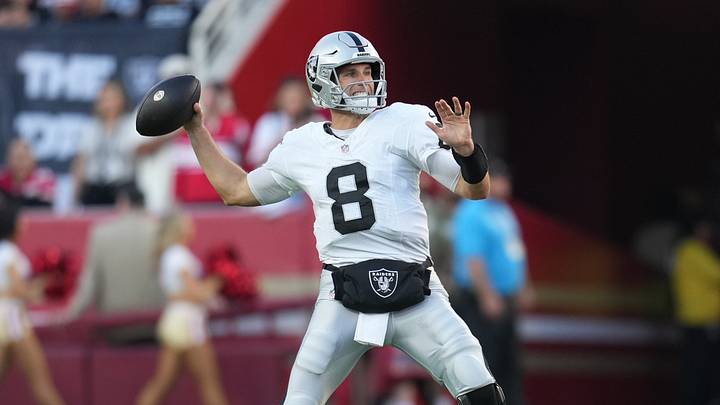
Kirk Cousins is headed back to Minnesota, and the Vikings are getting considerably more than a familiar face at quarterback.
They're bringing back one of the highest-paid players in NFL history.
The Vikings acquired Cousins from the Las Vegas Raiders on Tuesday, Nov. 10, sending a 2027 third-round draft pick to reunite with the quarterback who spent six seasons in Minnesota.
The last time Kirk Cousins suited up for the Vikings was in 2023 against the Packers at Lambeau Field.
— Adam Schefter (@AdamSchefter) November 10, 2026
He’s now back in Minnesota in 2026, and his first game could come Sunday against Green Bay at Lambeau Field. pic.twitter.com/TiBBw7U61B
It's a remarkable turn for a franchise that let Cousins leave in 2024. Now 38, he's returning to help rescue an offense that has struggled despite the Vikings' 6-2 record. Plus, the Cousins family have always loved Minnesota.
The trade also puts a staggering financial résumé back in the spotlight.
According to Spotrac figures cited by USA Today, Cousins has earned more than $333 million over his 15-year NFL career.
That puts the former fourth-round pick among the league's all-time highest earners, ahead of numerous quarterbacks with far more postseason success.
And the story of how he got there is nearly as interesting as the number itself.
How Much Has Kirk Cousins Earned in His NFL Career?
Cousins' estimated career earnings exceed $333 million, according to Spotrac, placing him fourth on the NFL's all-time list.
Only three players rank ahead of him:
- Matthew Stafford: $448.3 million
- Aaron Rodgers: $417.3 million
- Dak Prescott: $337.9 million
Those figures reflect career earnings, not net worth or the total advertised value of every contract signed.
Over the Cap calculates Cousins' earned compensation at approximately $331.5 million, illustrating how different databases can produce slightly different totals.
Either way, it's an extraordinary return for Washington's 102nd overall selection in the 2012 NFL Draft.

Cousins entered the league as Robert Griffin III's backup, earning relatively modest money on his rookie deal. His financial breakthrough came when Washington used the franchise tag to retain him in consecutive seasons.
He collected approximately $20 million in 2016 and nearly $24 million in 2017, then reached unrestricted free agency with enormous negotiating leverage.
Minnesota was waiting.
The Vikings Contract That Made Kirk Cousins One of the NFL's Richest Players

In 2018, the Vikings signed Cousins to a three-year, $84 million contract that was fully guaranteed.
The agreement was groundbreaking. At a position where teams typically protected themselves against injuries and disappointing performances, Cousins secured the entire contract.
He followed that deal with a two-year, $66 million extension in 2020 and another one-year extension worth $35 million in 2022.
Over six seasons, Minnesota paid Cousins approximately $185.7 million.
His production was substantial, too. Cousins threw for 23,265 yards and 171 touchdowns with the Vikings, helping them reach the playoffs twice.
But Minnesota never advanced beyond the divisional round during his tenure, and the two sides parted ways following the 2023 season.
That didn't slow his earning power.
Kirk Cousins' Falcons and Raiders Contracts Added Millions
Atlanta signed Cousins to a four-year, $180 million contract in March 2024, including $100 million guaranteed, despite the quarterback recovering from a torn Achilles tendon.

His first season alone brought a $62.5 million cash payout, the largest of his career.
The relationship quickly became complicated. Atlanta drafted Michael Penix Jr. just weeks after signing Cousins, eventually turned to the younger quarterback and released the veteran after the 2025 season.
Cousins then joined Las Vegas in April 2026 on a deal initially described as worth up to $172 million over five years.
That headline figure, however, wasn't guaranteed.
The contract was effectively a short-term arrangement, with $20 million guaranteed for the 2026 season through payments involving both the Raiders and Falcons. It also included a $10 million guaranteed roster bonus payable in 2027 and a team option that could trigger another $80 million in guarantees.

Those future guarantees are not the same as money Cousins has already earned.
What Kirk Cousins' Vikings Return Means for His Contract
Cousins' latest move reunites him with coach Kevin O'Connell and star receiver Justin Jefferson, two familiar faces from his previous stint in Minnesota.
The Vikings badly need the help.
Their offense ranks near the bottom of the league in several major categories, and Monday's 23-6 loss to Buffalo exposed just how much their quarterback situation has deteriorated.
Cousins, meanwhile, threw for 2,340 yards, 20 touchdowns and eight interceptions in nine games with Las Vegas this season.
His contract presents another decision for Minnesota. The Vikings inherit its remaining obligations, including a provision that could trigger $80 million in additional guarantees if Cousins remains on the roster beyond a specified deadline in March 2027.
For now, the immediate priority is getting Minnesota's offense back on track.
Cousins has already secured his place among the NFL's financial elite. He's earned more than $330 million, negotiated some of the league's most consequential quarterback contracts and continued finding opportunities even after teams decided to move on.
Now he's back with the franchise that once made him the NFL's first $84 million fully guaranteed quarterback.
And with Minnesota still firmly in the playoff race, Cousins has another chance to add something to his résumé that money can't buy: a meaningful postseason run.
 Add us as a preferred source on Google

Maggie MacKenzie is a Boston-based writer and editor who has spent more than a decade covering sports and entertainment, with a deep focus on NASCAR. At NASCAR.com she covered the sport from race-weekends and analysis to larger stories covering the athletes, teams and series. Maggie has also held editorial roles across sports media, including as a copy editor and writer at Sports Business Journal, where she worked on coverage of the business side of professional sports, and at Heavy.com covering sports and entertainment. Maggie has been writing and editing professionally for more than ten years. She earned a bachelor’s degree in journalism from Fairfield University and an MBA from Babson College.