
Arkansas Softball Catcher Kennedy Miller Issued Warning After Strike Zone Dispute
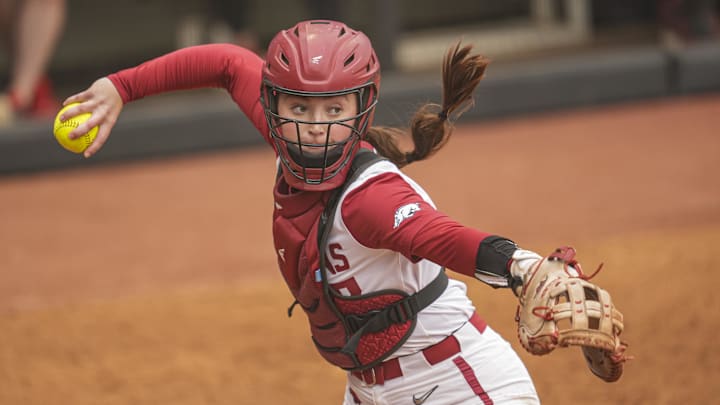
In a tense postseason matchup against Ole Miss, Arkansas catcher Kennedy Miller made a subtle yet powerful statement that caught the attention of both the umpire and the internet.
After a blatantly obvious strike was called a ball, Miller bent down and wiped off home plate. She was issued a warning.
Really? What she was actually saying – without saying it – was what so many of us were thinking:
“If you won’t see the plate, I’ll make sure you can.”
When catchers dust the plate off for umpires.
— Jen Schroeder (@jen_schro) May 23, 2025
That called ball walked in a run against Arkansas. No matter who you’re rooting for, we can all agree: when a strike is thrown, it should be called a strike. Period.
Lately, it feels like umpires are missing more than a few – and it’s changing the entire feel of the game.
As a former pitcher, I’ve seen that look. I have felt that moment and watched it unfold far too often this postseason: first-pitch strikes getting called balls, strike zones shifting from inning to inning, and pitchers left guessing which version of the game they’re playing. It doesn’t just mess with pitch sequencing, it completely shifts the momentum.
This isn’t about one missed call. It’s about Rhythm. Confidence. Trust.
The strike zone is supposed to be sacred ground – a space where the pitcher and hitter meet with equal opportunity. When that zone keeps moving, it doesn’t just throw off mechanics. It unravels the entire mental edge of a pitcher trying to attack. It also gives hitters a huge advantage.
That first pitch matters. That 3-2 count strike with runners on: Matters. If it’s called a ball instead of the strike it was, everything changes—the plan, the count, the tempo. In high-pressure innings, one missed strike can be the difference between a rally and an escape. Is this pitching calling inconsistency intentional? Probably not. However, It does make you wonder…
Postseason softball has clearly shifted into a hitter’s game. Don’t get me wrong—I love offense. There’s a difference between great hitting and forcing pitchers to work with a strike zone that simply doesn’t exist.
When strikes no longer exist. 👀
— Ashley Waters (@ashley3waters) May 23, 2025
As for Kennedy Miller’s wipe of the plate? I don’t see it as disrespectful. I see it as a message. One rooted in frustration, yes—but also in loyalty and leadership. The plate was dusty, sure – but more than that, it was a nod to her pitcher.
“I’ve got you. You and me, we’re in this together.”
When the zone disappears, so does the trust between battery and umpire. When that trust erodes, so does the integrity of the game.
There’s a difference between doing it for the ump and doing it because you don’t like the calls. It’s like asking the ump if they need glasses
— Dylan (@rthe1_dylan) May 23, 2025
Maybe Miller was doing the ump a favor. Or maybe she was sending a message that the ump needed a new pair of glasses. Either way—let the girl cook.
More news: Courtney Deifel Reveals During In-Game Interview That Arkansas Pitchers Had Food Poisoning
2025 NCAA Division I Softball Tournament: Bracket, Schedule & Updates
Fayetteville Super Regional: Schedule & Updates
 Add us as a preferred source on Google
Katie Burkhart is a former professional softball pitcher and Arizona State University alumna, where she was a three-time All-American and led the Sun Devils to a national championship. She played professionally in the U.S., Japan, and Italy, and has coached at the Division I level. She now provides private pitching instruction and mindset training for athletes of all levels. Katie is also the author of Mental Muscle and Beyond the Game, books focused on athletic performance and life after sports.