
Is Obstruction Hurting Softball? Why the Rule Is in the Spotlight at the WCWS
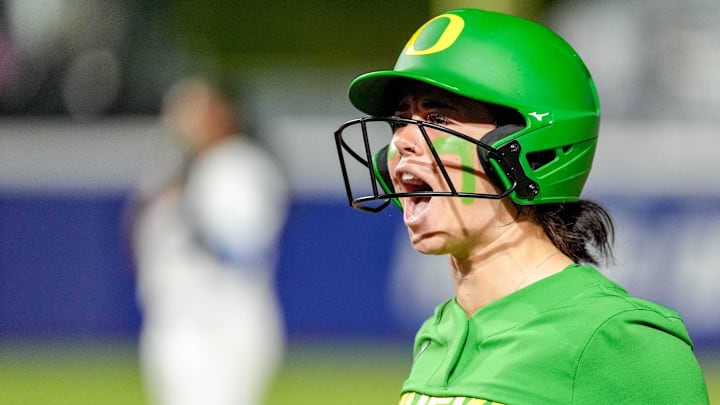
Here we go again, I get to talk about umpiring calls.
Controversial, to say the least, and it has everyone buzzing on social media, surprisingly divided in what they believe. This time, it’s an obstruction call that gifted Oregon the tying run against UCLA in the top of the seventh inning.
If you missed it: In the seventh inning, Paige Sinicki doubled down the line, moved to third on a sac bunt, and then dashed home on a ground ball to third. The throw beat her by a mile. The tag was applied. Game over, right?
Not so fast.
After a review requested by Oregon head coach Melyssa Lombardi, the umpire overturned the out and ruled obstruction on UCLA catcher Alexis Ramirez. The run counted. Tie game. Chaos. The softball world lost its collective mind – and for good reason.
Let’s break it down.
Brand new ballgame!
— Oregon Softball (@OregonSB) May 30, 2025
Ducks tie it up 2-2! Sokolsky back out for B7.#GoDucks | #Version7 pic.twitter.com/uGYt4xM3yi
What Is Obstruction?
According to the (Rule 9.5.1), obstruction occurs when a fielder without possession of the ball or not in the act of fielding impedes the progress of a runner. There’s also emphasis on allowing runners access to the base path or plate until the fielder is actively making a play—which usually means ball in glove or very, very close to it.
Rulebook time pic.twitter.com/gpJOJkZu6H
— James Crepea (@JamesCrepea) May 30, 2025
Now here’s where it gets murky.
If you slow down the clip, and trust me, I did. The throw beats the runner cleanly. The tag is there. She’s out by a mile. Ramirez’s left foot is posted on the front corner of the plate before the ball is in her glove, and in the eyes of the rule book, from start to finish, she was obstructing the plate, even though Sinicki was about ten yards from the home plate. It seemed like a very easy call as the ump initially called Sinicki out.

Technically? That’s obstruction.
Realistically? The runner never had a chance, and this is what has everyone’s knickers in a twist.
Upon review they granted obstruction and now the game is 2-2 in the bottom of the seventh. Luckily, that didn’t last long for the Bruins.
“Obstruction.”
— BoysInBlue (@BoysInBlue87) May 30, 2025
Ump didn’t get bat out of the way. Runner didn’t slide into open area of the plate. Ran inside the baseline into fair territory and ran into catcher to try to get the call, knowing she was out by 10 feet.
If that’s the rule, it’s an embarrassment to the sport. pic.twitter.com/liLGWrLzXn
Here’s what Oregon said about the call in the Post-Game Interview:
“I think you never know what the reviews are going to come back to, but seeing the play and looking at it from my vantage point, it looked like it was obstruction from the beginning to the end of the play.”Melyssa Lombardi
“ Yeah, for me at third base, I know I was just going to figure out any way I could score. I definitely got lucky in that situation. But for me to just go into the base as if she was in the way, as she was, that's all I had to do.Paige Sinicki
And no matter what, I was going to figure out a way to score for the team in that situation in the seventh inning. So that's what was going on and the thinking in my head, just figure out any way to score.”
On one hand, Ramirez could’ve adjusted her feet slightly to avoid blocking the plate early. That little shift might’ve saved the Bruins from the call. It’s a reminder to all catchers: be smart with your footwork, especially in big moments when every angle is being filmed, reviewed, and analyzed.
On the other hand, this is where we need clarity.
Softball is a fast sport. You’ve got milliseconds to make decisions. The rulebook doesn’t make it easy. It’s vague on what part of the plate is considered obstruction and when exactly a fielder “owns” the space. In real time, Ramirez was just doing her job – catch, tag, protect the plate. And she did it perfectly… almost.
So was it the right call? By the book, yes.
In the spirit of the game, debatable.
Here’s what UCLA had to say in the Post-Game Interview:
”Yeah, I don't agree with the call. Period. I thought she was clearly out.Inouye-Perez
So with that being said, it is a rule that is interesting. We were eliminated from the World Series when obstruction was clearly just a mess. And I believe, unfortunately, things like this in the game happen.
So with that being said, there is nothing. It was obstruction. They called it obstruction. Period.”
“Yeah, I think there are rules that are part of the game, and that's one of them. That's out of my control.”Ramirez
My Final Thought
If we’re going to call obstruction this tightly, then the NCAA owes it to players, coaches, and fans to define the rule more clearly. No one wants a game, especially at this level, decided by something that still feels up for interpretation.
Until then, catchers better perfect their dance at home plate. We’ll keep arguing about obstruction calls… probably all the way through the championship
MORE NEWS: Unlikely Hero Hits Walk-Off Homer to Lift UCLA Over Oregon in WCWS Thriller
MORE NEWS: UCLA, Oregon WCWS Game Delayed by Lighting Issues, Sparking 'Pac-12 After Dark' Flashbacks
MORE NEWS: Joley Mitchell Makes WCWS History for Texas Softball
 Add us as a preferred source on Google
Katie Burkhart is a former professional softball pitcher and Arizona State University alumna, where she was a three-time All-American and led the Sun Devils to a national championship. She played professionally in the U.S., Japan, and Italy, and has coached at the Division I level. She now provides private pitching instruction and mindset training for athletes of all levels. Katie is also the author of Mental Muscle and Beyond the Game, books focused on athletic performance and life after sports.