
Oregon Youth Coach Goes Viral After Demanding 11-Year-Old’s Birth Certificate
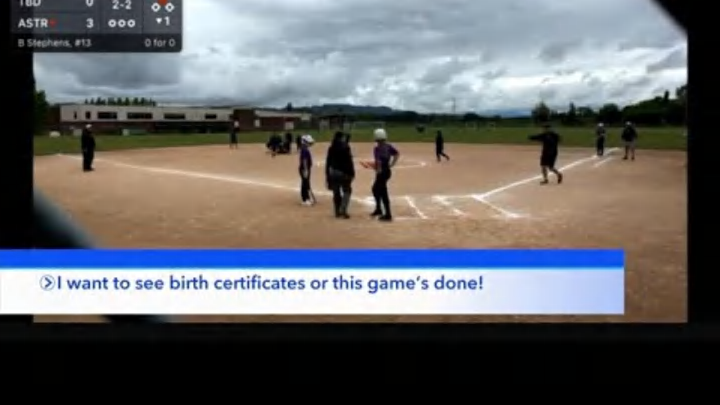
In a now-viral video out of Astoria, Oregon, an 11-year-old softball player was confronted—not for poor sportsmanship, cheating, or breaking a rule—but simply for being tall, strong, and confident. Her physical ability was so threatening to the opposing coach that he demanded to see her birth certificate. He couldn’t believe she could be that dominant and still just eleven.
Let that sink in.
In a world where we claim to want to grow the game, empower young girls, and support the next generation of athletes, we still find grown adults—often men—projecting their own insecurities onto children who dare to shine a little too brightly.
This wasn’t just a bad judgment call. This was a symptom of a much deeper issue in youth sports.
It’s easier to accuse than to compete. Easier to question a child’s legitimacy than to accept that maybe—just maybe—they’re outworking, outlearning, and outperforming your team. Instead of using it as a teachable moment, this coach used it as an opportunity to tear a young girl down.
I played high-level softball for years. I know what it feels like to be labeled “too much.” Too tall. Too dominant. Too intense. Now, as a coach and mentor, I see firsthand the emotional damage that happens when young athletes are made to shrink so adults can feel more comfortable.
In my opinion, we’re starting kids too early in competitive sports. Over the last two decades, the pressure of college recruiting has trickled all the way down to elementary-aged athletes. Parents feel the urgency to get their kids seen, and that pressure often turns into psychological and physical stress that lingers long after an athlete retires.
I speak from experience. Years of being in constant fight-or-flight mode as an adrenaline-fueled competitor took a toll. Fun fact: I didn’t start playing travel ball until I was fifteen—and I did just fine. We need to recalibrate. We need to stop chasing the recruiting timeline and start doing what’s actually best for our kids.
To the young girl in the video: keep going. Keep standing tall. Keep owning your strength. You don’t owe anyone your birth certificate—just your effort, your heart, and your belief in yourself.
To coaches everywhere: If your first response to talent is disbelief or defense, pause. Ask yourself why. Coaching isn’t about control—it’s about growth. If you’re threatened by an 11-year-old’s greatness, it’s time to look inward.
What is even worse are the toxic masculitnity that entered the chat like this twitter troll called “The Angry Bowel” making assanine comments like this.
Can’t blame the coaches - 11 year olds shouldn’t be 5 foot 10 - and it’s in Oregon 🤨🤔
— The Angry Bowel (@TheAngryBowel) May 14, 2025
This moment could’ve been one of celebration—for a young girl showing what’s possible. Instead, it revealed just how far we still have to go.
The good news? Every time a girl like her steps on the field, we get another chance to do better.
Let’s make sure next time, we do.
More News: Eugene Super Regional: Schedule & Updates
More News: Oregon Man Charged After Fatal Crash Involving Coach, Player
More News: No. 10 Oregon Softball’s Series Win Over No. 7 UCLA Shakes Up Big Ten Standings
More News: No. 7 Oregon’s Offense Explodes in Record-Setting Weekend Against Rutgers
Want to build mental strength like a champion? Check out my book —a practical, empowering guide for athletes who want to train their mind like they train their body.
 Add us as a preferred source on Google
Katie Burkhart is a former professional softball pitcher and Arizona State University alumna, where she was a three-time All-American and led the Sun Devils to a national championship. She played professionally in the U.S., Japan, and Italy, and has coached at the Division I level. She now provides private pitching instruction and mindset training for athletes of all levels. Katie is also the author of Mental Muscle and Beyond the Game, books focused on athletic performance and life after sports.