
1933 Goudey Lou Gehrig vs. 1952 Topps Jackie Robinson: Which Card Is More Iconic?
In this story:
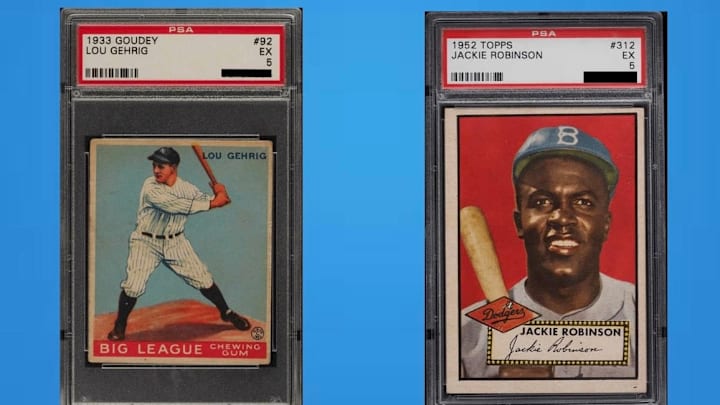
Collectors often associate the 1933 Goudey set with Babe Ruth and 1952 Topps with Mickey Mantle, but these landmark sets contain other baseball card cornerstones. Despite being overshadowed by Ruth and Mantle, the 1933 Goudey Lou Gehrig and 1952 Topps Jackie Robinson remain two of the most iconic cards in the history of the hobby.
Many parallels can be drawn between Gehrig and Robinson. Besides having cards that are overshadowed, they are both heroes for what they symbolized off the baseball field. Each player displayed tremendous courage and integrity in the face of unimaginable adversity. Both are legends of American history.

Baseball card collectors who want to collect the most important and iconic cards in the hobby have many difficult decisions to make. Deciding between a 1933 Goudey Lou Gehrig in a PSA 5 and a 1952 Topps Jackie Robinson in the same grade is especially difficult because both cards sell for around the same price ($15,000).
Many collectors buy what they like, while also considering how a card will perform in the market long term. Which of these two cards is more iconic, and which will perform better over time? It’s a close call, with excellent arguments to be made for each.
The Case for the 1933 Goudey Lou Gehrig

1. The 1933 Goudey Lou Gehrig comes from the First Mainstream Baseball Card Set
Earlier tobacco cards existed, but Goudey introduced the modern idea of baseball cards as a mass-market product for children. 1933 Goudey became the first set of cards that were sold with gum and distributed nationally. Because 1933 Goudey is the first traditional baseball card set, every key card in the set has extra importance.
While most serious collectors recognize the 1925 Exhibit as his official rookie, some argue for the 1933 Goudey Gehrig because it represents his first "mainstream" appearance in a traditional pack. Regardless of the rookie card label, the significance of the Goudey Gehrig is undeniable.
While Babe Ruth commands the spotlight in the 1933 Goudey set, Lou Gehrig firmly holds the second-place position. The set would lose much of its iconic status without him. On the other hand, Jackie Robinson lacks the clear "number two" status in 1952 Topps. Most collectors prioritize the Mickey Mantle and Willie Mays cards before turning their attention to Jackie in the 1952 Topps set.
2. Gehrig was a Superior to Jackie Statistically, while Still Highly Significant Off the Baseball Diamond

Lou Gehrig’s career statistics are clearly superior to Robinson’s. Gehrig ranks 18th all-time in career WAR (113.7), while Robison ranks 151st (63.9.). Robinson got a late MLB start through no fault of his own, but Gehrig was clearly a more dominant player. “The Iron Horse” ranks third all-time in OPS (On Base Percentage Plus Slugging), behind only Babe Ruth and Ted Williams. Jackie Robinson ranks 88th all time in OPS.
Lou Gehrig is universally regarded as the greatest first baseman of all time. While Jackie Robinson was a tremendous player and the 1949 MVP, he does not rank among the top 10 greatest players ever in the way Gehrig does statistically. Gehrig’s statistics are even more extraordinary when you consider the fact that he continued playing with ALS at the end of his career. He passed away at just 38, only months after retiring.
Just like Jackie Robinson breaking the color barrier, his story remains deeply embedded in American culture. “Lou Gehrig’s Disease” ensures that his name will forever be spoken. Few athletes have a medical condition named after them. Fewer have a moment as universally remembered as Gehrig’s farewell at Yankee Stadium.
That emotional story of Gehrig’s battle with ALS strengthens the appeal of his 1933 Goudey card. Over time, stories often outlast statistics. Gehrig’s story will live on forever, just like Jackie’s will.
3. Lou Gehrig has the Yankee and New York Premium
Gehrig’s identity as a lifelong New York Yankee adds strength to his iconic 1933 Goudey card. The Yankees are the most collected franchise in sports, with a fan base that spans generations. The Bronx Bombers dominate the vintage baseball card market.
Not only is Lou Gehrig a Yankee through and through, but he is also a true New Yorker. He grew up in a small apartment in Manhattan with parents who were German immigrants. His mother worked tirelessly as a cook and cleaning lady so that Lou always had enough food to eat.
Lou Gehrig’s poor upbringing in New York City helped create the great man he would eventually become. As a kid, worked tirelessly with his mother delivering laundry to neighbors to help support his family. This helped him grow big and strong, and he developed into a standout NYC high school athlete that earned the nickname “The Babe Ruth of High Schools.”

Gehrig accepted a football scholarship to Columbia University at the advice of his mother and then left school early and signed with the Yankees to help support his family when his father got sick. When he got the chance to replace Wally Pipp and play first base for the Yankees, it was an opportunity he took extremely seriously. From then on he played in 2,130 straight games for the Yankees, often playing through serious injuries.
He embodied the New York virtue of showing up to work every day. New Yorkers and Yankee fans will forever relish the opportunity to own a small piece of that legacy in the form of his most iconic playing days card.
The Case for the 1952 Topps Jackie Robinson

1. Jackie Robinson has an Unmatched Historical Impact
No baseball player has had a larger impact on American society than Jackie Robinson. By breaking Major League Baseball’s color barrier, he reshaped baseball and race relations in the United States.
Robinson is an important civil rights cultural figure. His baseball cards should be viewed as historical artifacts in a way that other cards are not. Jackie’s cards represent a turning point in American history. Both history-focused collectors and baseball card collectors will always appreciate the significance of a Jackie Robinson playing days card.

Robinson's story is taught in schools across the U.S. His name is scattered throughout American history textbooks. No other baseball player can make this claim. A typical high school student will not know who Mickey Mantle or Willie Mays are. Every young person knows the story of Jackie Robinson, which is a great thing for the long-term outlook of his baseball cards.
2. The 1952 Topps Set has Unmatched Iconic Status

1933 Goudey may have created the baseball card blueprint, but 1952 Topps perfected it. The set introduced the modern framework of baseball cards. It was the first set to include large color photography, colorful team logos, and backs with statistics.
1952 Topps is easily the most famous and popular baseball card set ever produced. Even in 2026, Topps is using the iconic 1952 set to sell more cards. In 2026 Topps (Series One is releasing February 11th), a “1952 Variation” with the iconic ’52 design will be reserved for a select group of top rookies as some of the major chase cards.
Topps will always keep the memory of their most iconic set alive. Goudey, now out of business, does not have the same opportunity. Another advantage Topps has over Goudey is aesthetics. 1933 Goudey is actually an unlicensed product and does not include team logos.
As more collectors view their cards as miniature works of art, eye appeal matters. The iconic image of a smiling Jackie Robinson with a bold red background is one of the most recognizable in the hobby. Even though the 1952 Mantle overshadows the rest of the set, 1952 Topps is still extremely popular among set collectors, and the Jackie will always be one of the set’s crown jewels.
3. The 1952 Topps Jackie Robinson has a Lower Population Count
According to Gem Rate data, the 1952 Topps Jackie Robinson card has a total population count of 2,061 graded copies across all major grading companies.
For the 1933 Goudey Lou Gehrig cards, the total graded population is significantly higher because the set features two distinct variations. Card #92 has a population count of 2,844 and card #160’s population count is 1,603. Combining both Gehrig cards results in a total population count of 4,447, meaning there are more than double the number of graded Gehrig cards.

Jackie Robinson's cards have significantly outperformed Lou Gehrig's in the sports card market as well in recent years. Since January 2020 (just before the sports cards COVID boom), the 1952 Topps Jackie Robinson has skyrocketed by 400%, nearly doubling the 237% growth seen by the 1933 Goudey Gehrig.
This trend suggests a market correction. Collectors are increasingly viewing Robinson cards as undervalued relative to his monumental historical significance. Jackie’s surging demand, combined with his tighter supply, means that his cards should be considered a superior value.
Which Card is the Better Long Term Investment? The Verdict:

The 1933 Goudey Lou Gehrig and the 1952 Topps Jackie Robinson are both iconic and historically important. They are both overshadowed by larger icons within their own sets, but they stand on their own as elite cornerstones in the baseball card hobby.
There has never been an athlete more important to American history than Jackie Robinson. That being said, Lou Gehrig remains one of the few historical figures/athletes whose legacy is equally defined by his actions both on and off the field. His “Luckiest Man Speech” is considered baseball’s Gettysburg Address.
Before a crowd of approximately 62,000 people, including Babe Ruth, Gehrig made his famous speech. Gehrig had not planned to speak. Unlike Ruth, Gehrig did not relish in the spotlight. Yankee Stadium’s fans chanted his name and compelled him to step to the microphone. He delivered the “Luckiest Man” speech with the upmost stoicism and bravery.
He was the first player in MLB history to have his uniform number (#4) retired. He will forever be a legend, and his 1933 Goudey is his most legendary card. Jackie Robinson has several other cards that are more legendary than his 1952 Topps, including his 1948 Leaf rookie card. For this reason, the Gehrig card wins by the slightest of margins.
TOP TRENDING COLLECTIBLES ARTICLES:
 Add us as a preferred source on Google
David is a collector based in Georgia and a lifelong fan of the New York Yankees, New York Giants, and New York Knicks. He is an avid sports card collector with a strong passion for vintage baseball cards and vintage on-card autographs. David enjoys obtaining autographs through the mail and loves connecting with other knowledgeable collectors to discuss the history and evolution of the hobby. He also previously wrote about the New York Giants for GMENHQ.com