
90s NBA Stars Whose Cards Are on the Rise (Part II)
In this story:
Sometimes, it’s easy to understand why certain names resonate in the hobby and why, even decades after they last suited up for a game, their cards are having a moment.
The players covered in Part One are proven superstars who have the stats, the style and the star power to remain relevant, so perhaps it was only a matter of time before their cards took off.
But cards of plenty of other ‘90s veterans, not just the hyped rookies whose first cards were produced during that decade, are trending upward, too.
Maybe it’s because, unlike today’s endless rainbow parallels and random swatches of laundry, the best ‘90s cards had wildly creative designs and massive eye appeal, while on-card autographs and game-used memorabilia were still genuinely groundbreaking.
Or it could be because dudes just sit around and name old basketball players and have the best time doing it.
Hakeem Olajuwon

Imagine getting drafted ahead of Michael Jordan and being so ridiculously good that no one ever criticizes the pick or plays the what-if game.
That’s how dominant Olajuwon was for nearly two decades, and why his “Dream Shake” still gives his former opponents nightmares.
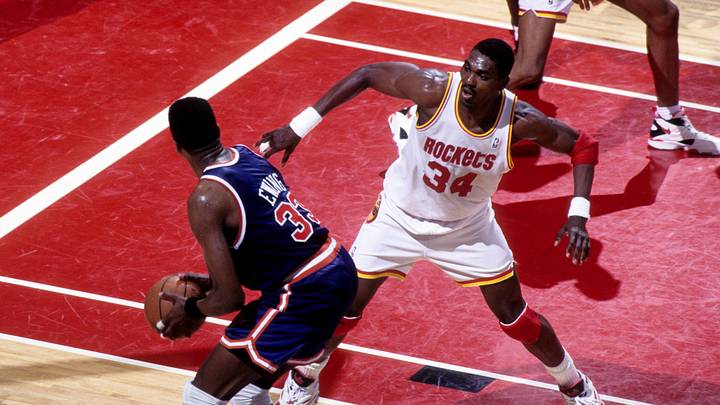
The former Rockets center (let’s just pretend the Raptors thing never happened) is still the only player to win regular-season MVP, Finals MVP, and Defensive Player of the Year in the same season. If there was any doubt about who sat atop the decade’s center hierarchy, Olajuwon answered it during Houston’s back-to-back championships, putting on an absolute masterclass of domination against Patrick Ewing, David Robinson, and Shaquille O’Neal.
He hasn’t reigned supreme in the hobby world, but a 38.68% bump over the last three months is a good start. What’s unusual is that six of his seven strongest performers are raw cards rather than graded versions, including his 1996 Flair Showcase Hot Shots #12 (+193.75%), 1997 Ultra Court Masters #17 (+125.83%), and 1995 Flair Hot Numbers #10 (+63.04%).
Olajuwon isn’t in Shaq’s territory just yet, but he’s at least starting to catch up. Never underestimate the heart of a champion!
Patrick Ewing

His Finals shortcomings aside, No. 33 was the heart and soul of the Knicks for 15 years, patrolling the paint at The Garden with a soft touch around the rim and a high-arching midrange jumper, while setting just about every team record imaginable.
Few playoff rivalries at the time were more riveting than Knicks-Bulls, with that familiar John Tesh “Roundball Rock” theme blasting at the start of every NBA on NBC broadcast (you’re humming it right now, aren’t you?), shining an ever-brighter national spotlight on Ewing and elevating his popularity far beyond Gotham City.
With Ewing occupying a front-row seat during the 2026 Knicks championship and finally posing for photos with the trophy that eluded him as a player, a modest spike in his card prices was almost inevitable.
Ewing’s cards are up 38.66% overall since June, with three of his most well-known cards atop the list. His 1992 Stadium Club Beam Team #18 in PSA 9 has nearly tripled to $225, and his 1993 Ultra Scoring Kings #3 in the same grade is similarly up 147% to $475.
Before the Finals, a PSA 10 1986 Fleer rookie card would’ve cost you around $5,400. The two most recent sales? $9,600 and an even $9,000. Olajuwon’s #82 from that iconic set last sold for 40% lower at $5,280, meaning that 30 years later, Ewing finally has a victory against Hakeem.
Vince Carter

At the height of Vinsanity, there may not have been a more popular player on the planet than the high-flying, high-scoring Raptors superstar. With an endless repertoire of 360s, detonating windmills, and violent tomahawks, Carter was made for YouTube, five years before YouTube was created.
But Carter’s relationship with the franchise deteriorated after 6-plus seasons, and after a brief run with Jason Kidd in New Jersey, he reinvented himself as a role player and veteran mentor on six other teams. Naming all of them should be a Final Jeopardy question because you’re guaranteed to miss a couple.
And so, Carter’s most desirable cards feature him in a purple jersey with a dribbling cartoon dinosaur, many of which are reaching new heights. The Hall of Famer’s overall Card Ladder index is up 40.50% over the last six months, on the strength of three key Raptors-era releases.
His PSA 9 1998 E-X Century Dunk ’N Go Nuts #12, a card with an unmistakably ‘90s design and cheesy wordplay, sold for an all-time high of $2,500 on August 29, rising by a whopping 150% since March.
A PSA 9 1998 Topps Chrome Refractor #199, which features Carter throwing down a casual two-handed reverse dunk, is up 50.14%, while one of his earliest and most sought-after autographs, a 1999 Upper Deck Retro Inkredible in a PSA 10 slab, has surged at an even higher rate of 99.63%.
Not surprisingly, collectors want to remember Carter soaring through the air in Toronto, rather than settling for long jumpers in Phoenix. See, you forgot about that one!
Tracy McGrady

Remember when “T-Mac” scored 13 points in 35 seconds? Like, that actually happened in a regular-season NBA game! And if that wasn’t enough, it was against a Spurs team in the midst of its championship dynasty. Two decades later, the math somehow still isn’t mathing.
The two-time league scoring champ could put the ball in the basket as well as anyone and made it look just as effortless. Before he was slowed down by recurring back trouble and knee surgery, McGrady evolved into an all-around player who could do just about everything else: defend, rebound, create for others, and lead his team all the way to the first round of the playoffs.
But even during his Orlando and Houston peaks, his cards were surprisingly attainable and affordable, and remained that way until the last few years.
Over the last three months, McGrady’s Card Ladder index is up 52.83%. His 1998 E-X Century Dunk ’N Go Nuts #10 is a much tougher card to find in a gem-mint 10 grade, with just 23 copies in the PSA population, but it’s still wild to see the card jump 468% over that time span, from $824 to $4,680.
His other biggest risers include his 1997 Metal Universe #42 rookie card in various grades. A PSA 10 last sold for $595, a 295% increase in the last 90 days and 441% over the last year, while a 9 has nearly quintupled, from $21 to $100.
It appears that after years of slumber, the sleepy-eyed McGrady’s card market is finally waking up.
Honorable Mentions
David Robinson: Much like the other elite bigs of his era, “The Admiral” is seeing a substantial bump in his cards (+38.92% over the last three months), with his 1989 Hoops rookie cards and 1993 Ultra Scoring Kings on the rise. His market cap, however, is a fraction of his center counterparts.

Alonzo Mourning: At first glance, Mourning’s card market appears to be exploding more than anyone else's, with a 128.51% increase. But that bump is almost entirely attributed to renewed interest in the 1993 Ultra Scoring Kings set, and Zo’s raw and graded versions are all appreciating.
Moses Malone: Technically, the three-time MVP played into the early ‘90s, but by that time he was a vagabond backup averaging under five points per game. His top cards are his 1986 Fleer #69 and 1975 Topps #254, in grades as low as 5 or 6, which have contributed to a 67.55% bump.
 Add us as a preferred source on Google
Alex Kramers is a Florida-based sportswriter who has covered the NBA and NFL since 2009. He served as a Sacramento Kings reporter and digital media coordinator from 2012-2014 and has written regular feature stories for the team's website. He has also covered the Miami Dolphins for DolfansNYC, and has produced content for publications including HOOP Magazine and Orangetheory Fitness. An avid sports-card collector since childhood, he has amassed one of the biggest Mitch Richmond collections in the world, and seeks out Florida Panthers cards and memorabilia with his son.