
How Auction Houses are Evolving with Marketing Grail Cards
In this story:
We have entered a territory where athlete moments, when “collectibilized” (new word?) and marketed, can become multi-million-dollar items - without the player ever winning a championship, MVP, or setting any records. Historically, photo-matched game-worn jerseys, and more recently the Logoman on a trading card, were the game-used grails for collectors.
Enter innovations like the Debut Patch and Gold Logoman, which allow Fanatics to develop and market scarcity, and it is now the Wild West of million-dollar sales. It is the truest version of a “one-of-one” occasion and, as we are now seeing, can make a lucky collector a multi-millionaire overnight.
Auction Houses Competing for the Biggest Grails
With the NBA and NFL following MLB, and other Fanatics-licensed products expected to join in, these moments are creating millions of dollars in new liquidity for all parties involved. But to compete for these items, Auction houses now have to offer collectors more than just a minimum guarantee or low fees to become the premier place to sell them.
Traditional auction houses helped build the high-end sports memorabilia market by marketing through catalogs, email lists, and more recently, social media. In order to keep up with the evolution of collectibles and the record-breaking sales, modern auction houses like Fanatics Collect, The Realest, and JOOPITER have taken a more immersive approach to their marketing, impacting a global buying audience.

Unexpectedly, the Cooper Flagg 2025-26 Topps Chrome Update NBA Rookie Debut Patch Autograph 1/1, featuring the patch from his first NBA game, sold for $8.04 million. In the same Fanatics Premier auction, rookies Dylan Harper and Kon Knueppel had their debut patch cards sold for $2.88 million and $2.34 million. Fanatics manufactured the cards, sold the boxes they came in, and consigned them on their auction platform, allowing a full cycle of marketing, trust, and communication for the sellers and buyers. Speed, trust, and liquidity clearly were the differentiators here. Auction houses have taken notice and are innovating their marketing approach to accommodate this surge.
Auction Houses Respond to Rising Competition

The Realest has brought to auction a signed jersey Shohei Ohtani wore during the first MLB game in Japan of the 2025 season. It also represents the first time the Gold Logoman was worn in an MLB game, giving the jersey multiple layers of “FIRST”: Ohtani, Japan, Gold Logoman a singular game-worn artifact and signed by Ohtani in both English and Kanji. The Realest founder Scott Keeney has described it as potentially “the defining jersey of Ohtani’s career”.
If we follow the investor grade attributes of a debut patch or Logoman card, it's arguable this jersey should be worth just as much - if not more than any Ohtani card ever sold including his dual Logoman card that sold for $11 million. To complement this, The Realest kicked off a global marketing tour ahead of its October 17th close to drive awareness and bidder consideration and brought back its "Guess the Price" contest.
Focusing on non-traditional marketing efforts, The Realest creates additional culturally relevant engagements to drive cool factor and desire around each item, deepening collector connection.

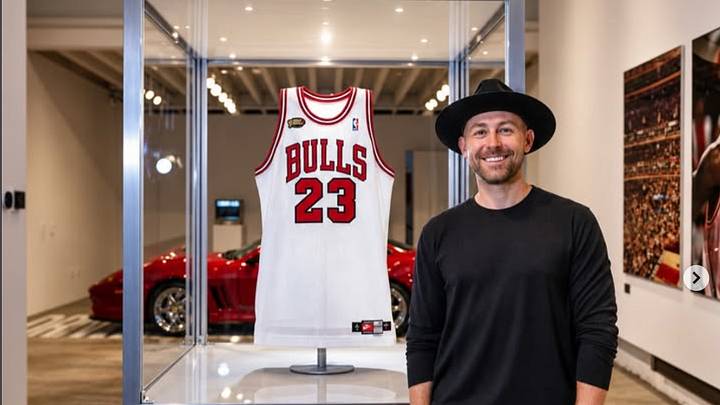
In contrast, Michael Jordan’s white Chicago Bulls jersey worn in Game 3 of the 1998 NBA Finals sold for over $10 million on the JOOPITER platform. The 8-figure sale was record-setting for a Michael Jordan jersey, and JOOPITER (founded by Pharell) being the chosen auction house was a disruptive choice by the consignor, renowned collector Rob Gough.

Rob Gough, who recently purchased the historic Jai Alai league, stated, “JOOPITER understood that this jersey deserved to be presented as a piece of history. They brought creativity and care to the marketing, telling its story in a way that connected sports, culture, and collecting.”
As companies evolve at collectibilizing moments, telling their stories and building hype, more opportunities to create the next generation of grails (and millionaires). Many of those items and moments probably haven’t even happened yet.
 Add us as a preferred source on Google
-83d4442a64cab760f636d15bfaa0f9d1.jpg "Mark Zablow")
Mark Zablow explores and lives at the intersection of collecting, creativity, and modern fandom. He built his career where storytelling, authenticity, and influence meet. Zablow is the founder of Bleecker Trading, a New York shop that helped bring the hobby into modern culture, and the CEO of Cogent World, a marketing agency that connects brands with audiences through creators, experiences, and storytelling. His work explores how provenance, identity, and value define what people collect and why they keep it. He lives on the East Coast with his wife and two sons.