
The Ultimate Cardboard Battle: T206 Honus Wagner vs. 1914 Babe Ruth RC
In this story:
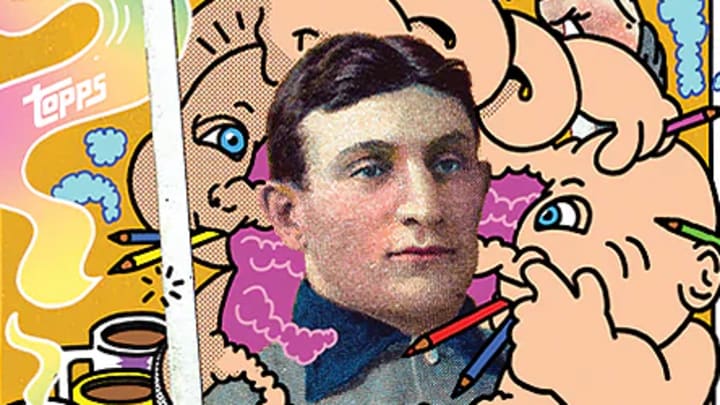
It doesn't take long as a sports card collector to learn that the Hobby's ultimate grail card is the T206 baseball card of Pittsburgh Pirates shortstop and Hall of Famer Honus Wagner. After all, the card has EVERYTHING going for it as far as legendary cardboard is concerned.
First off, this is not a card that came out of packs last week. The card was released in 1909 as part of the American Tobacco Company's multi-year "White Borders" release, meaning the card is now 117 years old! Second, the card is incredibly rare with only about 50 copies known to exist. Third, the card is of one of the early game's greatest players, Honus Wagner, still widely regarded today as the greatest shortstop of all-time. Fourth, the Wagner is the key card in what most collectors of vintage cardboard consider the greatest baseball card set of all-time. And finally, there is the mystery of the card. Why is it so rare? Why were so few copies printed back in 1909?
RELATED: Could this be the most expensive card ever?

Add all this up and you have a card that routinely sells for millions of dollars at auction with every sale making front page news. Still, these days plenty of cards sell for millions, ranging from Mickey Mantle to Paul Skenes to Pokemon. In other words, the Wagner is hardly alone in its exalted status high above the Hobby stratosphere. As heretical as it sounds, it may finally be time to consider whether the Wagner is even truly the GOAT.
RELATED: Babe Ruth modern cards and inserts

If there is any card to challenge the Wagner for Hobby supremacy, it would have to be the 1914 Baltimore News card of Babe Ruth, available in red or blue variations. While the Ruth cards are not nearly as well known to collectors as the Wagner, they not only feature the Bambino but are regarded by many in the Hobby as Babe Ruth's rookie cards. So yeah, there's that. Overall though, how do the two cards stack up?
Rarity

The PSA population of the T206 Wagner currently sits at 37, which is obviously not a very big number. That said, the PSA population of the Ruth card is 3. Yes, you read that right. Three. EDGE: Babe Ruth
Value
Sales of the Ruth card are few and far between though two recent sales (for the exact same card!) came in at roughly $7M and $4M. Meanwhile, it seems like every year or so that a Wagner sells, with pricing highly dependent on condition but generally somewhere in that same ballpark. EDGE: Tie
Star Power

Wagner, known as the Flying Dutchman, may have been the greatest player of the Deadball Era. Sure, some might choose Cobb or Walter Johnson, but Wagner was about as close to a five-tool superstar as a player could get back in the day when 8 homers might well lead the league. Not that they had the stat back then but Honus Wagner led National League position players in WAR eleven times over a stretch of thirteen seasons from 1900-1912. That's utterly insane! Still, he was no Babe Ruth. EDGE: Babe Ruth
Rookie Card Status
There are definitely collectors who will tell you each of these cards is a rookie card, but there are also collectors who will tell you neither is. Unlike today where the "RC" badge settles the debate before it even begins, there was no such designation assigned to cards 100+ years ago. In the case of Wagner, he definitely had earlier cards going back as far as the late 1800s but do they meet today's strict standards for rookie cards, in particular the "major release" criterion? The T206 set was unquestionably a major release but what about 1908 E102 set that included two separate Wagner cards? Or the Fan Craze cards of 1906, assuming one even counts game cards as baseball cards?
The Ruth card, meanwhile, is unambiguously the Bambino's first card. On the other, it depicts him as a minor leaguer with the Baltimore Orioles of the International League. By today's standards then, the card is technically a pre-rookie card, not a rookie card. Of course that's only if you believe today's rookie card requirements are relevant for much older cardboard. Still, while collectors today attach an almost holy primacy to rookie cards, aren't first cards just as exciting if not more so? EDGE: Babe Ruth
Significance

Were it not for the Ruth card, the 1914 Baltimore News set would be a big of a throwaway set in the Hobby. Make no mistake, it would be an extremely rare and expensive throwaway set but ultimately one of almost no interest to most vintage collectors. On the other hand, throw away the Wagner, and the T206 set is probably still the greatest baseball card set of all time. EDGE: Honus Wagner
Mystique
Whatever mystique you might imagine should be attached to Babe Ruth's earliest card, there is surprisingly none. In fact, most collectors don't even know it exists. The Wagner, on the other hand, transcends the Hobby and has become a mainstay in popular culture. Even your friends who don't collect baseball cards have heard of it and know something of its value. Beyond that, an entire mythology, some of it true, has been established surrounding the card's rarity, which only adds to the mystique. EDGE: Honus Wagner
The Verdict
Without a doubt, the Baltimore News Ruth puts up a heckuva fight. To recap, it's rarer than the Wagner, it depicts a better player, and it's that player's first card, rookie or otherwise. The Wagner, meanwhile, may be a 13th year card of a lesser player and have more than ten times as many known copies. When you look at it this way, Ruth ought to be the clear winner. Regardless, the Baltimore News is not exactly T206 and won't be the subject of a Dan Gutman book anytime soon. As long as the T206 set remains the Hobby standard, the Wagner will be the Hobby's standard bearer. Whether or not that's fair or right is another question, and the safe bet, as always, is to buy both just to cover your bases.
TOP TRENDING COLLECTIBLES ARTICLES:
 Add us as a preferred source on Google
Jason A. Schwartz is a collectibles expert whose work can be found regularly at SABR Baseball Cards, Hobby News Daily, and 1939Bruins.com. His collection of Hank Aaron baseball cards and memorabilia is currently on exhibit at the Atlanta History Center, and his collectibles-themed artwork is on display at the Honus Wagner Museum and PNC Park.