
Top 5 Iconic Baseball Cards from the 1990s
In this story:
Baseball card collectors who grew up in the 1990s are now in their 30s-40s. Many now have the disposable income to chase the iconic 90s baseball cards they couldn’t afford as kids.
There are so many iconic baseball cards that were released during the nineties, which makes it difficult to narrow down the list to just five. The early part of the decade consisted of overproduction and the “Junk Wax Era,” while the later part of the decade began to introduce scarcity and innovation (foil, refractors, die-cuts, pack-pulled autos, serial numbered cards, etc.)
So, what makes a 90s baseball card iconic? An iconic baseball card should include: a legendary player, historical set significance, aesthetic appeal, and market demand.
This ranking will consist of cards from the early and later part of the decade. For the sake of variety, there will be only one card per player. (Otherwise, this list would be dominated by Ken Griffey Jr.)
5. Barry Bonds 1993 Topps Finest #103 Refractor

Player Significance: Bonds is arguably the 2nd greatest baseball player ever after Babe Ruth (if you don’t dock him for taking steroids). He was already an all-time great before he started juicing. He has all the home run records, but many people would put an asterisk next to his numbers.
Set Significance: Arriving at the tail end of the Junk Wax era, Topps Finest changed the hobby forever by pioneering refractor technology. The first-ever refractors established scarcity within packs. Parallels have become such a fundamental aspect of card collecting, and these were the first.
Aesthetic Appeal: These were the first cards with the iconic “rainbow” effect. They were also the first cards to use “chromium stock” instead of simple paper-based cardstock.
Market Demand: Last sale of a PSA 10 copy (Population Count: 38) on 8/16/2025: $7,162
4. Cal Ripken Jr. 1998 SkyBox Metal Universe Precious Metal Gems

Player Significance: The “Iron Man” is one of the first players people think of when they think “90s baseball.” Not only did he break Lou Gehrig’s record playing 2,632 consecutive games, but he also won two MVPs and eight Silver Sluggers.
Set Significance: PMGs helped introduce the concept of artificial scarcity through serial numbering.
Aesthetic Appeal: These cards are iconic for the unique metallic, solid-color background with a vibrant, etched-foil finish. Ripken’s patented back-swing makes this card even sweeter.
Market Demand: Last sale of a SGC 7 copy (Population Count: 1) on 12/28/2024: $9,623
3. Frank Thomas 1990 Topps "No Name on Front" rookie card

Player Significance: “The Big Hurt” was one of the greatest players of the era. Thomas was a 10-time Silver Slugger winner, 5-time All-Star, a 2-time AL MVP (1993, 1994), the 1997 AL batting champion, the 2000 AL Comeback Player of the Year, a 2-time Home Run Derby champion, and a 2005 World Series champion with the Chicago White Sox
Set Significance: This is quite possibly the most famous error card in the baseball card hobby. The “No Name” card represents a time during the Junk Wax Era when error cards were the only form of card scarcity, which made them very sought after. Over twenty-four thousand standard versions of this card have been graded by PSA, while only 273 No Name versions of this card have been graded.
Aesthetic Appeal: The 1990s Topps set design just screams “Junk Wax Era.” The Big Hurt is easily recognizable, even without his name.
Market Demand: Last sale of a PSA 8 copy (Population Count: 101) on 8/8/2025: $14,800
2. Derek Jeter 1993 Upper Deck SP rookie card #279

Player Significance: Derek Jeter is included on most people’s lists of top five Yankees of all-time. His accomplishments over a 20-year career speak for themselves: 14-time All-Star, five Gold Gloves, five Silver Sluggers, and five-time World Series Champion.
Set Significance: Smack dab in the Junk Wax Era, the 1993 Upper Deck SP set represented one of the first “super-premium sets” in the baseball card hobby. These foil cards are prone to flaking, chipping, and scratching which makes them extremely condition sensitive and adds to the scarcity and allure of a high-grade copy.
Aesthetic Appeal: The shiny foil background was innovative and exciting for the time. A young Jeter, donning classic Yankee pinstripes, making one of his signature flips in the action shot just adds to the coolness factor of this card.
Market Demand: Last sale of a PSA 10 copy (Population Count: 22) on 3/20/2025: $324,000
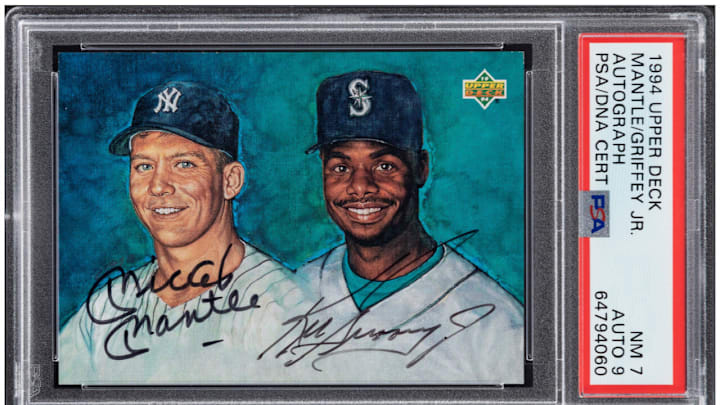
Ken Griffey Jr./Mickey Mantle 1994 Upper Deck dual-autographed card

Player Significance: The King of the Baseball Card Hobby (Mantle) and the 1990s King of the Baseball Card Hobby (Griffey) are together on one awesome card in a very cool “passing of the torch” tribute.
Set Significance: This card was released when pack-pulled autos cards were relatively new. This card helped to elevate their popularity and became an all-time chase card. Mickey Mantle tragically passed away in 1995, making this one of the last hard-signed certified autograph cards featuring the legend.
Aesthetic Appeal: This card includes a very cool artistic rendering by Jody Eastman showcasing side-by-side portraits of Mantle in his New York Yankees pinstripes and Griffey in his Seattle Mariners jersey. Some cards include just Griffey’s auto or just Mantle’s on-card auto. The ultimate version includes both.
Market Demand: a BGS 9.5 copy with both autos sold for $45,000 on 9/7/2025.
TOP TRENDING COLLECTIBLES ARTICLES:
 Add us as a preferred source on Google
David is a collector based in Georgia and a lifelong fan of the New York Yankees, New York Giants, and New York Knicks. He is an avid sports card collector with a strong passion for vintage baseball cards and vintage on-card autographs. David enjoys obtaining autographs through the mail and loves connecting with other knowledgeable collectors to discuss the history and evolution of the hobby. He also previously wrote about the New York Giants for GMENHQ.com