%20%20--%3E%0A%3Csvg%20version%3D%221.1%22%20id%3D%22Layer_1%22%20xmlns%3D%22http%3A%2F%2Fwww.w3.org%2F2000%2Fsvg%22%20xmlns%3Axlink%3D%22http%3A%2F%2Fwww.w3.org%2F1999%2Fxlink%22%20x%3D%220px%22%20y%3D%220px%22%0A%09%20width%3D%2239px%22%20height%3D%2240px%22%20viewBox%3D%220%200%2039%2040%22%20enable-background%3D%22new%200%200%2039%2040%22%20xml%3Aspace%3D%22preserve%22%3E%0A%3Cpath%20fill%3D%22%23FFFFFF%22%20d%3D%22M38.5%2C7H28.2v26h10.3V7z%22%2F%3E%0A%3Cpath%20fill-rule%3D%22evenodd%22%20clip-rule%3D%22evenodd%22%20fill%3D%22%23FFFFFF%22%20d%3D%22M26.1%2C25.5c0%2C5.8-4.1%2C7.5-12.9%2C7.5C3.9%2C33%2C0%2C31.2%2C0%2C25.2v-1.1h11.6%0A%09v2.4c0%2C0.7%2C0.1%2C1.4%2C1.2%2C1.4c1%2C0%2C1.2-0.4%2C1.2-1.3v-0.9c0-1.6-0.9-1.6-3.5-2.2C2.2%2C21.7%2C0%2C19.7%2C0%2C15.3v-0.9C0%2C9.3%2C5.5%2C7%2C12.9%2C7%0A%09c10.2%2C0%2C12.8%2C2.6%2C12.8%2C7.4v1.8h-11v-2.9c0-0.6-0.4-1.1-1.2-1.1c-0.6%2C0-1.2%2C0.4-1.2%2C1.1v0.9c0%2C1.5%2C0.9%2C2%2C3.3%2C2.5%0A%09c8%2C1.6%2C10.5%2C3.3%2C10.5%2C7.5V25.5z%22%2F%3E%0A%3C%2Fsvg%3E%0A)
Ranking the Baseball Hall of Fame Contemporary Era Candidates
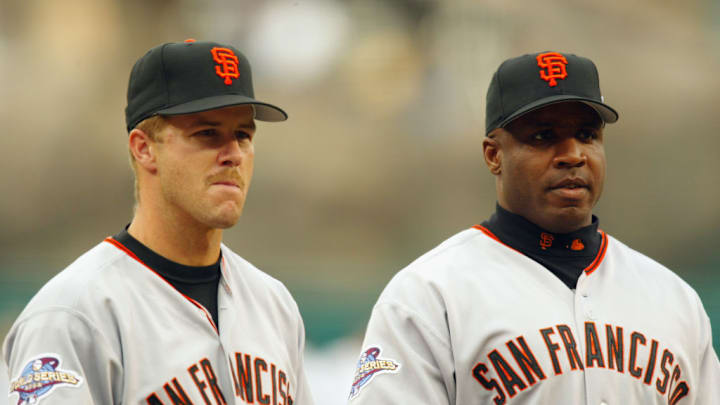
Barry Bonds and Roger Clemens get their 12th crack at the Baseball Hall of Fame Sunday when the Hall’s Era Committee considers them and six other candidates on a ballot of Contemporary Era players. Based on past voting patterns, Bonds and Clemens are not the most promising candidates on the ballot.
Bonds and Clemens appeared on a 2023 Era Committee ballot and whiffed there, getting fewer than four of the 16 available votes. Four players with known connections to PEDs have appeared on a committee ballot: Bonds, Clemens, Rafael Palmeiro and Mark McGwire. All four received less than five votes. Palmeiro and McGwire were not returned to this ballot.
The Hall does not release specific vote totals below five. There is a new wrinkle to voting results this year. Any candidate receiving less than five votes is ineligible for the subsequent Contemporary Era vote in 2028. If they should be placed on a ballot thereafter and fail to get at least five votes a second time since the implementation of this rule, the door to Cooperstown is slammed shut. Such twice poorly supported candidates “will not be eligible for future ballot consideration,” according to the Hall’s new rule.
The ballot includes three players with public ties to PEDs: Bonds, Clemens and Gary Sheffield; two players making their fourth appearance on a committee ballot and 19th overall: Don Mattingly and Dale Murphy; and three players appearing on a committee ballot for the first time: Carlos Delgado, Jeff Kent and Fernando Valenzuela. As on the writers’ ballot, a candidate needs 75% support to gain election (12 of 16 votes).
Every committee composition is different, so outcomes can be unpredictable. But based on past voting patterns, here are the ranked favorites on the ballot:
1. Don Mattingly
Over a six-year period (1984–89), Mattingly led the majors in slugging and was one of the best defensive players in baseball, a rare combination of elite skill. That’s how you become known as the best player in baseball year after year.
Then he hurt his back, lost his pop and from ages 29 to 34 was a good hitter, not a great one (105 OPS+). The sudden decline is why he maxed out at 28% (his first year) in 15 tries on the writers’ ballot.
Was his peak Hall worthy? For six years, yes.
Was the entirety of his career Hall worthy? It seems not, but even with his decline, Mattingly is one of only 33 players since the game was integrated to hit .300 with 3,300 total bases. Among those 33 elite hitters, here are the three who struck out least often: 1. Tony Gwynn (21.4 at-bats per strikeout). 2. Mattingly (15.8). 3. Stan Musial (14.6). That’s an impressive list of hitting artistry. Mattingly had more walks (588) than strikeouts (444).
But wait. We’re not done. Neither was Mattingly. He managed 12 seasons. No, he was not a Hall of Fame manager, but voters are instructed to consider a candidate’s entire contribution to baseball. Twelve years managing is not the crux of his case, but it’s something when taking the measure of a baseball life.
Think of it in terms of a Venn diagram. In one circle you have all the hitters who reached 2,000 career hits. That’s a subset of 298 players. In another circle you have all the managers who managed 1,800 games. That’s a subset of 74 managers. The intersection of those two achievements is a sliver of only seven people. Mattingly is one of those seven. Four of the previous six are in the Hall (Joe Torre, Joe Cronin, Frank Robinson and Red Schoendienst).
2. Jeff Kent
Kent has more home runs, more 100-RBI seasons and more games batting cleanup than any second baseman in history.
You should not need more, but if you do, there also is this:
- He was a career .290 hitter who hit .300 with runners in scoring position.
- Kent is the only middle infielder in the expansion era (since 1961) to hit .300 and slug .500 with runners in scoring position (min. 2,000 plate appearances).
- He has the highest postseason OPS of any second baseman in history (.880, min. 150 plate appearances).
- You can knock his defense, but managers—and managers of good teams (Kent went to the postseason seven times)—kept writing his name in the lineup at second base. Only 10 players ever started more games at second base.
During Kent’s career, the average MLB second baseman slashed .273/.337/.406. Kent slashed .290/.356/.500. He was a second baseman who hit like a corner player. That gave his managers a huge advantage over opponents.
3. Dale Murphy
Until Mattingly came along, Murphy was the best player in the game. In the seven full seasons from 1980–87, Murphy was named an All-Star and received MVP votes every year, winning back-to-back MVPs, two home run titles and five Gold Gloves—while playing center field.
Murphy posted an .854 OPS in more than 1,000 games in center field, one of only 16 players to do so. Only four of those elite center field sluggers also won five Gold Gloves: Willie Mays, Ken Griffey Jr., Jim Edmonds and Murphy.
4. Fernando Valenzuela
Okay, sure, he was done as an elite pitcher at 26, never making another All-Star team and wandering the baseball hinterlands with a 4.23 ERA over those final 11 seasons because he simply loved pitching.
But his long decline likely was due to how hard the Dodgers leaned on him when he hit the ground as the best pitcher in baseball and a cultural phenomenon. From ages 20 to 25, Valenzuela struck out more batters than anybody in baseball and piled up more wins, innings and complete games than anybody except Jack Morris. Standing only 5-foot-11 and throwing one screwball after another, Valenzuela threw more innings from ages 20–25 than every pitcher over the past 105 years except Bert Blyleven.
The word “influencer” has become trite, but the Mexican-born Valenzuela changed the game and the Dodgers’ fan base with his story, his style and his joy in the way he kept taking the ball. Fernando-mania wasn’t a one-year fluke. His long-term greatness has a lasting impact.
More MLB on Sports Illustrated
 Add us as a preferred source on Google
Tom Verducci is a senior writer for Sports Illustrated who has covered Major League Baseball since 1981. He also serves as an analyst for FOX Sports and the MLB Network; is a New York Times best-selling author; and cohosts The Book of Joe podcast with Joe Maddon. A five-time Emmy Award winner across three categories (studio analyst, reporter, short form writing) and nominated in a fourth (game analyst), he is a three-time National Sportswriter of the Year winner, two-time National Magazine Award finalist, and a Penn State Distinguished Alumnus Award recipient. Verducci is a member of the National Sports Media Hall of Fame, Baseball Writers Association of America (including past New York chapter chairman) and a Baseball Hall of Fame voter since 1993. He also is the only writer to be a game analyst for World Series telecasts. He lives in New Jersey with his wife, with whom he has two children.