
You Didn’t Just Watch These 80s Cartoons—You Can Collect the Cards
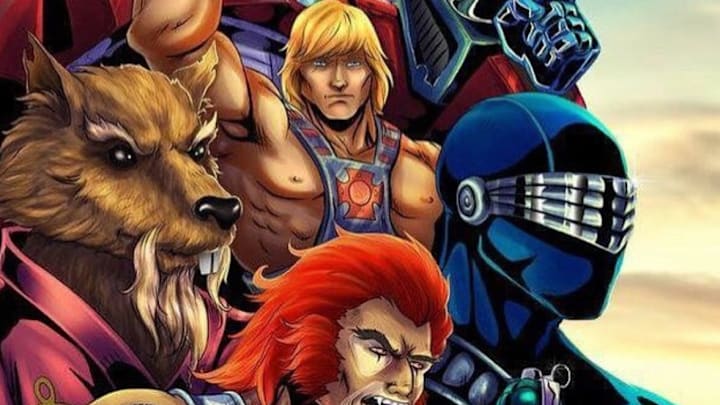
Before there were slabs, population reports, and livestreamed breaks, there was the toy aisle. And for a generation of collectors, that was the hobby’s first storefront. And like junk wax from the era, everything old is new again. Parents who grew up in the 80s are getting their collections out of their parents’ attics or buying some of their childhood glory on eBay, and even introducing their kids to the joy of cartoons from forty years ago,
The biggest animated hits of the 1980s weren’t just television shows; they were fully built collectible ecosystems. They existed simultaneously as action figures, comic books, trading cards, mail-away exclusives, sticker albums, and lunchboxes. To follow the story meant to collect the pieces, hoping for a new toy, t-shirt, or comic book for your birthday or under the tree at Christmas.
RELATED: Bob Marley Gets A Soccer Card in 2025 Topps Chrome MLS
He-Man and the Birth of the Modern Chase
He-Man was the prototype. When Filmation’s cartoon debuted in 1983, the mythology had already been seeded in Mattel’s figures and the mini-comics packed inside the boxes. Kids learned the story by opening packaging.
The 1984 Topps card set extended that experience, turning screenshots into a cardboard episode you could shuffle, trade, and rebuild on the floor of your bedroom. Castle Grayskull wasn’t just a toy—it was a centerpiece, the kind of display object that today would sit in a (large) glass case next to a high-grade vintage card.
Transformers: More Than Meets the Eye
With Transformers, the chase went international. The split history between Takara’s Japanese releases and Hasbro’s American versions created variants, packaging differences, and subtle design changes that turned completion into a lifelong pursuit.

Boxed Generation 1 Autobot and Decepticons feel less like toys today and more like sealed wax, their value tied as much to condition and artwork as to character popularity. Even the 1985 Transformers Action Cards introduced a master-set mentality that would be instantly familiar to anyone who has ever tried to build a modern rainbow.
Keep in mind that these were toys and were meant to be played with, like vintage sports cards. And as anyone that has watched an episode of Pawn Stars knows, every detail of the packaging set things up for collectors to profit if they kept their Optimus Prime in pristine condition—if it didn’t get sold at a family garage sale.
RELATED: Larry David Autos in 2026 Topps Transcendent & His 'Pretty, Pretty Good' Cards

A Real American Hero: The G.I. Joe Playbook
G.I. Joe introduced something that now feels strikingly modern: the first-appearance mentality. True fans will know that G.I. Joe originally debuted in 1964, but was relaunched to the masses in 1982. The Marvel comic didn’t simply support the toy line; it defined it. Characters were introduced in print, their personalities codified on file cards, and suddenly the packaging mattered as much as the figure inside.

And kids of the 80s will remember that the cartoon franchises were some of the first collaborations, from WWF (now WWE) to Transformers crossing over with G.I. Joe. A mail-away Sgt. Slaughter wasn’t just another piece—it was a redemption before redemptions existed, a reward for the collector willing to complete a process and wait by the mailbox with eager anticipation.
ThunderCats and the Rise of the Display Piece
By the time ThunderCats arrived, scale and presentation had become part of the collectible equation.
LJN’s larger figures and massive creatures dominated shelf space and, decades later, dominate collectors’ display cases. Cardback variations and character scarcity created a built-in hierarchy. You didn’t need a price guide to know which pieces were tougher—you could see it in the way they disappeared from the KB Toys shelves.

The Turtles and the Bridge to the Modern Hobby
Rounding out the late 1980s, the Teenage Mutant Ninja Turtles connected comic book fans to TV animation and toys, rounding out the collectible marketing trifecta.
A black-and-white indie comic by Eastman and Laird became a global animated phenomenon, and the Playmates toy line exploded into one of the deepest checklists of the decade. Variant figures, new waves, and vehicle releases created the rhythm of a modern product cycle, while Topps trading cards—especially the 1990 movie set—turned the Turtles into a wax-pack experience.

Condition, Completion, and the Collector Mindset
What these franchises really built was the psychology of collecting. They taught an entire generation that condition mattered because bent cards and torn bubbles meant something was lost. They introduced the idea that packaging was part of the collectible, that some pieces were short-printed by circumstance, and like Pokemon in later years, you really had to collect them all.
Walk into any toy and collectibles show today and you can still see it: the sealed box no one wants to open, the character-driven chase, the premium placed on the first version of something that later existed everywhere.
You didn’t just watch these shows. You built them—one figure, one issue, one pack at a time.
TOP TRENDING COLLECTIBLES ARTICLES:
 Add us as a preferred source on Google
Lucas Mast is a writer based in California’s Bay Area, where he’s a season ticket holder for St. Mary’s basketball and a die-hard Stanford athletics fan. A lifelong collector of sneakers, sports cards, and pop culture, he also advises companies shaping the future of the hobby and sports. He’s driven by a curiosity about why people collect—and what those items reveal about the moments and memories that matter most.
Follow sneakrz