
Everything Dave Hakstol Said During his Introductory Press Conference in Tempe
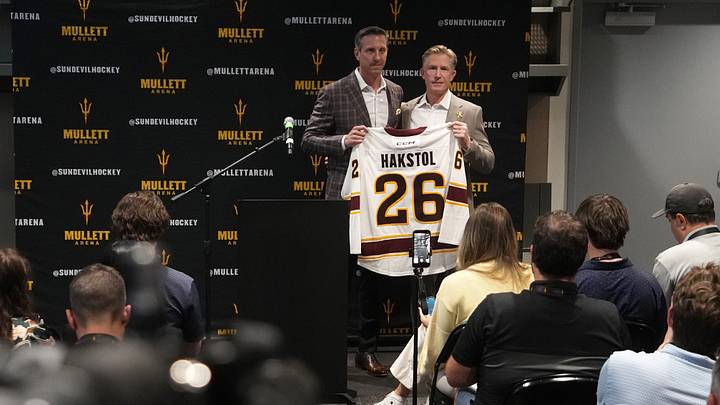
Nearly two weeks to the day after taking the reins in Tempe, new Sun Devil hockey coach Dave Hakstol spoke with the media for the first time from Mullett Arena.
Between sit down interviews and post game pressers after a road sweep against UMass-Lowell, Hakstol has had a few public comments since becoming the head coach, but faced the hometown media for the first time in his official introductory press conference. After being introduced by Athletic Director Graham Rossini, here's everything he had to say.
Opening Statement
"Thank you Graham (Rossini), and also want to thank President Crow, both of you for your leadership throughout the process, and really enabling this to happen. For me, this is a tremendous opportunity, for myself professionally, as well as for my family... for me (it's a) special opportunity to join this group of guys and work towards a successful season this year, while at the same time laying the foundation towards the future, and I'm excited to do that."

"You spent a decade away, what made you want to come back to college hockey?"
"When the opportunity arose, obviously it's very unique timing, and a difficult time of the year, but there was something about this opportunity that felt special, and I truly feel that way. I think everything that's here at ASU as an institution, when I look at the foundation that has already been laid here within the program, and the hard work of everybody previously involved with this program, including the alums, and as we look to the foundation of the future, I just think there's so much here."
"It's an exciting opportunity, and I truly mean that. I feel good about joining this group of players, and we want our focus to be on this year and everything we can do to make this a successful season, but also with an eye into the future. As we become full fledged members of the NCHC... there's a ton of challenges, but way more opportunity to continue to grow and build this program into national prominence, and become a championship level program on a year to year basis."
"What has changed since you left college hockey?"
"I remember in my last year or two(at North Dakota), our compliance department gave us permission to buy bagels for our guys for breakfast, but they had to bring their own cream cheese, so things have changes a little bit, right?"Dave Hakstol
"The changes with player movement, with NIL payments, things like that, there's a ton of positives there for the players. (It) creates challenges on other sides, in terms of building continuity with your roster and things of that nature, but it probably also drives us to make sure we're doing a great job for our players, that's the best thing you can do."
"College hockey has gotten better. The level of play right now, when I watch is from a fan standpoint, it's spectacular. There are so many dynamic players in the game. Those dynamic players have always been there, I just think there's a slightly higher level right now... a good friend of mine that coaches in the league, we talked about it over the summer. Is college hockey, 20% better, is it 25% better than it was a couple years ago, with the advent of opening to the CHL, there's more talent available."
"You were one of the original coaches back when the NCHC came together, how does it feel to come back to that conference?"
"It's pretty special, I gotta be honest with you. I can remember the first couple of meetings, where there was only a couple of us with a yellow legal pad, jotting things down as to where we were going to go. At that time, we knew there were stresses coming to our current league (WCHA) with the advent of Big 10 hockey, and that was going the change the landscape. We were trying to look forward, we were trying to plan forward, and as we wrote things down and tried to formulate a plan, it became kind of a daunting task. Yet, some great people brought it together very quickly, The league got off to a great start... the amount of success the NCHC has had on a national level is amazing."
"The uniqueness of the situation that you arrived in to, how have you felt about the players emotional state, their connectivity, and where you want to go from here in those areas?"
"I've found the guys want to be coached, they're craving that. The best thing that I can do is provide leadership. For whatever the day brings, provide leadership off the ice, provide leadership direction and coaching on the ice, and that's exactly what I've done. We haven't complicated that, we've dealt with it in a very straight forward manner."
"I'm aware of everything (on the situation). I'm aware of some of the things that these players are possibly dealing with, yet I make no assumptions. We just kind of hit things head on, on a daily basis."

"What were you trying to accomplish in your "mini training camp" and what was your assessment of the team in that period?"
"Number one, for myself as a coach, and for Matt Greene coming in, joining the program, (it's) get to know our players. And I don't just mean get to know who they are on the ice, but also get to know them a little bit off the ice, get to know what their abilities are and try and understand that a little bit so we know how to apply that to our team game. Coupled with that, lay the foundation of how we want to play systematically. That's going to take time, but truly a blessing really to have the weekend off where we could do that. We could take five days and just turn our focus completely inwards to what we want to be and how we want to do it... I think we made great progress, I believe that, now we have to take that and apply it to a game week, and then continue building."
"What is your message to Sun Devil fans, hockey fans in the Valley, for what you're trying to bring here?"
"We want them to be proud of what we're doing, and the best way that I know how to do that is you show the care every day on the ice. We do the work in practice, we do the work every day, but when the puck drops in front of a full house, we have to show everybody that's here, everybody that's spending their hard earned money, everybody that's spending their Friday or Saturday night (at Mullett Arena), that we care."
"I think this is a really good hockey community. There is a deep hockey tradition here, there's a ton of hockey acumen and knowledge. I believe our crowd is a knowledgeable hockey crowd, and I believe they're going to appreciate great effort and care, and that's what we're going to bring every day."
"How have the team captains stepped in and provided leadership so far?"
"As a group (Captains Kyle Smolen, Sean McGurn, Jack Beck, Logan Morrell, and Ben Murthersbaugh), I can't say enough about them. I haven't walked in their shoes over the past few weeks, I've just been with them for the past 10, 12 days, and I can tell you the quality and depth of the human beings is pretty impressive. They're good players, but along with that, they're probably better people. Leadership is not easy. Being a leader, being a captain on any pro sports or college sports team at any level is not easy... they've done a really good job. They speak to important things, things that matter to them, they've communicated well with me... they're a conduit (to the rest of the team)."
Team Staff Roles:
"Jimmy Mullin is staying, he'll run the power play, he's going to work with our forwards, he's going to be integral in terms of recruiting. Bringing Matt (Greene) in, he's going to work with our penalty kill, work with our defense, and really he's got such a wealth of knowledge, in terms of the steps necessary, not only to win, but the steps also necessary individually to build your career into a National Hockey League career, based off of his experiences, both as a player, and what he's done career wise, that he'll be involved top to bottom."
"I trust Greener (Matt Greene) with my life, with my family. That is a pretty good place to start. If we're going to do this, we've got to go into the coaches room and we have to believe in each other...I know this guy (Greene) inside and out. He was my first captain at the University of North Dakota, my very first year as a head coach... his directness, his honesty, his ability to communicate, is really dynamic, in terms of his ability to communicate with different personalities."
 Add us as a preferred source on Google

Fletcher Anderson is a 2025 graduate of the Walter Cronkite School of Journalism at Arizona State, and have been reporting for newspapers and writing sports columns since 2018. He began a sports column for the Lake Minnetonka Navigator, when he was still a sophomore in high school. Since then, he has written for teams, schools, newspapers and digital sites, including Cronkite News at Arizona State. In that role he covered area high school sports as well as the Arizona State athletics. He began contributing to On SI in 2026.