
Baylor’s latest collapse leaves Dave Aranda with nowhere left to hide
In this story:
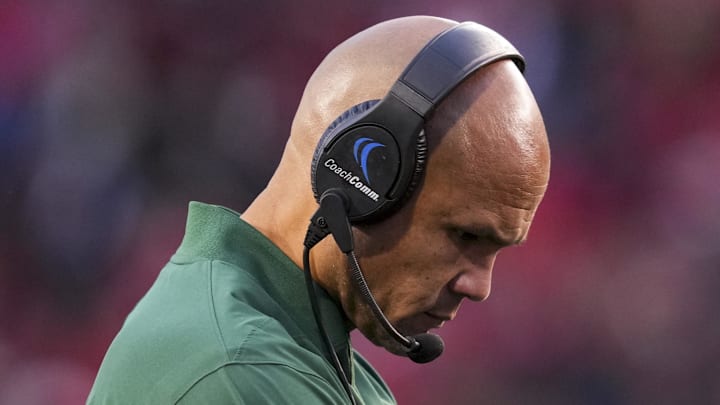
The collapse wasn’t subtle. It wasn’t debatable. And it certainly didn’t leave room for more defending. The Baylor Bears’ 55–28 blowout loss to No. 13 Utah Utes was the kind of performance that removes any lingering ambiguity about the trajectory of Dave Aranda’s program. If there were still questions about whether the sixth-year head coach could—or should—return in 2026, Saturday delivered a resounding answer.
Aranda didn’t sugarcoat his emotions afterward.
“Way disappointing game. Very frustrated. Gutted really. I was not anticipating that,” he said. “Really didn’t see that [coming]. The locker room is tough. A lot of guys are frustrated and angry, and I’m right there with them.”
What he didn’t do, however, was provide a reason for optimism. Because at this point, there isn’t one.

The Bears haven’t shown the kind of growth, discipline, or identity that would justify retaining Aranda for another season. And while this week’s uncertainty surrounding athletic director Mack Rhoades and his sudden leave of absence briefly raised questions about whether administrative limbo might buy Aranda more time, Utah’s demolition of Baylor made one thing unmistakably clear: no level of institutional chaos can overshadow the on-field product. And that product is nowhere near good enough.
Baylor continues to suffer from the same recurring issues—inability to force turnovers, a porous run defense that is allowing the second most rushing yards per game in the Big 12, and an overall inability to play complementary football for more than flashes at a time. Saturday simply magnified the pattern.
When asked about his future after the loss, Aranda pushed those conversations aside.
“Our focus is just trying to win this next one… and try to be able to show improvement and some excitement with winning,” he said. “Whether it’s the noise, the distraction, or whatever it is, we have to keep that on the outside.”
He talked about improvement. He talked about consistency. But improvement and consistency have been theoreticals for two years now, not realities.

To Aranda’s credit, he acknowledged the emotional weight of the moment.
“Anytime you lose, you get gutted. Anytime you get the ball run on you, you’re probably gutted more,” he said. He pointed to team leadership and the need to “stay together” for the final stretch, adding that players who don’t buy in “ain’t going to be part of it.”
But the truth is this: the final two weeks won’t erase what the past two seasons have revealed. Whether Baylor limps into a bowl game or fades out with a whimper, the clock is ticking loudly in Waco. And whatever comes next—Aranda stepping aside on his own terms or a new athletic director choosing their own coach—the outcome feels more and more inevitable.
Aranda knows it, too. His tone, his deflection, and his emphasis on “focusing on the next one” sound less like confidence and more like someone acutely aware that his time is running out.
Two games remain. Maybe a bowl. Maybe not. But the verdict is already forming—and Saturday’s performance only pushed it closer to unanimous.
 Add us as a preferred source on Google
Jalon Dixon is a sports journalist with a passion for covering basketball at every level. He has written extensively on men’s and women’s college basketball, as well as the NBA, building a reputation for clear analysis and thoughtful storytelling. His work focuses on the players, programs, and trends shaping the sport, offering readers insight that goes beyond the box score. Whether breaking down a key matchup or highlighting emerging talent, Jalon’s goal is to provide balanced coverage that connects fans to the game’s strategy, culture, and ongoing evolution.