
Boston College Football's Failure to Address Needs in the Portal is Unmistakable
In this story:
Disappointing is quite an understatement in regards to how the 2025 season under Boston College football’s second-year head coach, Bill O’Brien, has unfolded in Chestnut Hill, Mass.
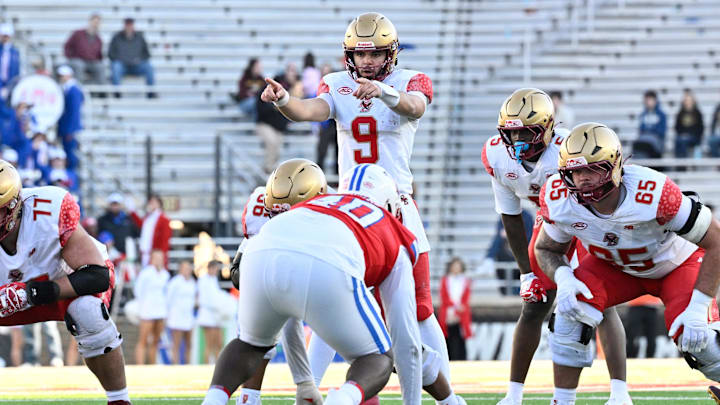
On Saturday, the Eagles (1-9, 0-6 ACC) dropped their ninth consecutive game in a blowout loss to SMU.
The Eagles faced a 17-6 deficit after the first two quarters but were outscored 28-7 in the second half despite receiving the ball first after halftime. The final score was 45-13.
BC’s defense, which has given up 4,317 total yards this year—good for 133rd in all of FBS out of 134 eligible teams—played abysmally once again, relinquishing 10 plays of 20 or more yards in the defeat, including touchdowns of 25, 61, 37, and 48 yards. The loss marked the sixth time this season that the Eagles have surrendered 38 points or more in a game.
BC’s defensive breakdowns—which either form out of broken coverage in the secondary and lack of pursuit, or the inability to fill in gaps at the line of scrimmage properly and pressure the opposing quarterback—have morphed into a systemic issue that is beyond resolve.
Defensive lapses are essentially an expectation for Boston College football fans who show up to watch the Eagles at Alumni Stadium on Saturdays.
“I think that if it's a problem in the beginning of the season and you can't solve it, then it just becomes a problem throughout the season,” O’Brien said after Saturday’s loss. “Whether it's long runs where we can't set the edge, or we don't fit the gap right, or whatever it might be, we've seen that over and over again, and we just have not been able to fix it, have not been able to coach it. … So I take responsibility for that.”
O’Brien added: “But yeah, I think it's a snowball effect. If you can't get it fixed early on, then you're gonna have trouble fixing it in November.”
While some key injuries on the defensive side of the ball have piled up in a snowball-esque manner as well—primarily through the on-and-off availability of DT Owen Stoudmire, LB Daveon “Bam” Crouch, and DBs Syair Torrence and Amari Jackson—the glaring reality is that BC’s roster is not deep enough to adequately compete in games, and the coaching ability of defensive coordinator Tim Lewis is simultaneously wrestling to even stay alive on a regular basis.
Want some more evidence?
The aforementioned pass rush has only manufactured 14.0 sacks this year as a team, which ranks 116th in FBS. In 2024, Donovan Ezeiruaku—the reigning ACC Defensive Player of the Year—finished his senior campaign on the Heights with 16.5 sacks on his own.
BC is tied for 123rd in the nation in team tackles for loss (40.0), and its 44 touchdowns surrendered is tied for 131st.
But, to O’Brien’s misfortune, there is no mid-year transfer portal window in college, and the results speak for themselves. The talent gap in BC’s defensive unit in comparison to almost every other opponent the Eagles have faced in 2025, barring Fordham, is blatantly obvious.
O’Brien said at the beginning of the season that replacing Ezeiruaku’s production was impossible, but the fact that the Eagles’ defense, as a whole, has not been able to replicate what just a single player churned out in a season is unfathomable, even if he was a second-round NFL draft pick.
If the defensive flaws were not perceptible to the coaching staff then, they certainly are now, and there is only one way to go about making sure it never happens again in the future—by using the transfer portal the way it is supposed to be utilized.
This also includes another key area in which BC needs significant improvement over the 2026 offseason—the offensive line, which has allowed more sacks in 2025 (34 sacks, 206 yards lost) than just about any other program in the country.
A concrete offensive-line unit is crucial at virtually any level of football, but particularly in college, when programs often swap out quarterbacks on a year-to-year basis, making the learning curve for offensive assimilation much narrower than in the NFL.
The Eagles possess weapons in their wide receiver and tight end rooms from top to bottom, most of all redshirt-senior Lewis Bond, who is on the verge of eclipsing the program record for career receptions—held by Zay Flowers of the Baltimore Ravens (200 receptions).
But if the quarterback does not have adequate protection to get the ball off in time, or move around the pocket without being throttled, the rest of the offense will inevitably flounder.
BC’s running backs room is arguably the most inconsistent position group on the team—the Eagles rank 128th in the nation in rushing yards per game (92.7), as well as average yards per rush (2.88)—yet O’Brien did not supplement the offense with any difference-making players in that department through the portal, either.
For both position groups, the offensive line and the running backs, there are a handful of underclassmen seeing the field every week, which is not sustainable, nor productive, by any stretch of the imagination.
Every week, O’Brien has implied that the team is giving its best effort in both practice and come game time. It is commendable that even amid one of the worst seasons in program history, there is very little sign of quit from the players and the coaches, who repeat the same line of “treating every game, day, play and practice like its own” despite the way this year has gone.
The question heading into the program’s uncertain future is not if O’Brien’s message resonates with his players and recruits, or if the team has quit in any capacity. That is simply not the case, and O’Brien has rightfully ripped into reporters whenever he is asked about the Eagles’ effort, or lack thereof, over the course of the season.
On the surface, the players all seem to trust what the coaching staff is telling them, and the confidence in O’Brien from the players’ standpoint has not yet breached, as far as people on the outside, including the media, can tell.
But the overall roster construction of the team is where O’Brien and his recruiting staff failed the most in 2025, which chiefly stems from not filling in roster gaps appropriately through what is basically free agency at the collegiate level—the transfer portal, a.k.a the wild, wild west.
Besides tampering with other program's recruits, there are basically no limits to what the portal can be utilized for, and there is no "cap," per se, on spending, like there is in professional sports.
If the approach to roster construction is not fixed, it will appear in the record like it has this season, because virtually every other team at the Power-Four, Division-1 level are aware of the new system and are working tirelessly to fight for donation money, which is easier said than done for teams like BC, and O'Brien even admitted so.
O’Brien’s approach to his job as the leader of BC’s football program has centered on a recruiting pitch which might align with the school’s mission, but it is not one that will necessarily lead to success in the record books. His strategy is ultimately not suitable for the current environment, and impatience from donors and alumni will likely amount at a rapid pace the longer BC does not recognize its reality.
The solution is not moving on from O’Brien himself, which would cost the university millions of dollars that could be applied to what actually matters—bringing in top talent from across the country, including a makeover in the coaching department, with prior experience at the Division-1 collegiate level.
But it all comes down to the simple root of money and what lengths the university is willing to reach in this realm. The possibility that BC cannot meet these demands are currently somewhere in the 50-50 range, it appears.
Even mediocrity, which has defined BC’s football program since the days of Matt Ryan in the early 2000s, will be difficult to attain if O’Brien does not receive the resources—and use it correctly by bringing in a group of experienced talent evaluators—to inherit top talent from the wide array of the Power-Four landscape.
Read More:
 Add us as a preferred source on Google
Graham Dietz is a 2025 graduate of Boston College and subsequently joined Boston College On SI. He previously served as an editor for The Heights, the independent student newspaper, from fall 2021, including as Sports Editor from 2022-23. Graham works for The Boston Globe as a sports correspondent, covering high school football, girls' basketball, and baseball. He was also a beat writer for the Chatham Anglers of the Cape Cod Baseball League in the summer of 2023.
Follow graham_dietz