
Why Boston College Football is Having a Major Offensive Identity Crisis
In this story:
There is an offensive identity crisis brewing in Chestnut Hill right now.
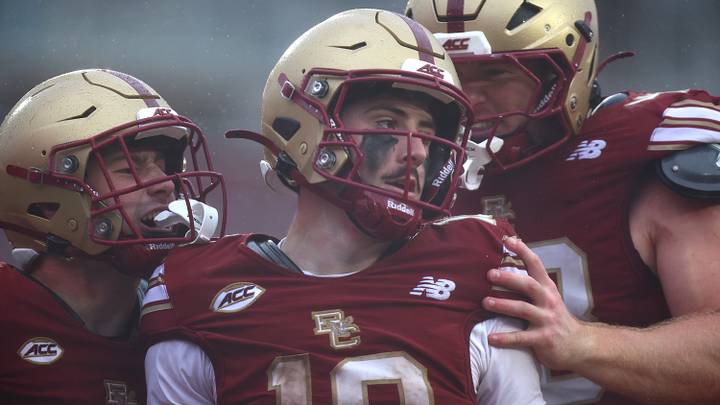
In Boston College football’s loss to the Virginia Tech Hokies on Saturday, quarterback Mason McKenzie accounted for 249 of the Eagles’ 261 total offensive yards, which is approximately 95 percent.
QB Mason McKenzie on what he’s learned about himself:
— Graham Dietz (@graham_dietz) September 26, 2026
“I mean, I think I belong at this level. I can play at this level. I hope everybody has seen that. I know my teammates believe in me, so I think I've just proved to myself that I think I can do it at this level.” pic.twitter.com/nDs6WAEE2B
Through four games, BC has yet to establish anything more than a lackluster passing game that doesn’t appear to have any sort of cohesion or rhythm, and its run game has largely consisted of McKenzie breaking away from the gameplan axis and using his innate athleticism to carry the offense in an off-script manner, which is unsustainable in the long-term — especially for his health.
Sure, weather was most definitely a factor this past weekend, but if Bill O’Brien can’t find suitable methods to get his playmakers involved to help out McKenzie, notably running back Evan Dickens and wide receiver Jaedn Skeete, then it’s going to be a lot more of what fans witnessed this past weekend against the Hokies.
BC currently ranks 124th in the country and second-to-last in the ACC in passing efficiency, and if you take away McKenzie’s rushing totals, the Eagles’ backfield has combined for just 304 yards and three scores, all of which belong to Dickens — who could only garner nine yards on six carries Saturday.
The Eagles’ third-down conversion rate of 28.0 percent (14 for 50) ranks 132nd in FBS, its fourth-down conversion rate of 33.3 percent (3 for 9) is tied for 116th, and its red-zone efficiency is nearly dead last at a clip of 61.5 percent.
For one thing, BC’s run blocking has to improve drastically to get Dickens and Bo MacCormack III some better looks in the backfield.

There hasn’t been a consistent enough effort from the offensive line to create adequate holes for the Eagles’ ball carriers, particularly on inside runs, which is where BC has struggled the most.
Based on PFF data, the left side of the offensive line is having far more trouble than the right, as Dickens is averaging 2.9 yards per carry (21 carries for 62 yards) going left of center and 5.7 yards per carry (23 carries for 130 yards) going right.
O’Brien has seemingly tried to address this situation, as he swapped out Veguer Jean-Jumeau, who started the Eagles’ first three games at left tackle, for Trevon Humphrey against Virginia Tech, but that did not appear to change much.
Arguably a bigger concern, however, is the lack of production from BC’s pass catchers, which has forced McKenzie to scramble excessively instead of airing the ball out.

That does not excuse McKenzie from the problem, either, as he has made some bad reads and errant throws in all four games this year — some of which have cost the Eagles touchdowns.
Nevertheless, O’Brien desperately needs to strategize a way to get his receivers and tight ends in better positions to make plays, because there is a clear disconnect in that realm of the offense, and it is not allowing BC to sustain drives.
Follow us on Twitter/X, Facebook, YouTube, Instagram, and Tiktok for the latest Boston College news.
 Add us as a preferred source on Google
Graham Dietz is a 2025 graduate of Boston College and subsequently joined Boston College On SI. He previously served as an editor for The Heights, the independent student newspaper, from fall 2021, including as Sports Editor from 2022-23. Graham works for The Boston Globe as a sports correspondent, covering high school football, girls' basketball, and baseball. He was also a beat writer for the Chatham Anglers of the Cape Cod Baseball League in the summer of 2023.
Follow graham_dietz