
What's it Going to Take for Vermont and New Hampshire to Get Unstuck in Hockey?
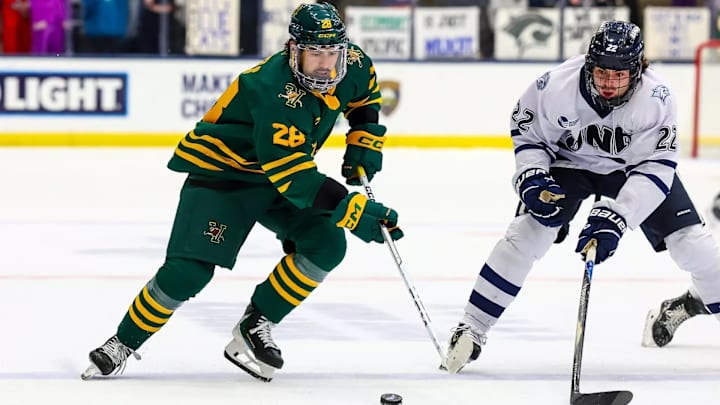
College hockey is a sport that is ever changing. Narratives change on a weekly basis, perennial losers become winners in a year's time, winners fall apart into basement dwellers overnight and the race for gold is coveted by everyone, every single year. No matter what, the status is chaotic in collegiate hockey, that is, unless it's Vermont and New Hampshire in Hockey East.
In three of the last five seasons, the Wildcats have finished in 10th place, and the Catamounts have been last in the 11-team league standings. To further expand on this, in seven out of the last eight years, these two teams were both in the bottom four of the Hockey East standings, in every sense of the word, they are basement dwellers.
Why is that? Both of these universities have had notable success in their other sports programs. In Vermont, the men’s basketball team has been the class of the America East conference, winning the championship six times in the last 13 years, which included a three-peat from 2022 to 2024.
As for the Wildcats, the also found success in football, with three championships in the CAA since joining the conference in 2007. If these Division I schools know how to win, why can’t they put together a cohesive hockey program that can, at the very least, compete?
Part of the answer to that has to be leadership, something that both of these programs used to be known for.
Vermont, which has been a member of Hockey East since 2005, has only made the championship game one time, when it lost to Boston College in 2008. That team was coached by Kevin Sneddon, a Catamount legend in every sense of the word.
When he took the job in 2003, Sneddon had his work cut out for him, as the program was struggling immensely. However, he turned the program around and had the Catamounts competing.
His best stretch was in the later 2000s, which saw the finals appearance, as well as two NCAA tournaments in the following years, including a Frozen Four in 2009. After that, the success was never duplicated, but he had the team at least competing in the middle of the table.
Upon his retirement in 2020, the program had to find his successor to build upon the culture that Sneddon had developed. That man would be Todd Woodcroft, a coach who had previously spent the last four seasons with the Winnipeg Jets, a great hire right?
Wrong. In his four seasons behind the bench, Woodcroft won a mere 25 games, while losing 78. During his tenure his team was constantly blown out and really looked like a second-rate college hockey team. The team only scored 207 goals while surrendering 346 goals. Truly destructive to a program that had worked so hard to be seen as a team that can win against anyone.
When Vermont cut ties with Woodcroft, it turned to former Catamount assistant Steve Wiedler. It's still too early to tell how Wiedler might fare, but his work is certainly cut out for him.
For New Hampshire, nothing has been the same since legendary hall of fame coach Dick Umile retired. During his 28 years as head coach, the Wildcats were always a team to watch out for, as Umile won two Hockey East titles, while making the final on eight different occasions. He was known for being a coach who got the most of his players, and his teams were always a threat, just like Sneddon. UNH has made the Frozen Four seven times, four until Umile, but the most recent was more than 20 years ago, 2003.
However, just like Vermont, the time came to hire a new head coach in 2018 to lead the program forward and they made the decision to bring in former Wildcat player Mike Souza. During his seven full seasons on the bench, UNH has gone 53-90-22, only mustering a joint fifth place finish in the 2023-24 season. The 'Cats have given up 678 goals, while only netting 593 — not a margin that competitive teams have.
Here's the thing, both of these coaches have tried to follow in the footsteps of legends, which is always extremely difficult under any circumstance. Predictably, they weren't able to land the best recruits, or keep pace with the league powers. If anything, the struggles have only reinforced just how good their predecessors really were.
For Wiedler, it is understandable, as it is just his second season in Burlington and he will need more time to get the players playing the way he wants them too. This season appears to be more of the same losing the fans have had to endure over the past decade, including last weekends' sweep by visiting Boston College. However, a foundation for the future could finally be established for the Catamounts.
Freshman goalie Aiden Wright already looks likes one of the best goalies in Hockey East, and good enough to build around. In six games, he's posted a .939 save percentage, while making 200 saves and helping his team secure three victories.
Good hockey teams only go as far as their goalie can carry them. It may not be for this season, but if recruitment in the future can find skaters to put in front of Wright, then Vermont may have the opportunity to accomplish its goal, fielding a competitive roster.
As for New Hampshire, which hasn't made the Hockey East semifinals since 2015, Souza landed a three-year contract extension in March 2024 after posting first winning season since 2013-14. Last year's team had a late-season collapse, and then UNH opened this season with a stunning win at Michigan State, the only setback for the No. 1 Spartans thus far. But since then it's been the typical downward part of the roller coaster, the Wildcats haven't done much and it's beginning to look like another frustrating season.
Part of the problem appears to be the lack of a team identity. Are the Wildcats a defensive team? Offensively heavy, physical? It isn’t clear what UNH wants to be building towards. It used to stack the roster with speed when Whittemore Center's ice size was Olympic-sized 200 by100 feet, but a few years ago changed to the standard 200 x 90 feet. Doing so was thought to help UNH in recruiting and improve the arena's chances of hosting an NCAA regional, but neither has happened.
Souza deserves a chance to succeed, however one good season should not be enough to offset seven losing seasons, and one has to think his time at the helm may be running out if success remains elusive.
Another answer to the complex problem seldom mentioned today is budget and financial struggles. In the world of NIL and transfer portal, these two schools have taken a massive hit in recruitment of high-end talent.
Compared to the likes of Boston College, which benefits from from football and basketball competing in the ACC, these schools do not have that luxury, as they rely on primarily donations for athletics. However, sports aren't often viewed as being a top priority.
"The gap between our revenues and expenses has continued to grow, including by $8.2 million associated with lower than anticipated fall enrollments and significant projected changes in federal funding," UNH President Elizabeth Chilton wrote before the start of the 2025-26 academic calendar.
On top of a hazing scandal, Vermont was hit hard by the Covid epidemic, and saw a significant drop in revenue from sources like ticket sales. In an effort to help mitigate its losses, the ath;letic department implemented cost-saving measures including layoffs, unfilled positions, campus-wide salary reductions, and mandatory unpaid furlough days.
Granted, those issues aren't unique to UNH and UVM, or the financial struggles that have continued, but money doesn't always translate to championships. It's on display on numerous levels, from Boston College hockey, to the Texas schools in football, or even the New York Mets. There has to be leadership, and a vision of what's possible to build greatness.
Vermont and New Hampshire have been in the building phase for far too long and their fans deserve better. At the end of the day, even with financial constraints, there has to be hope that things are going in the right direction. Isn't the excitement of at least having a chance the bare minimum?
 Add us as a preferred source on Google
Jake Messer has been covering hockey and other sports at UMass Lowell. He’s sports editor of the UMass Lowell Connector. “I grew up in Dracut Massachusetts, and as things changed in my life, one thing remained the same throughout, sports. Whether it was the reincarnation of the Big Bad Bruins in the early 2010’s, or the dynasty of the Patriots on the gridiron, or even the new generation Celtics securing a record setting 18th championship, sports has always been a fixture in my life and it will be for many more years to come as I pursue a career in sports journalism.”
Follow real_jakemesser