
Why BYU Coaches Went Conservative on the Final Drive Against UCF
In this story:
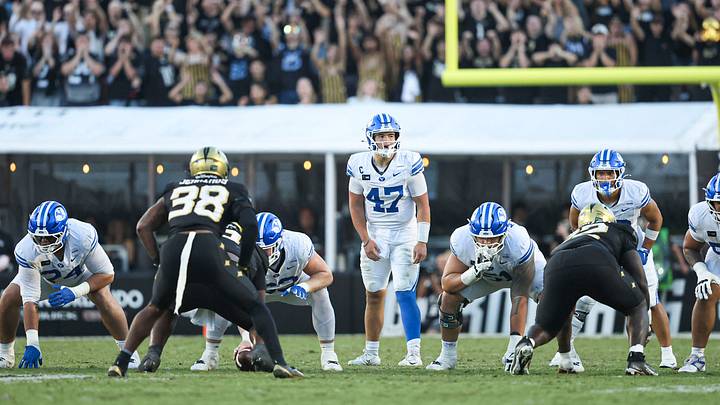
With one minute remaining in the fourth quarter of BYU's loss to UCF, the game was tied at 24. BYU was facing a 3rd & 6 after using the first two downs to get out of the shadow of its own end zone. Instead of throwing the football and trying to move the chains on third down, BYU opted to run the ball and force UCF to burn one of its timeouts. BYU coaches explained their decision to play conservatively at the end of regulation.
"We debated whether to throw a pass there or not," BYU offensive coordinator Aaron Roderick said. "The problem is, if you throw a pass and it's incomplete they get to save one of their timeouts. If you run it, you have a chance to get a first down but at worst case you make them use one of their timeouts, which are critical for them to try to get down and score, so we we elected to run it and make them use one of their timeouts."
Roderick also explained that the weather played a role in the decision as well. "Also the rain there's a factor too, the weather wasn't great...I think we played it smart right there."
Roderick continued, explaining the analytics behind the decision. "If you throw a pass, you've got about a 40%-45% chance of completing a pass on 3rd & 6, that's what the math says if you're a good third down team."
BYU head coach Kalani Sitake was asked about the decision in his press conference on Monday. Sitake admitted it may have been the wrong decision in hindsight.
"We felt good about the run play," Sitake said. "We felt comfortable that our defense can get us to overtime...maybe in hindsight it could have been better to be more aggressive and try to get the first down there, but we felt good about making [UCF] use a timeout and running some clock and possibly with that run play we could get [a first down]."
The Counter Argument to Running the Football in that Spot
To the credit of Sitake and Roderick, their track record in close games speaks for themselves. They have won more one-score games than they have lost, and more often than not, they have made the choice that's given BYU a chance to win. They did manage to get the game to overtime, so based on their reasoning, they made the right decision. However, it required a blocked field goal to get to overtime.
We disagreed with the decision to run the ball on third down for two reasons, so allow us to explain the counter argument to a conservative play call on that final drive of regulation. First and foremost, Bear Bachmeier has been one of the most clutch quarterbacks in the sport. When Bachmeier faced a long third down in overtime, he threw a laser to Legend Glasker for a touchdown. On fourth down in double overtime, Bachmeier threw a catchable pass in tight coverage to Walker Lyons. Earlier in the game on fourth down, Bachmeier went through his progressions and found Kyler Kasper for a first down. Just one week earlier, Bachmeier threw a game-winning touchdown on 3rd & 6 against Notre Dame. Bachmeier is at his best when his back is against the wall.
Because of his track record, Bachmeier has earned the right to go out and win BYU a game, even if the analytics say there is only a 40%-45% chance to get the first down. Bachmeier has multiple game-winning drives in his career - he has a way of defying the odds.
Second, there is an analytical counter-argument to running the football in that spot, especially based on BYU's struggles in the run game against UCF. Now we're going to do something we don't normally do: we're going to use rough estimates for a few numbers since we don't have the same data that BYU is looking at when making these decisions. If there is a 40%-45% chance of getting a first down through the air, what are the odds of getting a first down on the ground? It couldn't be more than 10%-15% when BYU was averaging 3 yards per carry.
Said differently, there was an 85%-90% chance that UCF would get the ball back in premier field position. Fuller Shurtz is averaging 45 yards per punt this season. That means, on average, UCF would get the ball back at midfield with ~50 seconds left on the clock. In that scenario, timeouts wouldn't be necessary to setup a game-winning field goal. UCF would be 10 yards away from attempting a long game-winning field goal.
The game-specific data for this decision is very relevant as well. If BYU was punting the ball to TCU's offense, for example, the Cougars would have had a better chance to prevent a game-winning field goal attempt. Against UCF, BYU only forced three-and-outs on 17% of drives, so when you put all the numbers together: (85%-90% UCF gets ball back) * (83% UCF gets at least one first down). There was a ~70%-75% chance that UCF was going to attempt a game-winning field goal based on our estimates.
Would you rather have a 40%-45% chance to possess the ball and try to win the football game, or would you rather face a 70%-75% chance that your opponent will attempt a game-winning field goal?
BYU was fortunate that Shurtz' punt took a BYU bounce and exceeded his average. His punt traveled 61 yards instead of his 45-yard average. Still, UCF had plenty of time to get in field position even though they didn't have that extra timeout. BYU's defense was struggling to stop the UCF offense, and that's why we believe it was the wrong decision to play conservatively.
There was a 40%-45% chance that BYU would get a first down, then they could transition to two-minute offense and try to win the game. Remember, the score was tied at 24 so BYU only needed a field goal to win. Instead, they erased their chances to win and hoped the game would go to overtime instead.
BYU could find itself in similar positions down the road. Perhaps next time, BYU will put the ball in Bachmeier's hands and let him try to win the game.
Sign up to our free newsletter and follow us on X and Facebook for the latest news.
 Add us as a preferred source on Google

Casey Lundquist is the publisher and lead editor of BYU On SI. He has covered BYU athletics since 2020. During that time, he has published over 3,500 stories that have reached millions of readers.
Follow casey_lundquist