
3 Key Stats That Defined Illinois Football's Loss at UCLA
In this story:
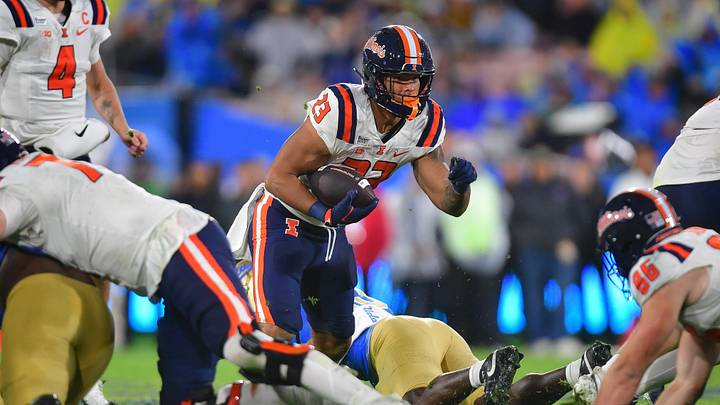
Illinois football hung tough with undefeated UCLA on Friday at Rose Bowl Stadium, but ultimately the Illini fell just short of the firepower needed to break through against the defensive Bruins and fell 22-14.
Illinois (6-4, 4-3 Big Ten) had numerous chances to escape L.A. with a "W," but it could never fully capitalize on any of them. Three stats stood out, and helped define the terms of yet another UCLA win in what has become a magical season for the No. 4 Bruins (10-0, 7-0 Big Ten):
Turnovers
More often than not, the team that wins the turnover margin, wins the game. And that was the case here. Illinois threw three interceptions and got dinged for a safety, while UCLA limited its damage to an interception.
UCLA's defense came into the game as one of the best playmaking defenses in the country, and against Illinois the Bruins showed exactly why. Although UCLA had only two sacks on the night, its defense pressured Illini quarterback Katin Houser over and over, forcing him into bad decisions – including the backbreaker.
Houser's third interception, which he flung with a defender dragging him to the field and fewer than three minutes of game time on the clock, all but finished Illinois. The Bruins converted the turnover into a field goal, and that was more or less that. Speaking of which ...
WHEN IT MATTERS MOST 🤯
— Yahoo Sports (@YahooSports) November 14, 2026
UCLA INTERCEPTS ILLINOIS’ KATIN HOUSER FOR THE THIRD TIME 👀
(via @B1Gfootball) pic.twitter.com/hcE3o65WaG
Points off turnovers
In a game in which points were at a premium and turnovers were plentiful, both teams were able to capitalize on their opponents mistakes. If you include the UCLA safety, the Bruins generated five of its 22 points off turnovers.


AIDEN GOBAIRA WITH THE SAFETY‼️@UCLAFootball gets the big play on defense 😤
— Big Ten Network (@BigTenNetwork) November 14, 2026
Watch on FOX pic.twitter.com/ncNg7Tay4O
By no means is five points off turnovers a lot, but it was the difference in Illinois having to play for three vs. eight on its final drive.
Illinois didn't score any points after picking off Dieffenbach in the second quarter, but the Illini did score a touchdown late in the fourth quarter after stopping the Bruins on fourth down.
Illinois wouldn't have had a chance to tie it up with just over a minute to go if that didn't happen, and give credit to the Illini defense, they did their job.
Explosive plays
Depending on what you consider an explosive play is, this number could vary, but in this instance, we're going to consider an explosive play anything over 20 yards.
And unsurprisingly, UCLA had more explosive plays than Illinois.
The Bruins had four offensive plays north of 20 yards, including one that went for a touchdown, while the Illini only had two.
UCLA's first touchdown came on a total coverage bust, and allowed Aidan Mizell to score on a 54-yard reception on the first offensive series of the game.
UCLA ON THE BOARD EARLY
— FOX College Football (@CFBONFOX) November 14, 2026
Aidan Mizell catches it and takes it to the HOUSE to get an early TD for @UCLAFootball pic.twitter.com/Jm2bIbujza
Mizell later had a 63-yard catch and run in this one, and was hands down UCLA's best offensive player on Friday.
Explosive plays aren't the end all be all, but in a game where points were limited, UCLA's two more explosive plays than Illinois made the difference.
 Add us as a preferred source on Google

Jared Shlensky is a contributing writer for On SI and a freelance play-by-play broadcaster. Jared was previously a sports betting writer for Yardbarker, an On-Air YouTube Personality for the Sports Geek and a minor league play-by-play broadcaster.