
K-State's pass rush will be one of the Big 12’s best and one of the Wildcats’ greatest strengths in 2026
In this story:
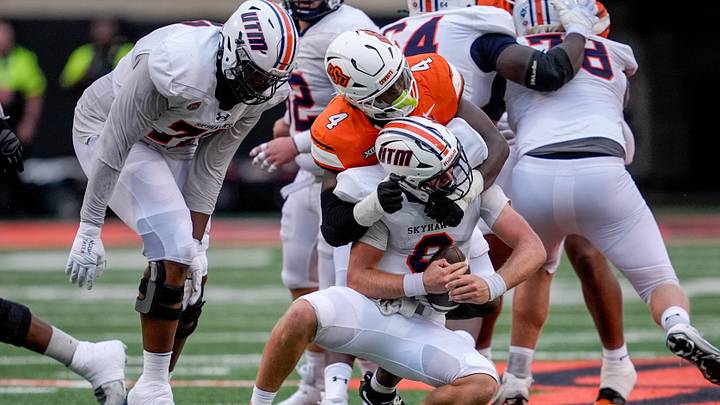
Defenses always want to put opponents in third-and-long situations for obvious reasons. That will be especially important for K-State in 2026, as it will allow defensive coordinator Jordan Peterson to unleash one of his units’ greatest strengths—their ability to pressure the quarterback.
Peterson was the co-defensive coordinator at Texas A&M in 2025, when the Aggies ranked No. 1 nationally with a 10.34% sack rate against FBS opponents. Peterson inherited a K-State defense that ranked top four in the conference in sack rate each of the last two seasons but lost most of its star power upfront, highlighted by the departures of Tobi Osunsamni and Chiddi Obiazor to Indiana and Malcolm Alcorn-Crowder to SMU.
However, K-State added one of the top defensive ends in the portal in Wendell Gregory, who has done nothing but impress the staff since his arrival in Manhattan. The Wildcats also added Elijah Hill from Kennesaw State, who led Conference USA with nine sacks as a true freshman in 2025. Couple those additions with the emergence of Jordan Allen, a former 4-star recruit heading into his senior season, and emerging star Darien Whitaker, and the Wildcats have the makings of a versatile group that can bring pressure from a variety of spots, giving opposing quarterbacks little time to get comfortable in the pocket this season.
Wendell Gregory, 6-foot-3, 265-pound junior
The headliner of the defensive end room is Gregory, who chose K-State over Texas Tech, Texas, Missouri and many other power-four programs this offseason. The 6-foot-3, 265-pound junior defensive end is a preseason All-Big 12 First Team selection in 2026 after recording 12 tackles for loss last season, which ranked second nationally among all freshman and fifth-most among all defenders in the Big 12. Gregory only had four sacks at Oklahoma State in 2025, but his 32 pressures and 17.6% pressure rate were among the highest in the conference, leading to him being named the Big 12 Defensive Freshman of the Year.
Gregory’s pressure rate of over 17% was far higher than Osunsamni or Obiazor, who had an 11.1% and 10.7% pressure rate last season, respectively. Gregory’s 77.2 pass-rush grade from Pro Football Focus (PFF) was also far higher compared to the pair of former Wildcats who left for Indiana.
Additionally, Gregory’s 17.6% pressure rate compared favorably to some of the country’s best pass rushers during the 2025 season. Texas Tech’s David Bailey, who became the No. 2 pick in the 2026 NFL Draft, was in a class of his own, recording a 21.3% pressure rate. Here’s how Gregory stacked up to some of the country’s best edge guys in pressure rate from last season:
- David Bailey (Texas Tech): 21.3%
- Colin Simmons (Texas): 18.3%
- John Henry Daley (Utah): 18.2%
- Wendell Gregory (Oklahoma State): 17.6%
- Elijah Hill (Kennesaw State): 17.5%
- Romello Height (Texas Tech): 17.5%
- Damon Wilson (Missouri): 17.2%
- Reuben Bain Jr. (Miami): 15.3%
Elijah Hill, 6-foot-1, 245-pound sophomore
Hill entered the transfer portal approximately a week before the entry deadline closed, and he wasted no time deciding on his future college choice, committing to K-State less than 48 hours later.
The news of Hill’s addition came just a few days after the Wildcats landed Gregory, giving K-State two of the top 30-ranked defensive ends in the entire transfer portal, according to On3’s transfer portal rankings.
Hill recorded 11.5 tackles for loss as a true freshman at Kennesaw State, earning All-Conference USA First Team honors. His nine sacks led Conference USA—three more than the next closest in the league. His 0.64 sacks per game ranked No. 1 among all freshmen nationally, while ranking No. 30 in the country among all defenders, regardless of classification.
Hill played 299 snaps last season, registering 37 pressures and a 17.5% pressure rate, according to PFF. He received an 87.0 pass rush grade from PFF, a tremendous number.
The knock on Hill is his size. He played at 230 pounds last season, impacting his ability to defend the run. He was on the field for approximately 30% of the opponents’ rushing plays, and recorded a 42.9 run grade, per PFF.
Hill is now heading into his second season of college football. While moving from Conference USA to the Big 12 Conference is a big step, it’s also important to note he’s now in a power-four strength and conditioning program and a year older. Hill missed some of spring ball due to injury, but has put on 15-20 pounds. I don’t anticipate Hill being an every-down defensive end at K-State this season, but look for him to be another weapon Peterson deploys off the edge in pass-rush packages.
Darien Whitaker, 6-foot-3, 246-pound sophomore
Whitaker is likely unknown to most of the country and to many K-State fans. But that won’t last long. The 6-foot-3, 246-pound sophomore missed most of last season after dealing with an injury, but former head coach Chris Klieman and his staff were very high on his potential.
Whitaker arrived at K-State as a hybrid linebacker/edge rusher. K-State has primarily moved him to defensive end, where they believe he will thrive this season and beyond.
Whitaker is a physical specimen with tremendous bend and speed off the edge. I would anticipate many of K-State's third-down pass rush packages to feature Gregory and Whitaker opposite of each other at defensive end, which could have opposing quarterbacks' heads on a swivel.
Whitaker is young and inexperienced. There will be growing pains, particularly when he’s on the field in standard-down situations. But there won’t be many better in the Big 12 at getting after the quarterback in 2026. And everyone in the league will remember his name by December.
Jordan Allen, 6-foot-4, 263-pound senior
Allen came to K-State as a local product with a lot of accolades. The headliner of the 2023 recruiting class was quarterback Avery Johnson, but not far behind him was Allen, who was a 4-star recruit by multiple recruiting outlets. He was the No. 422 player nationally in the 2023 class, and a top-five player in the state of Kansas in what was one of the state’s better classes in a long time. The Olathe South product chose K-State over Oklahoma, who tried to flip him on signing day, as well as offers from the likes of Tennessee, USC and many other power-four programs.
Allen played in all 12 games last season, recording 17 tackles, five tackles for loss, 2.5 sacks and a pass breakup over his 335 defensive snaps.
There has been a lot of buzz this offseason regarding Allen, who heads into his fourth season in Manhattan. He was also named as one of the team’s six captains this past week, signifying what his teammates think of him.
K-State's staff has discussed sliding Allen down inside on the interior at the three-tech spot of the defensive line at times. I would anticipate the Wildcats play him on the inside in passing situations, along with versatile fifth-year player Travis Bates, allowing them to bring pressure from the inside while getting another one of their talented edge rushers on the field in Whitaker, Hill or others.
Jayden Bryant, 6-foot-4, 230-pound junior
Bryant has shown flashes this offseason after transferring from Coastal Carolina, where he played for Jeremiah Johnson, who has since joined Collin Klein’s staff as a defensive backs coach.
The 6-foot-4, 230-pound junior will likely only be utilized in pass rush situations as he continues to get stronger and gain weight. He played in 13 games last season at Coastal Carolina, totaling 16 tackles, 4.5 tackles for loss and 2.0 sacks over 248 defensive snaps.
 Add us as a preferred source on Google
K-State grad serving as the co-host of 3MAW, a K-State podcast on KC Sports Network. Previously covered K-State as the beat writer for the Manhattan Mercury. KC Sports Network is the premier destination for Kansas City sports fans with podcasts, YouTube and social media content. Stay connected with the latest news and analysis by following KCSN on all social media platforms.
Follow kstate_kcsn