
3 Promising Signs from MSU's Successful First Weekend
In this story:
Michigan State has survived and advanced through the first phase of the NCAA Tournament.
The third-seeded Spartans are off to play in the Sweet Sixteen for a second consecutive year. MSU got there by dominating (14) North Dakota State, 92-67, in the first round and then besting (6) Louisville, 77-69, behind a monster Coen Carr performance in the Round of 32. It’s the 17th Sweet Sixteen the program has experienced with Tom Izzo as the head coach across his 28-year streak of reaching the tournament.

Reaching this point is a “separator,” as Izzo called it after the victory over the Cardinals. Teams that just happened to make the tournament or steal a game have been filtered out now. Everybody left has earned it and is a threat.
There are a couple of reasons that popped up on Thursday and Saturday to think Michigan State can “win the weekend” and reach the Final Four for the first time since 2019.
Fears’ 27 Assists

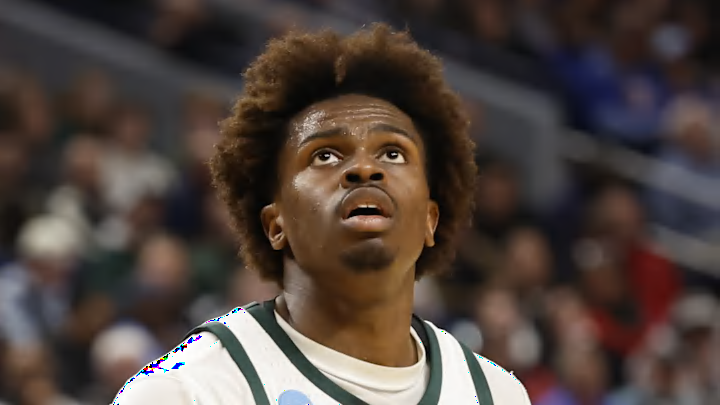
Guard play is always so key in the NCAA Tournament. Jeremy Fears Jr. has been elite all season, but his abilities as a facilitator have only gotten better under the bright lights. Fears dished out 11 assists against NDSU in the first round and then had 16 against Louisville, a program record in March Madness.
Having 27 assists through two games is a pretty insane number. According to ESPN, it’s the most assists over any two-game span in March Madness for a Big Ten player in 50 years, surpassing MSU’s own Magic Johnson.
What comes next is just figuring out the shot a bit. The Spartans have had enough supplemental scoring around Fears (more on that soon), but Michigan State would still definitely like to see Fears shoot better than 5-for-19 (26.3%) from the field through those same two games.
Fears could maybe benefit from the longer break between the Round of 32 and the Sweet Sixteen. His legs may be a bit tired after Louisville after handing in 69 total minutes during the first weekend. MSU will probably need even more than that in Weekend No. 2 in order to reach the Final Four in Indianapolis.
Bench Pieces Rising

One huge development was how much better Michigan State’s bench was in the first weekend. Non-starters contributed 30 points against North Dakota State, and then MSU got 21 from its bench against Louisville.
The season average is 21.6 points per game, but it should be remembered that the rotation tends to tighten in March Madness. There are no more guarantees now, so teams are forced to empty the tank every single game.

What makes it more promising is that the bench has had a different player go off in each round. It was Cam Ward’s night in Round One, as he put up 13 points (his second-most of the season) on a perfect 6-for-6 shooting night.
It was Trey Fort in Round 2. He hit multiple huge threes while coming off the bench, dropping 12 points while receiving 19 minutes, the most playing time he’s gotten in a game since North Carolina on Thanksgiving. He’s 6-for-10 from behind the arc in three games since receiving a DNP in the regular season finale against Michigan.
Better 3-Point Defense

One major problem entering the tournament was the Spartans’ perimeter defense. Dribble penetration leading to kick-outs against UCLA was the kiss of death in the one-and-done trip to Chicago for the Big Ten Tournament, and teams had consistently been hitting threes for a couple of weeks before that.
In the five games prior to North Dakota State, Michigan State had allowed its last five opponents to make at least 10 threes, with four of those opponents shooting at least 45%. Before that stretch, only two teams in the first 27 games had shot at least 45% from three against MSU.
It’s gotten much, much better through two tourney games. The Spartans were able to use their superior athleticism to make dribble penetration nearly impossible against North Dakota State, holding the Bison to 6-for-25 (24.0%) from three, but the real test was going to be against a Louisville team that takes as many threes as anyone.
MSU’s defense held. The Cards went 13-of-37 (35.1%) from deep, which was below their season average. That includes a 4-for-18 (22.2%) start in the first half that allowed Michigan State to build a lead that it never relinquished in the second, even when the triples started to fall for Louisville.

 Add us as a preferred source on Google
A 2025 graduate from Michigan State University, Cotsonika brings a wealth of experience covering the Spartans from Rivals and On3 to his role as Michigan State Spartans Beat Writer on SI. At Michigan State, he was also a member of the world-renowned Spartan marching band for two seasons.
Follow jacobcotsonika