
Why MSU's Fort Earned Rotation Spot Despite UCLA Loss
In this story:
The rotation for Michigan State may not be firmly set in March Madness.
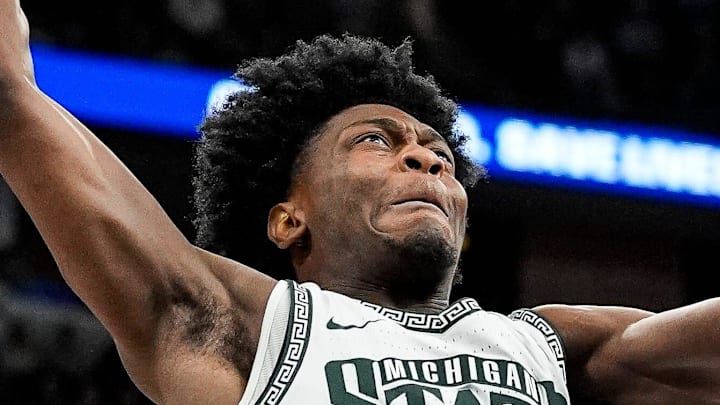
MSU was quickly ousted from the Big Ten Tournament by UCLA on Friday in an 88-84 loss. Not too much went well for the Spartans in Chicago, but one of the silver linings in the loss was Trey Fort's performance off the bench. Fort played his most minutes in more than a month (13), scoring eight points and helping give Michigan State a fighting chance towards the end.

Fort had previously seemed to be one guy who was getting slowly cut out of MSU's rotation entirely. He never saw the court in two of the Spartans' final four regular-season games. Michigan State was playing from behind on Friday, though, so Tom Izzo went to Fort to try and provide that spark.
This is what Fort was brought to East Lansing to do, and it's not the first time that he's taken advantage of an opportunity when he's gotten extended playing time. When the Spartans begin their March Madness run, he should be seeing the court.
Why Fort Should Play

Michigan State is starting to have a bit of a two-guard consistency problem again. Jordan Scott had seemed to be stabilizing things for some time, but he's suddenly been struggling lately. The lone freshman starter for MSU has averaged just 5.2 points on 32% field-goal shooting over his last five games.
Kur Teng has also been up and down all season. He was serviceable against UCLA, dropping 13 points (3-for-8 three-pointers), but his effectiveness is limited on nights when the shots from behind the arc don't drop. There is just a little more inherent randomness involved with Teng, given that more than 60% of his shots are threes.

This means that Izzo might have to do a quick feeling-out process to gauge which of his two-guards, Fort included, is having a good day. Scott still provides the highest ceiling to Michigan State if he's playing well, especially since Izzo often trusts him with the toughest defensive assignment, but the production has dropped.
The real question is about giving the bulk of the remaining minutes there to Teng or Fort. Neither player provides the length Scott does on the defensive end, but they can supplement the scoring over some stretches. They both can also shoot, which is something MSU needs more consistency from in the Big Dance.

Fort hasn't shot the ball quite as well as Teng has, which is partially why Teng plays more. Fort has made 32.9% of his threes this year, while Teng has made 38.1%. During a one-game sample size, though, that can change. Fort has more than enough capability to light it up. He was a 37.9% three-point shooter at Samford last year on 6.4 attempts per game, after all.
If the Spartans can harness that, Fort can make the difference in a close game. What remains to be seen is if Fort will get that opportunity if and when the time comes around.

 Add us as a preferred source on Google
A 2025 graduate from Michigan State University, Cotsonika brings a wealth of experience covering the Spartans from Rivals and On3 to his role as Michigan State Spartans Beat Writer on SI. At Michigan State, he was also a member of the world-renowned Spartan marching band for two seasons.
Follow jacobcotsonika