%22%3E%0A%3Cpath%20d%3D%22M0%200.683105H4.9762L10.6354%207.70833V0.683105H15.9043V16.5874H11.1843L5.28112%209.2451V16.5874H0.0121963V0.683105H0Z%22%20fill%3D%22white%22%2F%3E%0A%3Cpath%20d%3D%22M17.2964%2010.4526V10.4038C17.2964%206.69607%2019.9552%203.87866%2023.6752%203.87866C28.0781%203.87866%2030.1272%206.94%2030.1272%2010.7209C30.1272%2010.9893%2030.1272%2011.3064%2030.1028%2011.5869H22.1262C22.4921%2012.6724%2023.3581%2013.2456%2024.468%2013.2456C25.3949%2013.2456%2026.1755%2012.8188%2026.9927%2011.9772L29.7613%2014.1848C28.5294%2015.7703%2026.7853%2016.8924%2024.1021%2016.8924C20.0406%2016.8924%2017.2842%2014.3189%2017.2842%2010.4648L17.2964%2010.4526ZM25.4315%209.31833C25.3217%208.13527%2024.6143%207.45226%2023.6996%207.45226C22.7848%207.45226%2022.2238%208.18405%2022.0652%209.31833H25.4315Z%22%20fill%3D%22white%22%2F%3E%0A%3Cpath%20d%3D%22M36.5166%2015.1847V16.5873H31.3574V0H36.5166V5.708C37.3581%204.79325%2038.3095%203.89071%2040.1999%203.89071C43.2003%203.89071%2045.542%206.50078%2045.542%2010.2939V10.3427C45.542%2014.27%2043.1759%2016.8923%2040.2487%2016.8923C38.3583%2016.8923%2037.3215%2016.0751%2036.5166%2015.1847ZM40.5414%2010.4037V10.3549C40.5414%209.11084%2039.6511%208.13512%2038.468%208.13512C37.285%208.13512%2036.3946%209.11084%2036.3946%2010.3549V10.4037C36.3946%2011.6355%2037.285%2012.6357%2038.468%2012.6357C39.6511%2012.6357%2040.5414%2011.6599%2040.5414%2010.4037Z%22%20fill%3D%22white%22%2F%3E%0A%3Cpath%20d%3D%22M46.8086%204.1835H51.9677V6.68379C52.6751%205.00067%2053.8094%203.91517%2055.8585%204.00055V9.47681H55.3096C53.1264%209.47681%2051.9677%2010.6843%2051.9677%2013.4285V16.5874H46.8086V4.1835Z%22%20fill%3D%22white%22%2F%3E%0A%3Cpath%20d%3D%22M55.789%2013.0623V13.0135C55.789%2010.5376%2057.6307%209.14717%2060.5091%209.14717C61.558%209.14717%2062.8996%209.3789%2063.4363%209.59844V9.3911C63.4363%208.25682%2062.7289%207.5982%2061.1433%207.5982C59.8749%207.5982%2058.8016%207.86653%2057.7161%208.3056L56.8014%204.87837C58.2284%204.32952%2059.8749%203.96362%2062.0215%203.96362C64.5462%203.96362%2066.1805%204.48808%2067.266%205.57357C68.193%206.50051%2068.5589%207.70797%2068.5589%209.50087V16.5627H63.3997V15.3064C62.5337%2016.2334%2061.3751%2016.8554%2059.8261%2016.8554C57.4356%2016.8554%2055.7646%2015.4894%2055.7646%2013.0379L55.789%2013.0623ZM63.4973%2012.0012V11.4767C63.2046%2011.3669%2062.7533%2011.2694%2062.3142%2011.2694C61.2897%2011.2694%2060.7287%2011.8792%2060.7287%2012.6598V12.7086C60.7287%2013.4404%2061.2531%2013.916%2061.9117%2013.916C62.8265%2013.916%2063.4973%2013.1842%2063.4973%2012.0134V12.0012Z%22%20fill%3D%22white%22%2F%3E%0A%3Cpath%20d%3D%22M69.2422%2015.0876L70.9863%2012.1604C72.4865%2013.0873%2074.1696%2013.5508%2075.5722%2013.5508C76.0723%2013.5508%2076.3162%2013.441%2076.3162%2013.1483V13.0995C76.3162%2012.8556%2076.0844%2012.697%2074.8404%2012.3677C71.7059%2011.5993%2069.7788%2010.7578%2069.7788%208.18431V8.13552C69.7788%205.40349%2071.962%203.89111%2075.1819%203.89111C77.2309%203.89111%2079.2434%204.41556%2080.7435%205.31811L79.1092%208.39165C77.792%207.65985%2076.2064%207.23297%2075.1575%207.23297C74.6574%207.23297%2074.4257%207.36714%2074.4257%207.62326V7.67205C74.4257%207.91598%2074.694%208.07454%2075.9503%208.40384C79.0848%209.17223%2080.9753%2010.0382%2080.9753%2012.5873V12.6361C80.9753%2015.3437%2078.9506%2016.9049%2075.5844%2016.9049C73.1817%2016.9049%2070.9985%2016.295%2069.2178%2015.112L69.2422%2015.0876Z%22%20fill%3D%22white%22%2F%3E%0A%3Cpath%20d%3D%22M82.144%200H87.3032V8.00095L89.962%204.18343H95.5725L91.6818%209.23281L95.6334%2016.5995H90.1084L88.3155%2013.1967L87.291%2014.5139V16.5995H82.1318V0.0121969L82.144%200Z%22%20fill%3D%22white%22%2F%3E%0A%3Cpath%20d%3D%22M95.4873%2013.0623V13.0135C95.4873%2010.5376%2097.329%209.14717%20100.207%209.14717C101.256%209.14717%20102.598%209.3789%20103.135%209.59844V9.3911C103.135%208.25682%20102.427%207.5982%20100.842%207.5982C99.5731%207.5982%2098.4998%207.86653%2097.4143%208.3056L96.4996%204.87837C97.9266%204.32952%2099.5731%203.96362%20101.72%203.96362C104.244%203.96362%20105.879%204.48808%20106.964%205.57357C107.891%206.50051%20108.257%207.70797%20108.257%209.50087V16.5627H103.098V15.3064C102.232%2016.2334%20101.073%2016.8554%2099.5244%2016.8554C97.1338%2016.8554%2095.4629%2015.4894%2095.4629%2013.0379L95.4873%2013.0623ZM103.196%2012.0012V11.4767C102.903%2011.3669%20102.452%2011.2694%20102.012%2011.2694C100.988%2011.2694%20100.427%2011.8792%20100.427%2012.6598V12.7086C100.427%2013.4404%20100.951%2013.916%20101.61%2013.916C102.525%2013.916%20103.196%2013.1842%20103.196%2012.0134V12.0012Z%22%20fill%3D%22white%22%2F%3E%0A%3Cpath%20d%3D%22M0.0121992%2027.7428V27.6941C0.0121992%2022.9496%203.71996%2019.4004%208.46443%2019.4004C11.9648%2019.4004%2014.331%2021.1079%2015.6726%2023.535L11.2818%2026.1085C10.6964%2024.9742%209.85483%2024.1814%208.39124%2024.1814C6.59834%2024.1814%205.41528%2025.7548%205.41528%2027.6575V27.7063C5.41528%2029.7797%206.64713%2031.2311%208.39124%2031.2311C9.89142%2031.2311%2010.733%2030.4139%2011.3916%2029.2308L15.7702%2031.7067C14.4285%2034.0729%2012.2088%2035.9999%208.24489%2035.9999C3.84192%2035.9999%200%2032.6825%200%2027.755L0.0121992%2027.7428Z%22%20fill%3D%22white%22%2F%3E%0A%3Cpath%20d%3D%22M16.1475%2029.4871V29.4383C16.1475%2025.9379%2019.0503%2022.9375%2023.1483%2022.9375C27.2464%2022.9375%2030.1003%2025.8891%2030.1003%2029.3895V29.4383C30.1003%2032.9387%2027.1976%2035.939%2023.0995%2035.939C19.0015%2035.939%2016.1475%2032.9875%2016.1475%2029.4871ZM25.1363%2029.4871V29.4383C25.1363%2028.2064%2024.2216%2027.2307%2023.0873%2027.2307C21.953%2027.2307%2021.0871%2028.2064%2021.0871%2029.3895V29.4383C21.0871%2030.6701%2021.9896%2031.6459%2023.1361%2031.6459C24.2826%2031.6459%2025.1363%2030.6701%2025.1363%2029.4871Z%22%20fill%3D%22white%22%2F%3E%0A%3Cpath%20d%3D%22M31.3447%2023.2421H36.5039V25.7424C37.2113%2024.0593%2038.3456%2022.9738%2040.3946%2023.0591V28.5354H39.8457C37.6626%2028.5354%2036.5039%2029.7429%2036.5039%2032.4871V35.646H31.3447V23.2421Z%22%20fill%3D%22white%22%2F%3E%0A%3Cpath%20d%3D%22M41.3584%2023.2424H46.5175V24.9743C47.3103%2023.9498%2048.5666%2022.9497%2050.3107%2022.9497C52.9207%2022.9497%2054.5551%2024.6816%2054.5551%2027.4746V35.6585H49.3959V29.1334C49.3959%2028.0723%2048.7617%2027.4502%2047.9933%2027.4502C47.225%2027.4502%2046.5175%2028.0601%2046.5175%2029.1334V35.6585H41.3584V23.2546V23.2424Z%22%20fill%3D%22white%22%2F%3E%0A%3Cpath%20d%3D%22M56.1177%2019.0586H61.2768V24.9008C62.0696%2023.8762%2063.3258%2022.9493%2065.07%2022.9493C67.68%2022.9493%2069.3144%2024.6812%2069.3144%2027.4742V35.6581H64.1552V29.133C64.1552%2028.0719%2063.521%2027.4498%2062.7404%2027.4498C61.9598%2027.4498%2061.2646%2028.0597%2061.2646%2029.133V35.6581H56.1055V19.0708L56.1177%2019.0586Z%22%20fill%3D%22white%22%2F%3E%0A%3Cpath%20d%3D%22M70.7656%2031.4256V23.2417H75.9248V29.7669C75.9248%2030.8402%2076.559%2031.45%2077.3396%2031.45C78.1202%2031.45%2078.8154%2030.8402%2078.8154%2029.7669V23.2417H83.9745V35.6456H78.8154V33.9869C78.0226%2035.0114%2076.7663%2035.9383%2075.0222%2035.9383C72.4122%2035.9383%2070.7778%2034.2064%2070.7778%2031.4134L70.7656%2031.4256Z%22%20fill%3D%22white%22%2F%3E%0A%3Cpath%20d%3D%22M84.7178%2034.1462L86.4619%2031.219C87.9621%2032.1459%2089.6452%2032.6094%2091.0478%2032.6094C91.5478%2032.6094%2091.804%2032.4996%2091.804%2032.2069V32.1581C91.804%2031.9142%2091.5722%2031.7556%2090.3282%2031.4263C87.1937%2030.6579%2085.2666%2029.8164%2085.2666%2027.2429V27.1941C85.2666%2024.4621%2087.4498%2022.9497%2090.6697%2022.9497C92.7187%2022.9497%2094.7311%2023.4742%2096.2313%2024.3767L94.597%2027.4502C93.2798%2026.7184%2091.6942%2026.2916%2090.6453%2026.2916C90.1453%2026.2916%2089.9135%2026.4257%2089.9135%2026.6819V26.7306C89.9135%2026.9746%2090.1818%2027.1331%2091.4381%2027.4624C94.5726%2028.2308%2096.4631%2029.0968%2096.4631%2031.6459V31.6947C96.4631%2034.4023%2094.4384%2035.9635%2091.0844%2035.9635C88.6816%2035.9635%2086.4985%2035.3536%2084.7178%2034.1706V34.1462Z%22%20fill%3D%22white%22%2F%3E%0A%3Cpath%20d%3D%22M97.6225%2019.0586H102.782V27.0595L105.441%2023.242H111.051L107.16%2028.2914L111.112%2035.6581H105.587L103.794%2032.2553L102.769%2033.5725V35.6581H97.6104V19.0708L97.6225%2019.0586Z%22%20fill%3D%22white%22%2F%3E%0A%3Cpath%20d%3D%22M110.493%2029.5115V29.4627C110.493%2025.7549%20113.152%2022.9375%20116.871%2022.9375C121.274%2022.9375%20123.323%2025.9988%20123.323%2029.7798C123.323%2030.0481%20123.323%2030.3652%20123.299%2030.6457H115.323C115.688%2031.7312%20116.554%2032.3045%20117.664%2032.3045C118.591%2032.3045%20119.372%2031.8776%20120.189%2031.036L122.958%2033.2436C121.726%2034.8292%20119.982%2035.9512%20117.298%2035.9512C113.237%2035.9512%20110.48%2033.3778%20110.48%2029.5236L110.493%2029.5115ZM118.628%2028.3772C118.518%2027.1941%20117.811%2026.5111%20116.896%2026.5111C116.03%2026.5111%20115.42%2027.2429%20115.262%2028.3772H118.628Z%22%20fill%3D%22white%22%2F%3E%0A%3Cpath%20d%3D%22M124.553%2023.2421H129.712V25.7424C130.419%2024.0593%20131.554%2022.9738%20133.603%2023.0591V28.5354H133.054C130.871%2028.5354%20129.712%2029.7429%20129.712%2032.4871V35.646H124.553V23.2421Z%22%20fill%3D%22white%22%2F%3E%0A%3Cpath%20d%3D%22M133.689%2034.1462L135.434%2031.219C136.934%2032.1459%20138.617%2032.6094%20140.019%2032.6094C140.52%2032.6094%20140.776%2032.4996%20140.776%2032.2069V32.1581C140.776%2031.9142%20140.544%2031.7556%20139.3%2031.4263C136.165%2030.6579%20134.238%2029.8164%20134.238%2027.2429V27.1941C134.238%2024.4621%20136.421%2022.9497%20139.641%2022.9497C141.69%2022.9497%20143.703%2023.4742%20145.203%2024.3767L143.569%2027.4502C142.251%2026.7184%20140.666%2026.2916%20139.617%2026.2916C139.117%2026.2916%20138.885%2026.4257%20138.885%2026.6819V26.7306C138.885%2026.9746%20139.154%2027.1331%20140.41%2027.4624C143.544%2028.2308%20145.435%2029.0968%20145.435%2031.6459V31.6947C145.435%2034.4023%20143.41%2035.9635%20140.056%2035.9635C137.653%2035.9635%20135.47%2035.3536%20133.689%2034.1706V34.1462Z%22%20fill%3D%22white%22%2F%3E%0A%3Cpath%20fill-rule%3D%22evenodd%22%20clip-rule%3D%22evenodd%22%20d%3D%22M155.368%204.36764C161.191%20-1.45588%20170.632%20-1.45588%20176.456%204.36764C182.279%2010.1912%20182.279%2019.6324%20176.456%2025.4559L165.912%2036L155.368%2025.4559C149.544%2019.6324%20149.544%2010.1912%20155.368%204.36764ZM158.009%207.55761C157.948%207.86849%20157.916%208.39718%20157.916%209.14566V10.4189C157.916%2011.1832%20157.948%2011.7198%20158.013%2012.0267C158.078%2012.3317%20158.278%2012.6168%20158.617%2012.8762C158.956%2013.1376%20159.403%2013.3316%20159.958%2013.4623C160.512%2013.593%20161.1%2013.6584%20161.837%2013.6584C162.573%2013.6584%20163.217%2013.591%20163.769%2013.4524C164.322%2013.3158%20164.761%2013.1178%20165.086%2012.8604C165.411%2012.6029%20165.605%2012.3178%20165.666%2012.0069C165.728%2011.6961%20165.759%2011.1674%20165.759%2010.4189V9.14566C165.759%208.38134%20165.728%207.84473%20165.662%207.53781C165.597%207.23287%20165.397%206.94971%20165.058%206.68834C164.72%206.42696%20164.272%206.23291%20163.718%206.10223C163.163%205.97154%20162.536%205.90619%20161.839%205.90619C161.102%205.90619%20160.459%205.97352%20159.906%206.11213C159.352%206.24875%20158.914%206.44677%20158.589%206.70418C158.265%206.9616%20158.071%207.24673%20158.009%207.55761ZM163.276%2024.8638C166.876%2024.8638%20168.557%2024.2064%20168.557%2021.862V21.858V21.3155C168.557%2019.6581%20167.516%2018.971%20164.252%2018.3136C163.278%2018.1136%20162.908%2017.9136%20162.908%2017.3136V16.9414C162.908%2016.6543%20163.177%2016.5117%20163.413%2016.5117C163.749%2016.5117%20163.918%2016.7137%20163.918%2016.9414V18.1136H168.391V17.3988C168.391%2015.4563%20167.347%2014.4266%20163.177%2014.4266C160.15%2014.4266%20157.896%2015.3414%20157.896%2017.3711V17.7433C157.896%2019.5155%20158.805%2020.3155%20162.201%2021.0303C162.28%2021.0472%20162.355%2021.063%20162.427%2021.0781C163.329%2021.2674%20163.647%2021.3341%20163.647%2021.9174V22.2897C163.647%2022.6619%20163.546%2022.8045%20163.142%2022.8045C162.67%2022.8045%20162.637%2022.5471%20162.637%2022.262V21.2897H157.894V21.7471C157.894%2024.149%20159.476%2024.8638%20163.276%2024.8638ZM169.424%2024.5569H173.925V14.7355H169.424V24.5569ZM170.955%2013.5019H173.925V6.06064H171.092V9.411L169.193%206.06064H166.359V13.5019H169.193V10.1199L170.955%2013.5019ZM162.269%2012.152C162.204%2012.2688%20162.055%2012.3262%20161.825%2012.3262L161.827%2012.3282C161.604%2012.3282%20161.459%2012.2767%20161.398%2012.1758C161.336%2012.0748%20161.305%2011.8074%20161.305%2011.3758V7.90068C161.305%207.51852%20161.352%207.28684%20161.445%207.20962C161.538%207.13239%20161.675%207.09279%20161.851%207.09279C162.059%207.09279%20162.198%207.14031%20162.265%207.23734C162.332%207.33239%20162.366%207.55416%20162.366%207.90068V11.3203C162.366%2011.7579%20162.334%2012.0352%20162.269%2012.152Z%22%20fill%3D%22white%22%2F%3E%0A%3C%2Fg%3E%0A%3Cdefs%3E%0A%3CclipPath%20id%3D%22clip0_15191_23649%22%3E%0A%3Crect%20width%3D%22181%22%20height%3D%2236%22%20fill%3D%22white%22%2F%3E%0A%3C%2FclipPath%3E%0A%3C%2Fdefs%3E%0A%3C%2Fsvg%3E%0A)
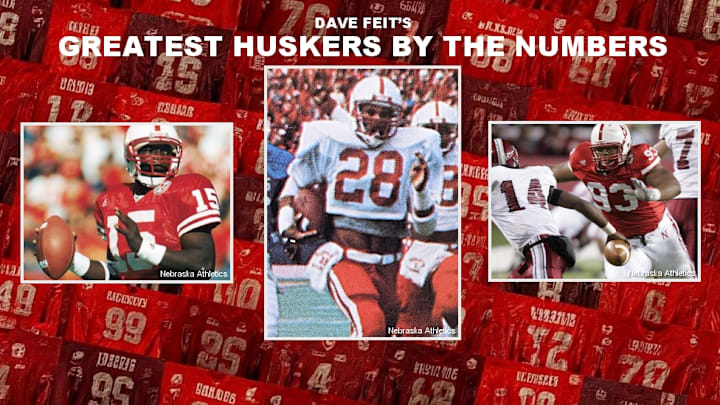
Dave Feit's Greatest Huskers by the Numbers: 28 - Jeff Smith
In this story:
Dave Feit is counting down the days until the start of the 2025 season by naming the best Husker to wear each uniform number, as well as one of his personal favorites at that number. For more information about the series, click here. To see more entries, click here.
Greatest Husker to wear 28: Jeff Smith, I-back, 1980-1984
Honorable Mention: Eric Hagg, Theodore James, Everett Kreizinger
Also worn by: Byerson Cockrell, Frank Collopy, Isaiah Fluellen, Larry Frost, Dave Gillespie, Dave Goeller, Kwinten Ives, Austin Jones, David Liegl, Sevion Morrison, Luke Reimer, Pat Ricketts, Brian Schuster, Adam Taylor, Maurice Washington, Jamel Williams
Dave's Fave: Jamel Williams, Linebacker, 1993-1996
"What if…"
Those two words have sparked thousands of hypothetical discussions and bar room debates among sports fans for generations. It's fun to ponder how things might have turned out if one little thing was different.
Within the Nebraska football world, there are dozens of classic "what if…" scenarios:
- What if Tom Osborne had kept coaching past the age of 60? Or, what if Bill Byrne had overruled Osborne's request to promote Frank Solich?
- What if Solich's revamped staff that went 10-3 in 2003 had gotten another season?
- What if instant replay had existed in 1982 or 1993? Or in 1997?
- What if Osborne had kicked the PAT in the 1984 Orange Bowl instead of going for two? (hold that thought…)
- What if one second had not been added back to the clock in the 2009 Big 12 Championship Game?
- What if Scott Frost's first game against Akron hadn't been rained out?*
*I'll tell you what would have happened if the Akron game hadn't been canceled. The 2018 Huskers still finish 4-8.
Remember, the Bethune Cookman game (a win) replaced Akron on the schedule. The multitude of issues the Scott Frost era Huskers faced would not have magically been avoided if they had beaten a MAC team that went 7-7 the year before. Nothing we saw in Frost’s tenure suggests Nebraska wins six or more games in 2018 if the Akron game is played under cloudless skies.
We could list “what if…” questions all day long.
"What if…" wonderings are not limited to coaches and games. There have been hundreds of players who have had "what if…" careers.
Take another look at the "Also worn by" section at the top. In that list, you'll see five different running backs, most of whom likely left Lincoln thinking "you know, if not for ____, my career would have turned out completely different."
Adam Taylor lost more than 2½ seasons to a multitude of injuries. Mo Washington had legal issues. Four-star recruit Sevion Morrison was one of 13 running backs on the roster* trying to get playing time. Larry Frost (yes, Scott's dad) was a high school legend who struggled to find a role at NU, where he could contribute until his senior season.
*That's not an exaggeration. The 2021 team had 13 running backs. Six of them, including Morrison, Jaquez Yant, Rahmir Johnson, Markese Stepp, Cooper Jewett and Zach Weinmaster, earned letters.

I-back Jeff Smith is also from the "what if…" camp. Heck, he might be the mayor of Whatifsville.
How good an I-back was Jeff Smith? Did we ever really know? Sure, we saw the flashes. He was an excellent punt returner, leading the Big Eight conference twice. In the first 10 quarters of his senior season (1984), he ran for 473 yards. And who can forget his off-the-bench heroics in the 1984 Orange Bowl?
The top-ranked Huskers were trailing by 14 points going into the fourth quarter of the championship game vs. Miami, in Miami. Heisman Trophy winner Mike Rozier was out of the game with an injured ankle.

Jeff Smith stepped up and put the team on his back. A one-yard touchdown got Nebraska close and set up the Huskers' dramatic final drive that started from their own 26 with 1:47 left in the game. Quarterback Turner Gill found Irving Fryar for 29 yards. A 19-yard completion to Ricky Simmons. Irving Fryar dropped a wide-open pass in the end zone.* Gill was nearly sacked on third down.
*Contrary to the conspiracy theories, I do not believe there was any unsavory reason behind the drop. As NBC's Don Criqui said, "Even the great ones have a lapse." If it was intentional, Fryar did one hell of a good job of selling his disappointment.
Trailing Miami by seven points, with a perfect season and national championship hanging in the balance, Nebraska had fourth-and-eight from the Miami 24. There were 57 seconds left in the game.
Tom Osborne called an option play.
On fourth down.
Needing eight yards to keep the season alive.
The 193 Scoring Explosion Huskers - one of the greatest offenses college football has ever known - averaged 6.7 yards per carry.
Turner Gill waited until the absolute last nanosecond and made a perfect pitch. Jeff Smith took it in for a 24-yard touchdown.
Absolutely unreal.

With the score 31-30 (and college football overtime still 13 years away), Osborne had two options:
- Kick the PAT to tie the game, knowing Nebraska would - at worst - share the national championship.
- Go for two, which if successful would give Nebraska a one-point lead.
Osborne never hesitated. He was going for two.* "I don't think you go for a tie in that case," he said. "You try to win the game. We wanted an undefeated season and a clear-cut national championship."
*In a press conference before the game, Osborne and Miami's Howard Schnellenberger were asked if they would play for a tie or try to win. "I hope it doesn't come up, " Osborne said. "I'll be crucified one way or another on that one."
That was one of the few times in his career where Osborne was dead wrong. Osborne's decision to go for two has long been lauded as an example of his character and integrity.
The two-point conversion play - a quick rollout pass to Jeff Smith - was incomplete. Gill's throw was a little behind Smith, which gave Miami's Ken Calhoun an opportunity to knock it away. It was a bitter, gut-wrenching loss.
Despite the ending, that fourth quarter was a top moment in Smith's Husker career. A big part of that is because we never really got to see Smith at his best for an extended period of time. His time with the freshman team in 1980 was cut short due to injuries. With Roger Craig and Rozier on the roster, carries were hard to come by as a sophomore and junior.
When Smith finally got the opportunity to be the featured back in 1984, he got off to an incredible start. But a sprained ankle just before halftime of the UCLA game hindered the rest of his senior season. Doug DuBose seized the opportunity and became the top back before injuries put him on the all-time "what if" team.

Despite all the "what ifs," Jeff Smith left Nebraska as the 10th-leading rusher in school history. Who knows what might have happened in a different time and place?
Let's circle back to the classic "what if…" question: What if Osborne kicks the PAT (or the conversion is successful)?
Back in 2010, ESPN wrote about some of the potential ramifications. Aside from putting the 1983 team into the "greatest of all time" conversation, I'd be most curious to see how the 1983 title would impact Osborne's legacy. Remember, Osborne would lose eight of his next 10 bowl games - often by 20+ points. His "can't win the big one" reputation undoubtedly played a role in the changes that set up the 1990s championship run.
Does the 1990s dominance not happen if Osborne wins in 1983? I guarantee the 1994 championship doesn't taste nearly as sweet without the years of bitter losses.
That's the thing about "what if…" questions. Even the ideal results can have unintended consequences.
***
In 1986, the NCAA enacted Proposition 48 (known colloquially as "Prop 48"). The intention was to set minimum academic standards for incoming college freshmen to be eligible for intercollegiate sports. The standards - which have evolved over the decades - were originally tied to a high schooler's grade point average in core curriculum classes (math, science, English, etc.) and scores on standardized tests like the SAT or ACT.*
*Since we're going to be talking about players from the 1990s, let's use the 1991 standards of a 2.0 GPA in 11 core classes AND a score of 700 on the SAT (or a score of 18 on the ACT). The current standards are different, largely because of research that shows standardized test scores are correlated with socioeconomic status, which could put some minority groups at a disadvantage.
A prospective student-athlete who met both requirements was a "full qualifier" and could practice and play with his or her team as a true freshman. The vast majority of college athletes in the 1990s fell under this classification.
If a high schooler met only one of the requirements (i.e., a 1.75 GPA but an ACT score of 20, or a 2.5 GPA and a SAT score of 650), he or she was known as a "partial qualifier." If neither threshold was met, the player was a "non-qualifier."

In the 1990s, the NCAA allowed schools to recruit and enroll partial and non-qualified student athletes. However, they would not be athletically eligible their first year. They would not even be able to practice or participate in team activities.
Partial and non-qualifiers could earn their eligibility by getting a 2.0 GPA across 24 credit hours during their freshman year. If that hurdle was cleared, the player would enter the following season as a true sophomore (the year of athletic eligibility was lost), but he or she could still redshirt, meaning four years were available to complete three seasons.
Some leagues - notably, the Southwest Conference - did not allow Prop 48 players. In the Big Eight, the individual schools could set their own policies. A rival coach once referred to 1990s Nebraska as a "haven" for non- and partial qualifiers. Osborne's argument was Prop 48 students deserved the right to "pay your own way and prove you can make the grade. If he can pass 24 hours in college with a 2.0 grade average, it seems he ought to be given a chance to play."
The way Osborne's program was structured in the 1990s, not much harm could come from taking a flyer on a Prop 48 prospect. Nebraska's academic supports were excellent, as witnessed by the program's nation-leading number of Academic All-Americans. The teams were large enough - with almost everybody taking a redshirt year - that if a Prop 48 kid didn't make grades, it would not leave a gaping hole on the roster.

But let's be honest: Nebraska didn't take Prop 48 players to be altruistic. The partial and non-qualifiers Nebraska signed were talented, speedy difference-makers. The 1995 Cornhuskers had a dozen Prop 48 players, five of whom were regular starters. Three - Jared Tomich, Christian Peter and Tyrone Williams - have been inducted in the Nebraska Football Hall of Fame, with others likely to join them in the coming years.
Jamel Williams was a great example of the talent Nebraska gained through Prop 48. He was a Parade All-American blue-chip recruit who, if he had been fully qualified, would have been one of the most coveted prospects in his class. Williams came to Nebraska and, as his Huskers.com bio put it, "sat out the 1993 season." In 1994, he moved from rover to linebacker, a position change that would lead to a breakout in 1995. He used his elite speed and explosion to make plays all over the field.
I’ll always remember his sack and safety of Danny Wuerffel in the 1996 Fiesta Bowl. Everybody in the stadium knew Williams was coming, but the Gators could not do anything about it. Wuerffel and Florida never had a chance. As a senior in 1996, Jamel Williams earned second-team All-Big 12 honors. He was drafted by Washington in the fifth round.
As the 1995 season was playing out on the field, a different kind of competition was going on in the meetings to establish the new Big 12 Conference. Partial and non-qualifiers were a hot topic. Nebraska wanted to maintain its status quo. The former SWC teams - led by Texas - did not want any Prop 48 players. At one point, Texas president Bob Berdahl* threatened to pull out of the Big 12 if non-qualifiers were allowed.

The other Big Eight schools, tired of getting beat by Nebraska, backed Texas' proposal to limit each school to four partial qualifiers per year (two men, two women, no more than one per sport). Non-qualifiers were not allowed. The vote was 11-1 with Nebraska the lone dissenter.
In his book "The Transformative Years at Kansas State: The Years of President Jon Wefald from 1986 to 2009," Jon Wefald acknowledged the vote was "aimed directly at Cornhusker football."
"By the late 1990s, this new Big 12 rule has seriously damaged the quality of Nebraska football. In fact, you could say it brought the era of Bob Devaney and Tom Osborne to a close," the former K-State president gloated.
*Later, Berdahl was the president of the Association of American Universities (AAU) in 2011 when the University of Nebraska was voted out. Wefald believes Berdahl could have impacted the vote to allow Nebraska to stay in the prestigious group of leading research universities. He did not, and Nebraska was narrowly voted out.
As Wefald wrote in his book: "The truth is, no outside academic leader has dented Nebraska’s athletic and academic standing over the years more than Bob Berdahl."
Former UNL chancellor Harvey Perlman doesn't look so bad now, does he?
More from Nebraska on SI
Stay up to date on all things Huskers by bookmarking Nebraska Cornhuskers On SI, subscribing to HuskerMax on YouTube, and visiting HuskerMax.com daily.
 Add us as a preferred source on Google
Dave Feit began writing for HuskerMax in 2011. Follow him on Twitter (@feitcanwrite) or Facebook (www.facebook.com/FeitCanWrite)