
Oklahoma State Film Review: Breaking Down Play that Sealed Cowboys' UCF Win
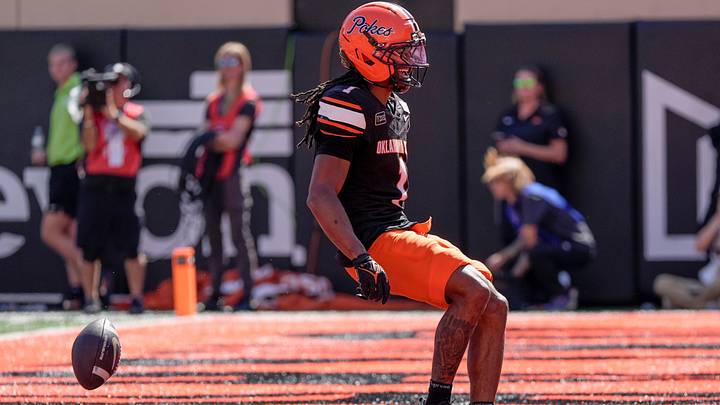
In this story:
It was the most exciting play of the game. It was also one that was probably a week in the making.
Oklahoma State safety Evan Jackson’s scoop and score against UCF was set up by good scouting, good play diagnosis and great anticipation by nickel back Christian Bodnar. Jackson was in the right spot at the right and made a terrific athletic play. But Bodnar — and the scouting that went into that week — made the whole thing happen.
Based on the video of the play, I’ve broken down how it started, the trigger that Bodnar used to figure out what was happening and the mistakes that UCF made that allowed the game-clinching play to happen.
The Pre-Snap Alignment
scoop, there it is
— OSU Cowboy Football (@CowboyFB) October 10, 2026
📺: ESPN2 | @TheEvanJackson pic.twitter.com/LPQaiVpggM
The Cowboys were in their base 4-2-5 scheme. The Knights had five down linemen with quarterback Keyone Jenkins working out of the shotgun. He had a back to his right, one receiver to his left and two receivers to his right. Another receiver went in motion from left to right before the snap.
Bodnar was set up in the slot just inside of UCF’s slot receiver to Jenkins’ right. He was standing on the edge of the OSU logo at the 42-yard line.
UCF had run so many screens to that point that Bodnar and the Cowboys had seen every look the Knights could muster. With a back to Jenkins’ right and another in motion, the Knights were going to do one of two things. They were either going to run the football up the middle, likely to the weak side, or run some kind of screen game to the strong side. They opted for the screen.
The Key

Before the ball is even snapped Bodnar is already starting to slide to the right side. He sees the receiver in motion, and he’s already figured it out. But even as he moves, he keeps his head on Jenkins. The Knights had run the ball well enough that he had to respect the run. But his key is clearly what Jenkins does with the ball. It’s an RPO. If it’s a run, he can head to the edge to help. If it’s a pass, he’s already figured out its coming to his side.
The receiver below him is too far away from Jenkins to be the target. The receiver in the slot is too close to Bodnar to be the target. He’ll get blown up the second he catches the ball. Bodnar knows the target is the receiver in motion and slot receiver is going to be his blocker. The fake handoff didn’t fool Bodnar. He kept moving toward the receiver in motion.
The Mistake(s)

UCF made two mistakes on the play. The first was by the slot receiver. Bodnar, having already diagnosed the play, was going full sprint toward the receiver. Bodnar took a path slightly below the intended receiver. The slot receiver, the blocker in this case, was never set up properly. He drifted backwards to create space from Bodnar and ended up putting himself right in the receiver’s path.
The second was on Jenkins’ part. He must have seen Bodnar coming in to blow up the play. The smart thing would have been to throw it away. Maybe that’s what he thought he was doing because the pass ended up in the ground at the receiver’s feet. But he threw it behind him, or his natural left-handed throwing motion pulled the ball behind the receiver. Either way, it ended up as a backwards pass, which set off the scoop and score.
It didn’t help that when Bodnar and the blocker collided that they fell backwards into the receiver. He simply had no chance to make a play.
The Touchdown

Now go back to the pre-snap. Bodnar is set up in the slot, but Jackson is standing at the 48-yard line on the ‘S’ on the OSU logo at midfield. He appeared to diagnose the same thing. Rewind to the fake handoff. Jackson realizes the slot receiver is staying in to block and because the pass comes out of Jenkins hands quickly, he doesn’t have to help with the receiver on the edge.
By the time the ball is loose Jackson has covered eight yards and is at the UCF 40. The ball is still seven yards away. As Jackson said after the game it was a “see ball, get ball” situation. Jackson leaped over the intended receiver at the 33-yard line and picked the pick the football up in full stride at the 29-yard line and ran for the touchdown. The reality is the play had broken down to the point where he was the only player for either side that had a shot at the football. He could have walked up by that point and picked it up.
From snap to fumble recovery this play took five seconds. In five seconds, Bodnar correctly diagnosed the screen, blew up the play and Jackson correctly diagnosed where the football was going and picked it up to begin his touchdown run. The repetition of the screen game that day certainly helped.
This was a game prep diagnosis and shows much preparation these players put into the game plan each week. Bodnar picked up on the play quickly, knew exactly where to go and knew exactly what to do. And by putting a little extra effort into blowing up a play and because Jackson was in pursuit, it turned into the play that ultimately gave Oklahoma State enough cushion to win.
 Add us as a preferred source on Google
Matthew Postins is the publisher of Oklahoma State on SI. He is an award-winning sports journalist who was formerly the editor of the College Football America Yearbook and covers the Big 12 Conference for Heartland College Sports.
Follow PostinsPostcard