
3 Reasons Penn State Will Beat Minnesota — and 3 Reasons the Nittany Lions Will Lose
In this story:
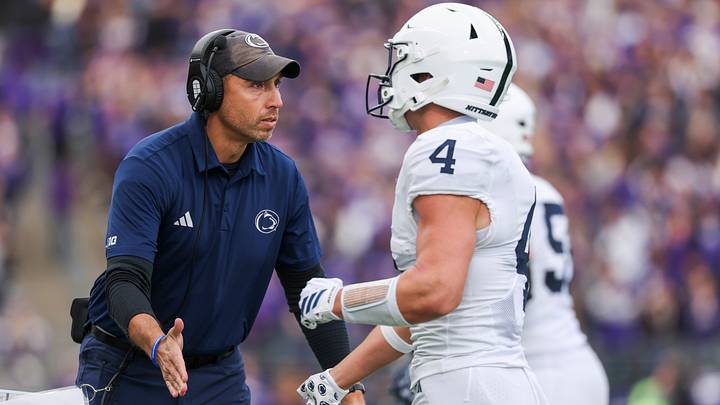
Penn State and Minnesota meet for the 18th time in program history on Saturday, with the winner claiming the Governor’s Victory Bell. That’s probably not the hardware head coach Matt Campbell was expecting in his first year as head coach.
In what seems to be the Nittany Lions’ toughest remaining game, here are three reasons why Penn State will win against the Golden Gophers, and three reasons why it will lose.
Why Penn State will win vs. Minnesota
Minnesota’s rushing offense is struggling

Minnesota enters the weekend ranked 133rd nationally in rushing offense. That’s perfect for a Penn State defense whose kryptonite has been stopping the run. The Nittany Lions rank 83rd in the country in rushing defense, allowing 152.6 yards per game.
The Golden Gophers' rushing leader has actually been solid. TJ Thomas, who leads Minnesota with 400 rushing yards, is averaging 5.8 yards per carry through nine games. The problem is that he splits carries regularly with two other backs: Darius Taylor and Xavier Ford.
Taylor, who has handled the bulk of the Golden Gophers’ carries, is averaging 2.7 rushing yards per game. Minnesota leans on its pass attack, so expect watching a strength on strength matchup on Saturday night, as Penn State holds the third-best passing defense (144.8 ypg) nationally.
Penn State’s running backs are rolling

The Nittany Lions Carson Hansen and Cam Wallace have flipped the script on the Penn State offense. They have combined for 406 yards and four touchdowns the past two contests, helping the offense to score 59 combined points, the most by a wide margin in any two-game stretch in conference play this season.
Hansen is on a five-game touchdown streak, which stretches to Oct. 2 against Northwestern, while Wallace has scored in two straight matchups. Wallace also has a rush of at least 45 yards in two straight games, with three overall this season.
Wallace and Hansen’s explosives have changed the complexity of the Nittany Lions’ offense. They should continue their dominance against a middle-of-the-pack Minnesota defense that surrenders 130.2 rushing yards per game and ranks 112th nationally in explosive-play defense.
The Golden Gophers remain landlocked

Minnesota’s offense doesn't land big plays, with an explosive-play rate of 11.33 percent. And it’s trending in the opposite direction compared to Penn State. The Golden Gophers have made just 14 big plays in the past two weeks, while Penn State has made 20.
The teams are ranked about the same nationally in explosive-play rate (Minnesota is 109th, Penn State is 111th), but the Nittany Lions at least are on the upswing.
In cold temperatures Saturday night in Happy Valley, Penn State-Minnesota could easily be decided by who has more explosive plays. Advantage Nittany Lions.



Why Penn State will lose vs. Minnesota
Penn State’s second-half struggles continue

The Nittany Lions have been outscored 84-40 in the second halves of Big Ten games. In the third quarter alone, Penn State has been outscored 42-9. Campbell said that’s a concern, and rightfully so.
Luckily for the Nittany Lions, Minnesota comes in as the 128th-ranked total offense nationally. The Golden Gophers have also won the second half in only two of six conference matchups. They were outscored by 14 against UCLA, by 11 against Purdue and by eight against Washington.
But Penn State also has a big problem to fix. The defense has averaged 5.87 yards allowed per play on the first drive out of the half in Big Ten games. The offense? It has averaged 3.05 yards per play.
Quarterback Rocco Becht is careless with the football

Becht has thrown five interceptions and lost one fumble in six Big Ten games. When the quarterback turns the ball over, it snowballs. He had three turnovers against Michigan and two against Northwestern, both road losses.
So he needs to emphasize protecting the football against Minnesota. The Golden Gophers feed off takeaways; They’ve forced 11 fumbles (best in Big Ten) and registered nine interceptions for a +6 turnover margin, 18th in the country.
Penn State’s fifth-year quarterback is on pace to throw his fewest interceptions since becoming a starter in 2023. He needs to keep it that way with the spotlight on him in a night game at Beaver Stadium.
Minnesota's special-teams advantage becomes a factor

Two weeks ago, Penn State surrendered a blocked punt to Purdue at Beaver Stadium, while kicker Ryan Barker missed two field goals. Two states west, Minnesota’s Luke Drzewiecki drilled field goals from 51 and 60 yards to give the Golden Gophers the lead twice in the fourth quarter, including what seemed to be a game-winner against Indiana with 19 seconds left.
Minnesota still lost, but it wasn’t his fault.
Drzewiecki owns the second-best field-goal percentage in the Big Ten (89.5 percent) and has one of the strongest legs in the country. Until missing twice last week against UCLA (both from 56 yards), Drzewiecki had made 26 straight field goals, the nation’s longest streak.
He has been significantly better than Barker, who has missed four field goals one year removed from tying Drzewiecki (then at New Mexico) for the national lead with a 94.7-percent success rate. Further, the Golden Gophers’ Quayd Hendryx leads the Big Ten kickoff return average (24.9 ypg), and Javon Tracy is No. 1 in punt returns (16.5 ypg).
Sign up to our free Penn State Nittany Lions newsletter, follow us on social media and add Penn State on SI as a Preferred Source on Google.
 Add us as a preferred source on Google

Chase Fisher is a student at Penn State University who has covered men's hockey and baseball for The Daily Collegian. He is covering football for Penn State on SI. Follow him on X @chase_fisher4.
Follow chase_fisher4