
Midseason Defensive Line Report Card: How Does Tech's Front Four Fare?
In this story:
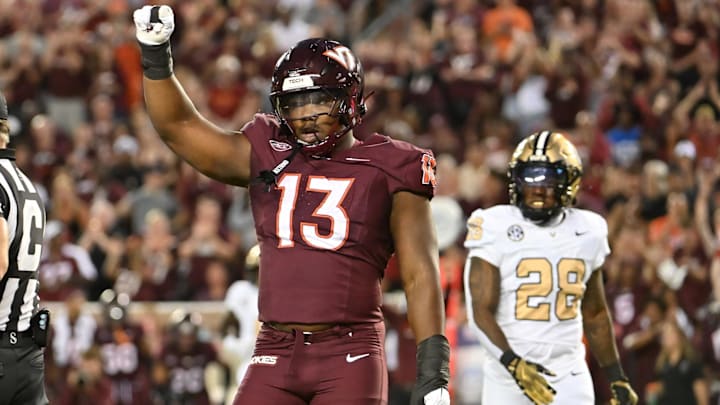
Tech’s defensive line has emerged as one of the steadier groups on a defense that’s struggled for consistency elsewhere. The unit has had its share of rough moments — particularly in the losses to Vanderbilt and Old Dominion — but it’s also produced some of the team’s most complete performances, highlighted by a dominant showing against Wofford in which the Terriers finished with negative rushing yardage.
Here we comee 🙂↕️#ThisIsHome pic.twitter.com/ORXD3Tgorc
— Virginia Tech Football (@HokiesFB) October 11, 2025
Unlike the offensive side of the ball, where injuries and depth issues have necessitated an assortment changes, the Hokies’ defensive line has largely remained intact, except for Keyshawn Burgos transferring and James Djonkam no longer being with the team. That continuity has paid off. The group has established a physical presence at the line of scrimmage and has shown a clear understanding of gap responsibilities. Tech hasn’t been perfect against the run, but has shown growth in how it pursues, contains and finishes plays. In three straight games, spanning from Week 4 vs. Wofford to Week 6 vs. Wake Forest, the Hokies held their opponents to under 100 net rushing yards.
The low points of the season came against Vanderbilt and Old Dominion, when the defensive line failed to maintain gap integrity and allowed opposing backs — and Vanderbilt's signal-caller, Diego Pavia — to break off chunk runs. Against both teams, Tech was pushed backward at key moments, struggling to get off blocks and losing contain on the perimeter.
Those games showed that while the front four has potential, it’s still developing consistency. The unit can dominate inferior competition, as it did against Wofford, but it’s still learning how to sustain that level against stronger offensive lines. Brent Pry’s system relies heavily on defensive line penetration to create disruption, and when that doesn’t happen, the entire structure starts to wobble.
To the group’s credit, it has responded. Since those early struggles, the Hokies’ defensive front has tightened up. The Wofford game, in particular, was the perfect illustration of how good this group can be when it’s clicking. The Terriers finished with –1 net rushing yard, a testament to both gap control and relentless pursuit. The interior line was assertive in one-on-one matchups, collapsing the pocket and blowing up plays before they developed.
That type of performance is exactly what the Hokies need more of. When the front four plays fast and physical, it allows the linebackers to stay clean and the secondary to play more confidently. The defensive line has been the group most capable of setting the tone, and when it does, Tech looks much more composed on that side of the ball.
Behind the starters, depth has quietly improved. Players like Elhadj Fall and Kody Huisman have provided meaningful snaps in rotation, allowing the starters to stay fresher deeper into games. That’s been especially important in the second halves, where the Hokies have tended to wear down in previous years. The ability to rotate without a significant drop-off has been one of the quiet successes of the first half. The starters have done solid thus far, specifically at the tackle spot. Through seven games, Kemari Copeland and Kelvin Gilliam have 24 and 19 tackles, respectively, and have combined for three sacks.
While the unit hasn’t consistently dominated against Power Five competition, the overall progress is clear. The front four is doing enough to keep the defense competitive, even as other areas, particularly in coverage and tackling at the second level, have been more erratic.
If Tech hopes to finish the season on a stronger note, this group will have to continue leading the way. The defensive line’s ability to generate pressure and contain the run is the foundation for everything the defense does well. The secondary has shown flashes, but it depends heavily on the line’s ability to hurry quarterbacks and limit early-down yardage. When the front doesn’t win early, the defense as a whole struggles.
There’s still room for improvement — more consistent gap discipline, fewer over-pursuits and a steadier interior push — but the trajectory is encouraging, leading me to give the defensive line a B. This unit hasn’t been perfect, yet it’s given the Hokies a fighting chance most weeks. Considering the ups and downs elsewhere, that’s saying something.
Virginia Tech football resumes its season in one week with a Week 9 clash against California on Friday, Oct. 24 at 7:30 p.m. ET. The game will be available for viewing on ESPN.
More Virginia Tech Football News:
 Add us as a preferred source on Google
Hughes serves as Virginia Tech On SI's lead editor, a position that he has held since July 2025. Hughes is a junior at Virginia Tech majoring in sports media and analytics. He also serves as the open-wheel correspondent for the motorsports outlet Steering Wheel Nation, where he has written on Formula 1, the NTT IndyCar Series, the NASCAR Cup Series and the NASCAR CRAFTSMAN Truck Series. Hughes has previously authored bylines in 3304 Sports, Virginia Tech's multimedia student journalism outlet.
Follow thomashughes_05