%22%3E%0A%3Cpath%20d%3D%22M0%205.12903H12.8817C17.559%205.12903%2020.5268%206.30107%2022.3762%208.13977C23.9569%209.7204%2024.7848%2011.6881%2024.7848%2014.3978V14.4731C24.7848%2018.3118%2022.7848%2020.9892%2019.5805%2022.5375L25.7203%2031.5052H15.6558L10.6774%2023.9676H8.79565V31.5052H0V5.12903ZM12.6236%2017.6773C14.7311%2017.6773%2016.0107%2016.7311%2016.0107%2015.1182V15.043C16.0107%2013.344%2014.6881%2012.5161%2012.6558%2012.5161H8.81716V17.6773H12.6236Z%22%20fill%3D%22white%22%2F%3E%0A%3Cpath%20d%3D%22M25.8506%2021.3008V21.2256C25.8506%2015.4191%2030.6785%2010.4514%2037.4527%2010.4514C44.2268%2010.4514%2048.9795%2015.3546%2048.9795%2021.1503V21.2256C48.9795%2027.032%2044.1516%2031.9997%2037.3774%2031.9997C30.6032%2031.9997%2025.8506%2027.0965%2025.8506%2021.3008ZM40.7752%2021.3008V21.2256C40.7752%2019.1933%2039.2699%2017.5697%2037.3882%2017.5697C35.5064%2017.5697%2034.0763%2019.1933%2034.0763%2021.1503V21.2256C34.0763%2023.2578%2035.5817%2024.8814%2037.4634%2024.8814C39.3451%2024.8814%2040.7752%2023.2578%2040.7752%2021.3008Z%22%20fill%3D%22white%22%2F%3E%0A%3Cpath%20d%3D%22M50.4629%2021.3762V21.301C50.4629%2014.7849%2054.3768%2010.4516%2059.237%2010.4516C62.3661%2010.4516%2064.0972%2011.8064%2065.4198%2013.2795V4H73.9681V31.5052H65.4198V28.9784C64.022%2030.4837%2062.4413%2031.9891%2059.3123%2031.9891C54.3338%2031.9891%2050.4629%2027.6558%2050.4629%2021.3655V21.3762ZM65.6133%2021.258V21.1827C65.6133%2019.1505%2064.1402%2017.4945%2062.1833%2017.4945C60.2263%2017.4945%2058.7532%2019.1182%2058.7532%2021.1827V21.258C58.7532%2023.3332%2060.2263%2024.9461%2062.1833%2024.9461C64.1402%2024.9461%2065.6133%2023.3225%2065.6133%2021.258Z%22%20fill%3D%22white%22%2F%3E%0A%3Cpath%20d%3D%22M76.0537%2021.3333V21.2581C76.0537%2015.1183%2080.4623%2010.4409%2086.6451%2010.4409C93.9569%2010.4409%2097.3439%2015.5269%2097.3439%2021.7849C97.3439%2022.2366%2097.3439%2022.7634%2097.3009%2023.215H84.0752C84.6773%2025.0215%2086.1074%2025.9677%2087.9569%2025.9677C89.5053%2025.9677%2090.7848%2025.2473%2092.1397%2023.8602L96.731%2027.5161C94.6988%2030.1505%2091.7956%2031.9999%2087.344%2031.9999C80.6021%2031.9999%2076.043%2027.7419%2076.043%2021.3333H76.0537ZM89.5375%2019.4516C89.344%2017.4946%2088.1827%2016.3656%2086.6773%2016.3656C85.172%2016.3656%2084.2257%2017.5699%2083.9677%2019.4516H89.5483H89.5375Z%22%20fill%3D%22white%22%2F%3E%0A%3Cpath%20d%3D%22M98.7305%2021.3008V21.2256C98.7305%2015.4191%20103.558%2010.4514%20110.333%2010.4514C117.107%2010.4514%20121.859%2015.3546%20121.859%2021.1503V21.2256C121.859%2027.032%20117.031%2031.9997%20110.257%2031.9997C103.483%2031.9997%2098.7305%2027.0965%2098.7305%2021.3008ZM113.655%2021.3008V21.2256C113.655%2019.1933%20112.15%2017.5697%20110.268%2017.5697C108.386%2017.5697%20106.956%2019.1933%20106.956%2021.1503V21.2256C106.956%2023.2578%20108.462%2024.8814%20110.343%2024.8814C112.225%2024.8814%20113.655%2023.2578%20113.655%2021.3008Z%22%20fill%3D%22white%22%2F%3E%0A%3Cpath%20fill-rule%3D%22evenodd%22%20clip-rule%3D%22evenodd%22%20d%3D%22M131.368%204.36764C137.191%20-1.45588%20146.632%20-1.45588%20152.456%204.36764C158.279%2010.1912%20158.279%2019.6324%20152.456%2025.4559L141.912%2036L131.368%2025.4559C125.544%2019.6324%20125.544%2010.1912%20131.368%204.36764ZM134.009%207.55761C133.948%207.86849%20133.916%208.39718%20133.916%209.14566V10.4189C133.916%2011.1832%20133.948%2011.7198%20134.013%2012.0267C134.078%2012.3317%20134.278%2012.6168%20134.617%2012.8762C134.956%2013.1376%20135.403%2013.3316%20135.958%2013.4623C136.512%2013.593%20137.1%2013.6583%20137.837%2013.6583C138.573%2013.6583%20139.217%2013.591%20139.769%2013.4524C140.322%2013.3158%20140.761%2013.1178%20141.086%2012.8604C141.411%2012.6029%20141.605%2012.3178%20141.666%2012.0069C141.728%2011.6961%20141.759%2011.1674%20141.759%2010.4189V9.14566C141.759%208.38134%20141.728%207.84473%20141.662%207.53781C141.597%207.23287%20141.397%206.94972%20141.058%206.68834C140.72%206.42696%20140.272%206.23291%20139.718%206.10223C139.163%205.97154%20138.536%205.90619%20137.839%205.90619C137.102%205.90619%20136.459%205.97352%20135.906%206.11213C135.352%206.24875%20134.914%206.44677%20134.589%206.70418C134.265%206.9616%20134.071%207.24673%20134.009%207.55761ZM139.276%2024.8638C142.876%2024.8638%20144.557%2024.2064%20144.557%2021.862V21.858V21.3155C144.557%2019.6581%20143.516%2018.971%20140.252%2018.3136C139.278%2018.1136%20138.908%2017.9136%20138.908%2017.3136V16.9414C138.908%2016.6543%20139.177%2016.5117%20139.413%2016.5117C139.749%2016.5117%20139.918%2016.7137%20139.918%2016.9414V18.1136H144.391V17.3988C144.391%2015.4563%20143.347%2014.4266%20139.177%2014.4266C136.15%2014.4266%20133.896%2015.3414%20133.896%2017.3711V17.7433C133.896%2019.5155%20134.805%2020.3155%20138.201%2021.0303C138.28%2021.0472%20138.355%2021.063%20138.427%2021.0781C139.329%2021.2674%20139.647%2021.3341%20139.647%2021.9174V22.2897C139.647%2022.6619%20139.546%2022.8045%20139.142%2022.8045C138.67%2022.8045%20138.637%2022.5471%20138.637%2022.262V21.2897H133.894V21.7471C133.894%2024.149%20135.476%2024.8638%20139.276%2024.8638ZM145.424%2024.5569H149.925V14.7355H145.424V24.5569ZM146.955%2013.5019H149.925V6.06064H147.092V9.411L145.193%206.06064H142.359V13.5019H145.193V10.1199L146.955%2013.5019ZM138.269%2012.152C138.204%2012.2688%20138.055%2012.3262%20137.825%2012.3262L137.827%2012.3282C137.604%2012.3282%20137.459%2012.2767%20137.398%2012.1757C137.336%2012.0748%20137.305%2011.8074%20137.305%2011.3758V7.90068C137.305%207.51852%20137.352%207.28684%20137.445%207.20962C137.538%207.13239%20137.675%207.09279%20137.851%207.09279C138.059%207.09279%20138.198%207.14031%20138.265%207.23734C138.332%207.33239%20138.366%207.55416%20138.366%207.90068V11.3203C138.366%2011.7579%20138.334%2012.0352%20138.269%2012.152Z%22%20fill%3D%22white%22%2F%3E%0A%3C%2Fg%3E%0A%3Cdefs%3E%0A%3CclipPath%20id%3D%22clip0_15247_3552%22%3E%0A%3Crect%20width%3D%22157%22%20height%3D%2236%22%20fill%3D%22white%22%2F%3E%0A%3C%2FclipPath%3E%0A%3C%2Fdefs%3E%0A%3C%2Fsvg%3E%0A)
Cowboy Soul, Nitro Fuel: Scott Palmer Keeps Defying Odds on Racing’s Wildest Stage
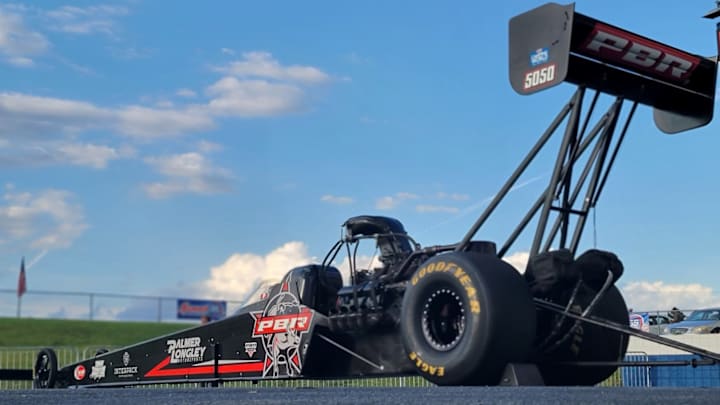
Scott Palmer stood in victory lane in Columbus last July, doused in foamy beer, grinning. He was ecstatic to be the fastest, of course. But more than the win, Palmer was thankful and aware of fortune much grander.
He was alive and well. Pretty remarkable after what happened in Kansas two summers before.
That August, Palmer was racing one of the most powerful Top Fuel Pro Mod cars ever to roll onto a racetrack. He had put the drive train of a dragster into a 1953 Studebaker body, creating a hulking 12,000-horsepower nitro-fueled land rocket he named “Studezilla.”
During an exhibition run at Mid America Dragway in Geuda Springs, Kansas, Palmer bombed halfway down the track but stayed on the gas too long. The streaking black Studebaker got sideways, hit the right side concrete wall, exploded into a fireball, veered across the track to slam the other wall, and barrel rolled.
“Complete driver error,” Palmer says. “Push it, that’s part of the deal. It’s like bull riding. Mess with the bull long enough, you’re gonna get the horns.”
Studezilla bucked Palmer into hospital’s head trauma unit for a week. He had five surgeries on his arm, wrist, hand and fingers. Still, the racing community agrees it’s a miracle – or close to one – that Palmer’s injuries weren’t fatal.
Palmer dodged the Grim Reaper. But more than abundant gratitude, his predominant emotion turned into restless ambition. Rehab hurt; what hurt more was being sidelined from racing. Within months, he was rolling on his stool across the shop floor in Missouri, his one good arm holding a Milwaukee cordless impact to work on his cars.

While Palmer has been racing Top Fuel dragsters for decades in a regulation helmet, when strapping into the claustrophobic, bare-bones cockpit of the PBR dragster, he might as well be wearing a cowboy hat.
He looks up to cowboys and likes hanging out with cowboys. He uses cowboy euphemisms and tries his best to act like a cowboy, which to Palmer means working hard, being true to your word, and doing things for the right reasons.
Known as “The People’s Champ,” Palmer will sign every autograph, speak to any approaching fan, and never blow off a photo request. At every race, he welcomes fans into the pits to see his race machine up close. Even when losing, he leaves the dragster out for everyone to enjoy.
“What’s the point of success if you can’t share it?” he asks.
During race season, Palmer’s voice mail is usually full – which is what happens when the sport’s most beloved driver gives his mobile phone number to any fan who asks for it. The calls aren’t a hassle. They’re a reminder of who ultimately pays the bills. Without the fans, he’s unemployed.

In a sport where big brands spend big dollars to buy speed, Palmer is a workingman’s throwback – the perennial independent underdog, eschewing corporate deals that would put him under the less-experienced thumb of others dictating how things are done. He works for only himself. Which means he’s almost always working – perpetually servicing the race cars, handcrafting the parts in his shop in Cassville, Missouri.
Other racing operations have more cash and mechanics; nobody matches Scott Palmer in elbow grease or stubborn will.
Incredibly, the independent driver has finished in the Top 10 twice in recent NHRA (National Hot Rod Association) seasons.
His win in Columbus came in the IHRA (International Hot Rod Association), which has lived in the shadow of NHRA for decades but had a comeback year in 2025 with plans for more races, bigger purses and a national championship in 2026. Palmer plans to run the full ten-race schedule along with select NHRA events as he guns for the IHRA title.
His two Top Fuel dragsters will again feature PBR paint schemes in his fourth year of unconventional alignment. PBR, which claims to serve up the most exciting 8 seconds in sports, has found a kindred partner in the humble fan-first racer who tears down the track at 330 mph in the fastest 3.7 seconds in sports.
“It’s hard to explain how much it means to have PBR Teams on this car,” Palmer said. “The partnership is a huge honor to me. I truly love the sport.”

How PBR Teams came to adorn Palmer’s Top Fuel dragster is a story linking old-fashioned cowboy friendships and gut-punch tragedy that periodically visits the bull riding community.
Moving his race shop to Missouri more than 15 years ago, Palmer lived in Exeter, hometown of star bull rider Mason Lowe.
New to town, Palmer patronized a local sports bar called Jersey’s. Coming from outside Springfield, Missouri, he wasn’t exactly a city slicker but still radiated a foreign vibe in an insular small-town joint.
One night at the sports bar, a motley assortment of homegrown rednecks nobody would confuse with a local meeting of the Mensa society was giving Palmer trouble. Stu Crowe, PBR’s reliable arena safety man, was there. Crowe only knew Palmer by sight. That didn’t matter. On a basic human level, he was sympathetic to an unfair situation unfolding. Crowe walked over with authority and promptly ironed things out.
Chatting with Palmer, Crowe came to view him as a fellow cowboy as much as a professional racer. The two became fast friends.
“I didn’t know Stu’s last name for three years. He was just ‘Cowboy Stu’ to me,” Palmer said.
Palmer settled in as a regular at Jersey’s and got to know Mason Lowe, Exeter’s pride and joy, a kid who would show up and flash an impish grin, revealing a missing tooth, then go on to win the bull riding. The rising PBR star was tragically killed in a bull riding accident at the Denver stock show in January 2020. He was 25.

After Lowe died, Crowe put together a benefit rodeo drawing top riders. The event wasn’t far from Palmer’s shop, and Crowe would bring the bull riders over to check out the race cars, drink beer, and tell Mason Lowe stories.
“The talk was always that we should do something together – bull riding and the race team,” Palmer said.
In mid-summer 2023 a partnership came together with the PBR Teams Top Fuel Dragster. Palmer also put the PBR Teams logo on the “Studezilla” and a nitro-fueled 1970 Chevelle, both equipped with 12,000-horsepower engines, making them two of the wildest and most dangerous cars on earth.
Palmer’s 1963 Corvette Outlaw Pro Mod also sported a PBR Teams paint scheme.
As sensually arresting as top-tier professional drag racing is, Palmer is blown away by bull riding.
“It’s an awesome spectacle – probably the greatest show on earth,” he said.
The People’s Champ loves the sport’s optimistic family feel, the riders all pulling for one another.
“You look up at the big screen and you see there are riders who bucked off every time they got on – not a single ride,” he said. “And the announcers promote it like, ‘This kid has all the tools and is about to hit a hot streak! Watch out for this cowboy!’ It’s all positive encouragement. PBR has the best announcers I’ve ever heard.”

His love of ground-shaking racecars began in Marlow, Oklahoma, watching his dad race in the area and learning from him how to paint cars.
“That’s what you did then; you worked,” Palmer remembers. “Dad said, ‘If you don’t like it enough, you’ll get an education and do something else. You’ll never starve if you have a trade.’”
Palmer moved to Missouri where the economy was better, a hot rod inevitably in the driveway. He leaned on his trade, painting cars in a detached garage while beginning to race locally, meeting the right people, and drawing support.
When someone asked about his hobbies, he’d say, “Racing is my golfing, fishing, and deer hunting.” He disappeared for days in the garage working on his cars.
“I was obsessed with racing, and people saw that passion and started helping me,” Palmer said. Whatever he earned was pumped back into the race team, which turned into a multimillion-dollar operation.
Most drag race teams have up to a dozen full time employees. Palmer has himself; crew members from California to New Jersey pitch in part time at the shop and racetrack.
Getting back on the podium in Columbus and with runs like a record-breaking blast down Mo-Kan Dragway in Asbury, MO, setting the best track mark in the eighth and quarter mile, he’s never lost the kid-in-a-candy-store enthusiasm around racecars.
Even amid calamity.
Down in Bradenton, Florida last February, he was racing his 1963 Corvette when the throttle stuck. The car zoomed past the run-off area into a strawberry field, barrel-rolling a dozen times at nearly 200 MPH. Palmer made sure to pull his bad arm close to his body. The car disintegrated; he walked away. The good-natured driver has since received ample shipments of fresh strawberries and strawberry shirts and strawberry jackets and mugs and trinkets.
“Bull riders have a bad wreck and get hurt – they come back,” he said. “It was important to walk out of that strawberry field for the TV coverage. It looked like Big Foot clearing the tree line. I represent PBR; you gotta get up and walk out. (Two-time world champion) J.B. Mauney said, ‘If you can’t walk out, you crawl out.’ That’s the mentality I have.”
Drag racing is amid an offseason lasting about three months. Teams head back to the track for testing in February. Until then, outside of a few trips to Florida to run in winter series Pro Mod races, Palmer will be servicing his cars every day.
“We’ll have Christmas, and I’ll go to the shop later that day,” he said. “But I’m not going to work. I’m going to do what I love.”
He’s even more optimistic for the prospects of a small independent race team with the IHRA under the ownership of businessman Darryl Cuttell, who recently bought the association along with seven racetracks. Cuttell wants to rebuild the second-largest drag racing sanctioning body through increasing driver pay, creating a credible national championship, and striking a media deal with SPEED SPORT 1 for live streaming and TV coverage
Palmer, 62, has no plans to slow down, figuratively or literally. He points out John Force retired at 75. His retirement plan? “Whatever the price of whatever scrap metal is when I am done.”
Until then he’ll be racing and relentlessly promoting PBR, but not due to contractual obligations.
“This is not your normal sponsorship deal,” he said. “I represent PBR; I want my fans to become PBR fans and race fans to be introduced to bull riding. I already see it happening. You can’t believe how many rodeo and race fans are out there. Now let’s get them in the same tent!”
The sport of bull riding is fortunate to have The People’s Champ – a humble, tough, friendly determined cowboy – as one of its most enthusiastic champions.
More Rodeo News
 Add us as a preferred source on Google
Andrew Giangola, who has held high-profile public relations positions with Pepsi-Cola, Simon & Schuster, Accenture, McKinsey & Co., and NASCAR, now serves as Vice President, Strategic Communications for PBR. In addition to serving in high-profile public relations positions over the past 25 years, Andrew Giangola is the author of the critically acclaimed books The Weekend Starts on Wednesday: True Stories of Remarkable NASCAR Fans and Love & Try: Stories of Gratitude and Grit in Professional Bull Riding, which benefits injured bull riders and was named the best nonfiction book of 2022 at the 62nd Annual Western Heritage Awards. Giangola graduated from Fordham University, concentrating in journalism, when he was able to concentrate. He lives in Brooklyn with his wife Malvina.