%22%3E%0A%3Cpath%20d%3D%22M0%205.12903H12.8817C17.559%205.12903%2020.5268%206.30107%2022.3762%208.13977C23.9569%209.7204%2024.7848%2011.6881%2024.7848%2014.3978V14.4731C24.7848%2018.3118%2022.7848%2020.9892%2019.5805%2022.5375L25.7203%2031.5052H15.6558L10.6774%2023.9676H8.79565V31.5052H0V5.12903ZM12.6236%2017.6773C14.7311%2017.6773%2016.0107%2016.7311%2016.0107%2015.1182V15.043C16.0107%2013.344%2014.6881%2012.5161%2012.6558%2012.5161H8.81716V17.6773H12.6236Z%22%20fill%3D%22white%22%2F%3E%0A%3Cpath%20d%3D%22M25.8506%2021.3008V21.2256C25.8506%2015.4191%2030.6785%2010.4514%2037.4527%2010.4514C44.2268%2010.4514%2048.9795%2015.3546%2048.9795%2021.1503V21.2256C48.9795%2027.032%2044.1516%2031.9997%2037.3774%2031.9997C30.6032%2031.9997%2025.8506%2027.0965%2025.8506%2021.3008ZM40.7752%2021.3008V21.2256C40.7752%2019.1933%2039.2699%2017.5697%2037.3882%2017.5697C35.5064%2017.5697%2034.0763%2019.1933%2034.0763%2021.1503V21.2256C34.0763%2023.2578%2035.5817%2024.8814%2037.4634%2024.8814C39.3451%2024.8814%2040.7752%2023.2578%2040.7752%2021.3008Z%22%20fill%3D%22white%22%2F%3E%0A%3Cpath%20d%3D%22M50.4629%2021.3762V21.301C50.4629%2014.7849%2054.3768%2010.4516%2059.237%2010.4516C62.3661%2010.4516%2064.0972%2011.8064%2065.4198%2013.2795V4H73.9681V31.5052H65.4198V28.9784C64.022%2030.4837%2062.4413%2031.9891%2059.3123%2031.9891C54.3338%2031.9891%2050.4629%2027.6558%2050.4629%2021.3655V21.3762ZM65.6133%2021.258V21.1827C65.6133%2019.1505%2064.1402%2017.4945%2062.1833%2017.4945C60.2263%2017.4945%2058.7532%2019.1182%2058.7532%2021.1827V21.258C58.7532%2023.3332%2060.2263%2024.9461%2062.1833%2024.9461C64.1402%2024.9461%2065.6133%2023.3225%2065.6133%2021.258Z%22%20fill%3D%22white%22%2F%3E%0A%3Cpath%20d%3D%22M76.0537%2021.3333V21.2581C76.0537%2015.1183%2080.4623%2010.4409%2086.6451%2010.4409C93.9569%2010.4409%2097.3439%2015.5269%2097.3439%2021.7849C97.3439%2022.2366%2097.3439%2022.7634%2097.3009%2023.215H84.0752C84.6773%2025.0215%2086.1074%2025.9677%2087.9569%2025.9677C89.5053%2025.9677%2090.7848%2025.2473%2092.1397%2023.8602L96.731%2027.5161C94.6988%2030.1505%2091.7956%2031.9999%2087.344%2031.9999C80.6021%2031.9999%2076.043%2027.7419%2076.043%2021.3333H76.0537ZM89.5375%2019.4516C89.344%2017.4946%2088.1827%2016.3656%2086.6773%2016.3656C85.172%2016.3656%2084.2257%2017.5699%2083.9677%2019.4516H89.5483H89.5375Z%22%20fill%3D%22white%22%2F%3E%0A%3Cpath%20d%3D%22M98.7305%2021.3008V21.2256C98.7305%2015.4191%20103.558%2010.4514%20110.333%2010.4514C117.107%2010.4514%20121.859%2015.3546%20121.859%2021.1503V21.2256C121.859%2027.032%20117.031%2031.9997%20110.257%2031.9997C103.483%2031.9997%2098.7305%2027.0965%2098.7305%2021.3008ZM113.655%2021.3008V21.2256C113.655%2019.1933%20112.15%2017.5697%20110.268%2017.5697C108.386%2017.5697%20106.956%2019.1933%20106.956%2021.1503V21.2256C106.956%2023.2578%20108.462%2024.8814%20110.343%2024.8814C112.225%2024.8814%20113.655%2023.2578%20113.655%2021.3008Z%22%20fill%3D%22white%22%2F%3E%0A%3Cpath%20fill-rule%3D%22evenodd%22%20clip-rule%3D%22evenodd%22%20d%3D%22M131.368%204.36764C137.191%20-1.45588%20146.632%20-1.45588%20152.456%204.36764C158.279%2010.1912%20158.279%2019.6324%20152.456%2025.4559L141.912%2036L131.368%2025.4559C125.544%2019.6324%20125.544%2010.1912%20131.368%204.36764ZM134.009%207.55761C133.948%207.86849%20133.916%208.39718%20133.916%209.14566V10.4189C133.916%2011.1832%20133.948%2011.7198%20134.013%2012.0267C134.078%2012.3317%20134.278%2012.6168%20134.617%2012.8762C134.956%2013.1376%20135.403%2013.3316%20135.958%2013.4623C136.512%2013.593%20137.1%2013.6583%20137.837%2013.6583C138.573%2013.6583%20139.217%2013.591%20139.769%2013.4524C140.322%2013.3158%20140.761%2013.1178%20141.086%2012.8604C141.411%2012.6029%20141.605%2012.3178%20141.666%2012.0069C141.728%2011.6961%20141.759%2011.1674%20141.759%2010.4189V9.14566C141.759%208.38134%20141.728%207.84473%20141.662%207.53781C141.597%207.23287%20141.397%206.94972%20141.058%206.68834C140.72%206.42696%20140.272%206.23291%20139.718%206.10223C139.163%205.97154%20138.536%205.90619%20137.839%205.90619C137.102%205.90619%20136.459%205.97352%20135.906%206.11213C135.352%206.24875%20134.914%206.44677%20134.589%206.70418C134.265%206.9616%20134.071%207.24673%20134.009%207.55761ZM139.276%2024.8638C142.876%2024.8638%20144.557%2024.2064%20144.557%2021.862V21.858V21.3155C144.557%2019.6581%20143.516%2018.971%20140.252%2018.3136C139.278%2018.1136%20138.908%2017.9136%20138.908%2017.3136V16.9414C138.908%2016.6543%20139.177%2016.5117%20139.413%2016.5117C139.749%2016.5117%20139.918%2016.7137%20139.918%2016.9414V18.1136H144.391V17.3988C144.391%2015.4563%20143.347%2014.4266%20139.177%2014.4266C136.15%2014.4266%20133.896%2015.3414%20133.896%2017.3711V17.7433C133.896%2019.5155%20134.805%2020.3155%20138.201%2021.0303C138.28%2021.0472%20138.355%2021.063%20138.427%2021.0781C139.329%2021.2674%20139.647%2021.3341%20139.647%2021.9174V22.2897C139.647%2022.6619%20139.546%2022.8045%20139.142%2022.8045C138.67%2022.8045%20138.637%2022.5471%20138.637%2022.262V21.2897H133.894V21.7471C133.894%2024.149%20135.476%2024.8638%20139.276%2024.8638ZM145.424%2024.5569H149.925V14.7355H145.424V24.5569ZM146.955%2013.5019H149.925V6.06064H147.092V9.411L145.193%206.06064H142.359V13.5019H145.193V10.1199L146.955%2013.5019ZM138.269%2012.152C138.204%2012.2688%20138.055%2012.3262%20137.825%2012.3262L137.827%2012.3282C137.604%2012.3282%20137.459%2012.2767%20137.398%2012.1757C137.336%2012.0748%20137.305%2011.8074%20137.305%2011.3758V7.90068C137.305%207.51852%20137.352%207.28684%20137.445%207.20962C137.538%207.13239%20137.675%207.09279%20137.851%207.09279C138.059%207.09279%20138.198%207.14031%20138.265%207.23734C138.332%207.33239%20138.366%207.55416%20138.366%207.90068V11.3203C138.366%2011.7579%20138.334%2012.0352%20138.269%2012.152Z%22%20fill%3D%22white%22%2F%3E%0A%3C%2Fg%3E%0A%3Cdefs%3E%0A%3CclipPath%20id%3D%22clip0_15247_3552%22%3E%0A%3Crect%20width%3D%22157%22%20height%3D%2236%22%20fill%3D%22white%22%2F%3E%0A%3C%2FclipPath%3E%0A%3C%2Fdefs%3E%0A%3C%2Fsvg%3E%0A)
Bringing the West to the Rest: Inside Ian Munsick’s New Frontier
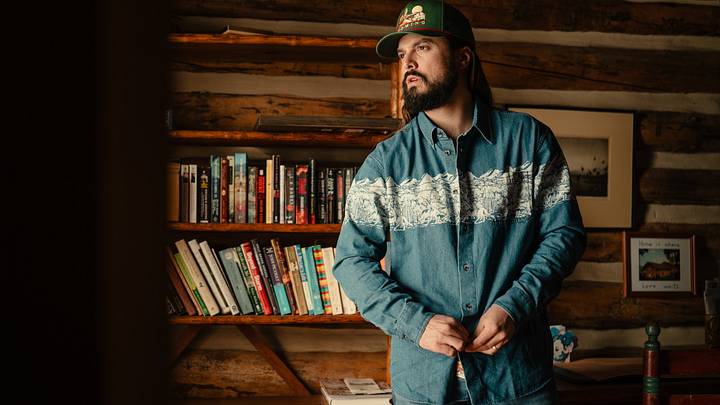
Ian Munsick is stepping into a new era; one where music, style, and Western culture collide.
With The Mountain Goat, his most personal and hand-built album yet, Munsick pushes deeper into the raw, organic sound of the Rocky Mountains he grew up in. At the same time, he’s expanding his footprint far beyond the studio: launching a heritage-driven clothing line with Schaefer Outfitter and opening an authentic Western bar in the historic heart of Deadwood, South Dakota.
Together, these three projects form a full-circle Western ecosystem; a modern, living expression of the cowboy lifestyle Munsick has spent years championing. This season, he isn’t just releasing new work; he’s building a world.
THE MOUNTAIN GOAT — The Album, Out Friday, 8/21/26

SI: The Mountain Goat is your first independent album, and you’ve described it as climbing farther out on your creative ledge. What did independence unlock for you creatively that you couldn’t access before?
IM: I’ve always been blessed to do my own thing; even with my old label, they really let me be myself. That freedom is what’s gotten me to where I am. With this album, I wanted to put even more of me into the music. I played a lot of the instruments, co-produced it, and wrote every track.
When you do that, you hear more of me (Ian) in the music. Most artists hire A-list players, but on this project, my two co-producers and I played almost everything, only bringing in a few musicians for very specific textures. It made the whole thing feel personal and handcrafted.
SI: You recorded many of the foundational instruments yourself - guitar, mandolin, banjo, harmonica, even bouzouki. How did building this album “by hand” shape its authenticity?
IM: It really does feel like it was built by hand. Playing so many of the instruments myself gave the album a rawness and honesty you don’t always hear in country music. It’s not polished in a corporate way; it’s polished in a human way. You’re hearing the same hands that wrote the songs actually play them, and that creates a deeper connection.
SI: You’ve described The Mountain Goat as more connected to nature, fatherhood, and the land you live on. How did those themes influence the sonic texture of the album?
IM: A lot of that comes from my co-producers, Jeremy Spillman and Mike Robinson. Jeremy brings maturity and experience, and Mike brings incredible musicianship and engineering. Together, we were able to capture the raw, organic feel of the Rocky Mountains, the textures you don’t normally hear in country music but blend beautifully when they’re done right. I wanted the album to sound like the land I grew up on.
SI: Is there one song that feels like the “heart” of the project?
IM: Honestly, no. I love albums that feel like chapters. The Beatles are my number one. Their albums are cohesive journeys, not just hits with filler in between. That’s what I wanted: a no-skip album you can start at track one and ride all the way through.
SI: Your music has evolved from Coyote Cry to White Buffalo, Eagle Feather, and now The Mountain Goat. How would you describe that evolution?
IM: A lot of it is maturity, especially as a producer. I’ve learned that you don’t need every element in a track. Muting things can make the song more powerful. And becoming a dad has given me more life experience, which helps me create more meaningful music. This album is definitely more organic and rooted.
SI: Your singles “Love Is Blind” and “World War III” feel like opposite ends of the emotional spectrum. Why were these the right songs to lead the charge?
IM: We’ve released five or six tracks already, but “Love Is Blind” is the current radio single. It shows one emotional side of the album, while “World War III” shows another. Together, they give listeners a sense of the range this project has.
SI: Your first show of the tour is in Minden, NV, the same day the album drops. What can fans expect?
IM: Yes ma’am, Minden on Friday, then Park City, Utah the next day for the official album release concert. We love it there, and every time we play Deer Valley Amphitheater, the turnout is incredible. We were honestly torn at first because not a lot of country acts come through that venue leans a little more artsy, but the fact that it’s actually in the Rocky Mountains and not just near them makes it the perfect setting for this album. It feels like the landscape the music was born from.
SI: What do you hope fans take away from The Mountain Goat?
IM: If you’re from the Rocky Mountains, I hope you feel proud, like someone is accurately representing your lifestyle and culture. And if you’re not from the West, I hope this album gives you a new appreciation and maybe even inspires you to incorporate some of that lifestyle into your own.
WESTERN CLOTHING LINE — Schaefer Outfitter, Launching Tuesday 8/18/26
SI: What inspired you to step into fashion, and how did you know Schaefer Outfitter was the right partner?
IM: My wife Caroline deserves all the credit. She helped put my flavor on Western apparel. We’ve wanted to create a clothing line for years, but the quality was never right. A lot of companies focus on profit over materials. If I’m putting my name on something, it has to be quality, just like my music.
Schaefer prioritizes quality above everything. Their pieces last a lifetime. They started in Jackson Hole. And that was just really cool. They have roots in Wyoming and now, obviously, in Texas, and I think that's perfect, as those are the two cowboy worlds. They really understand the brand, the lifestyle, and the culture of the West. Caroline and Johnny, one of the heads there, hit it off immediately. Johnny’s a cowgirl first, not a corporate person, and that made all the difference.
SI: What makes this collection uniquely “Ian Munsick”?
IM: I’d wear every piece on stage and out on the ranch. It’s authentic, durable, and true to the Western lifestyle. Schaefer nailed it.
SI: What part of the creative process felt the most personal?
IM: Seeing Caroline dive into the details; fabrics, artwork, design inspiration, and watching her bring our vision to life. She has a gift for speaking things into reality.
SI: Western fashion is having a moment. Why do you think people are gravitating toward authentic cowboy culture again?
IM: People are craving authenticity. Real cowboy culture still exists with ranchers, farmers, and families living the Western way of life. It’s not just history. It’s still happening right now, and people want to connect with that.
NEW BAR IN DEADWOOD —Partnering With the Landmark Hotel & Casino to Open the Ian Munsick Cowboy Bar & Western Grill September 18th in Deadwood, S.D
Built between 1894 and 1920, The Landmark is Deadwood’s largest historic structure at approximately 35,000 square feet. The Ian Munsick Cowboy Bar & Western Grill will reside within over 2,600 square feet of the footprint.
The venue will promote and celebrate country and western music with old-school country bar decor, along with two performance stages, one indoors and one outdoors.
SI: What made Deadwood the right place to open your bar, and how did this project come together?
IM: About a year ago, real estate owner Gerard Keating approached us. He’s done incredible work preserving the history of the Black Hills while modernizing it. He owned the first auto garage in town, from the early 1900s, and wanted to turn it into a bar attached to his historic hotel. He wanted authenticity, not just another cowboy bar.
Caroline, my wife, actually said back in 2019, after our first show there, “We need a spot here.” So being approached years later felt like fate. The Cowboy Bar is almost done, about a month from opening, and we’re really proud of how it honors Deadwood’s history.

SI: What kind of experience do you want fans to have when they walk in?
IM: I want them to feel the real West, the history, the culture, the authenticity, but in a fresh, modern space. It should feel like stepping into our world.
SI: Deadwood has such rich history. How are you honoring that while keeping the space authentically yours?
IM: By preserving the original character of the building and blending it with our aesthetic. We didn’t want to erase the history; we wanted to elevate it.
THE WESTERN ECOSYSTEM — Connecting All Three
SI: You’re launching an album, a clothing line, and a bar — all rooted in Western culture. How do these projects fit into the larger Western world you’re building?
IM: This has been our goal from the start. There’s nobody from our region in country music, and I feel honored to bring the West to the rest. People love the Old West, but they need to know cowboy culture is still alive today. These projects help educate people and let them experience the Western lifestyle firsthand.
SI: Would you say you’re building a full Western ecosystem?
IM: Yes, we are! Music, lifestyle, culture, community. It’s all part of one vision.
SI: What do you hope fans understand about the “world of Ian Munsick”?
IM: That Western life isn’t a trend or a vacation, it’s a way of life. And we’re proud to represent it authentically through all of this.
SI: If The Mountain Goat had a signature drink at your Deadwood bar, what would it be?
IM: We just finalized the menu, and there’s not a Mountain Goat drink yet, but there is a Geronimo drink and a few others named after my songs from the new album. When the right drink comes along, the Mountain Goat will be honored.
SI: What’s something fans don’t know yet about any of these launches — but you’re excited for them to discover?
IM: How connected everything is. The album, the clothing line, the bar, they’re all pieces of the same Western world we’re building. And this is just the beginning.
 Add us as a preferred source on Google
Tresha Glowacki grew up on a dairy farm in East Tennessee, where hard work and storytelling went hand in hand. Now living in Texas, she’s a devoted writer with a love for all things Western-horses, rodeos, and music. Her writing reflects the life she lives: grounded, spirited, and full of heart. When she’s not riding or writing, she’s spending time with her kids and animals that keep her world turning.