%22%3E%0A%3Cpath%20d%3D%22M0%205.12903H12.8817C17.559%205.12903%2020.5268%206.30107%2022.3762%208.13977C23.9569%209.7204%2024.7848%2011.6881%2024.7848%2014.3978V14.4731C24.7848%2018.3118%2022.7848%2020.9892%2019.5805%2022.5375L25.7203%2031.5052H15.6558L10.6774%2023.9676H8.79565V31.5052H0V5.12903ZM12.6236%2017.6773C14.7311%2017.6773%2016.0107%2016.7311%2016.0107%2015.1182V15.043C16.0107%2013.344%2014.6881%2012.5161%2012.6558%2012.5161H8.81716V17.6773H12.6236Z%22%20fill%3D%22white%22%2F%3E%0A%3Cpath%20d%3D%22M25.8506%2021.3008V21.2256C25.8506%2015.4191%2030.6785%2010.4514%2037.4527%2010.4514C44.2268%2010.4514%2048.9795%2015.3546%2048.9795%2021.1503V21.2256C48.9795%2027.032%2044.1516%2031.9997%2037.3774%2031.9997C30.6032%2031.9997%2025.8506%2027.0965%2025.8506%2021.3008ZM40.7752%2021.3008V21.2256C40.7752%2019.1933%2039.2699%2017.5697%2037.3882%2017.5697C35.5064%2017.5697%2034.0763%2019.1933%2034.0763%2021.1503V21.2256C34.0763%2023.2578%2035.5817%2024.8814%2037.4634%2024.8814C39.3451%2024.8814%2040.7752%2023.2578%2040.7752%2021.3008Z%22%20fill%3D%22white%22%2F%3E%0A%3Cpath%20d%3D%22M50.4629%2021.3762V21.301C50.4629%2014.7849%2054.3768%2010.4516%2059.237%2010.4516C62.3661%2010.4516%2064.0972%2011.8064%2065.4198%2013.2795V4H73.9681V31.5052H65.4198V28.9784C64.022%2030.4837%2062.4413%2031.9891%2059.3123%2031.9891C54.3338%2031.9891%2050.4629%2027.6558%2050.4629%2021.3655V21.3762ZM65.6133%2021.258V21.1827C65.6133%2019.1505%2064.1402%2017.4945%2062.1833%2017.4945C60.2263%2017.4945%2058.7532%2019.1182%2058.7532%2021.1827V21.258C58.7532%2023.3332%2060.2263%2024.9461%2062.1833%2024.9461C64.1402%2024.9461%2065.6133%2023.3225%2065.6133%2021.258Z%22%20fill%3D%22white%22%2F%3E%0A%3Cpath%20d%3D%22M76.0537%2021.3333V21.2581C76.0537%2015.1183%2080.4623%2010.4409%2086.6451%2010.4409C93.9569%2010.4409%2097.3439%2015.5269%2097.3439%2021.7849C97.3439%2022.2366%2097.3439%2022.7634%2097.3009%2023.215H84.0752C84.6773%2025.0215%2086.1074%2025.9677%2087.9569%2025.9677C89.5053%2025.9677%2090.7848%2025.2473%2092.1397%2023.8602L96.731%2027.5161C94.6988%2030.1505%2091.7956%2031.9999%2087.344%2031.9999C80.6021%2031.9999%2076.043%2027.7419%2076.043%2021.3333H76.0537ZM89.5375%2019.4516C89.344%2017.4946%2088.1827%2016.3656%2086.6773%2016.3656C85.172%2016.3656%2084.2257%2017.5699%2083.9677%2019.4516H89.5483H89.5375Z%22%20fill%3D%22white%22%2F%3E%0A%3Cpath%20d%3D%22M98.7305%2021.3008V21.2256C98.7305%2015.4191%20103.558%2010.4514%20110.333%2010.4514C117.107%2010.4514%20121.859%2015.3546%20121.859%2021.1503V21.2256C121.859%2027.032%20117.031%2031.9997%20110.257%2031.9997C103.483%2031.9997%2098.7305%2027.0965%2098.7305%2021.3008ZM113.655%2021.3008V21.2256C113.655%2019.1933%20112.15%2017.5697%20110.268%2017.5697C108.386%2017.5697%20106.956%2019.1933%20106.956%2021.1503V21.2256C106.956%2023.2578%20108.462%2024.8814%20110.343%2024.8814C112.225%2024.8814%20113.655%2023.2578%20113.655%2021.3008Z%22%20fill%3D%22white%22%2F%3E%0A%3Cpath%20fill-rule%3D%22evenodd%22%20clip-rule%3D%22evenodd%22%20d%3D%22M131.368%204.36764C137.191%20-1.45588%20146.632%20-1.45588%20152.456%204.36764C158.279%2010.1912%20158.279%2019.6324%20152.456%2025.4559L141.912%2036L131.368%2025.4559C125.544%2019.6324%20125.544%2010.1912%20131.368%204.36764ZM134.009%207.55761C133.948%207.86849%20133.916%208.39718%20133.916%209.14566V10.4189C133.916%2011.1832%20133.948%2011.7198%20134.013%2012.0267C134.078%2012.3317%20134.278%2012.6168%20134.617%2012.8762C134.956%2013.1376%20135.403%2013.3316%20135.958%2013.4623C136.512%2013.593%20137.1%2013.6583%20137.837%2013.6583C138.573%2013.6583%20139.217%2013.591%20139.769%2013.4524C140.322%2013.3158%20140.761%2013.1178%20141.086%2012.8604C141.411%2012.6029%20141.605%2012.3178%20141.666%2012.0069C141.728%2011.6961%20141.759%2011.1674%20141.759%2010.4189V9.14566C141.759%208.38134%20141.728%207.84473%20141.662%207.53781C141.597%207.23287%20141.397%206.94972%20141.058%206.68834C140.72%206.42696%20140.272%206.23291%20139.718%206.10223C139.163%205.97154%20138.536%205.90619%20137.839%205.90619C137.102%205.90619%20136.459%205.97352%20135.906%206.11213C135.352%206.24875%20134.914%206.44677%20134.589%206.70418C134.265%206.9616%20134.071%207.24673%20134.009%207.55761ZM139.276%2024.8638C142.876%2024.8638%20144.557%2024.2064%20144.557%2021.862V21.858V21.3155C144.557%2019.6581%20143.516%2018.971%20140.252%2018.3136C139.278%2018.1136%20138.908%2017.9136%20138.908%2017.3136V16.9414C138.908%2016.6543%20139.177%2016.5117%20139.413%2016.5117C139.749%2016.5117%20139.918%2016.7137%20139.918%2016.9414V18.1136H144.391V17.3988C144.391%2015.4563%20143.347%2014.4266%20139.177%2014.4266C136.15%2014.4266%20133.896%2015.3414%20133.896%2017.3711V17.7433C133.896%2019.5155%20134.805%2020.3155%20138.201%2021.0303C138.28%2021.0472%20138.355%2021.063%20138.427%2021.0781C139.329%2021.2674%20139.647%2021.3341%20139.647%2021.9174V22.2897C139.647%2022.6619%20139.546%2022.8045%20139.142%2022.8045C138.67%2022.8045%20138.637%2022.5471%20138.637%2022.262V21.2897H133.894V21.7471C133.894%2024.149%20135.476%2024.8638%20139.276%2024.8638ZM145.424%2024.5569H149.925V14.7355H145.424V24.5569ZM146.955%2013.5019H149.925V6.06064H147.092V9.411L145.193%206.06064H142.359V13.5019H145.193V10.1199L146.955%2013.5019ZM138.269%2012.152C138.204%2012.2688%20138.055%2012.3262%20137.825%2012.3262L137.827%2012.3282C137.604%2012.3282%20137.459%2012.2767%20137.398%2012.1757C137.336%2012.0748%20137.305%2011.8074%20137.305%2011.3758V7.90068C137.305%207.51852%20137.352%207.28684%20137.445%207.20962C137.538%207.13239%20137.675%207.09279%20137.851%207.09279C138.059%207.09279%20138.198%207.14031%20138.265%207.23734C138.332%207.33239%20138.366%207.55416%20138.366%207.90068V11.3203C138.366%2011.7579%20138.334%2012.0352%20138.269%2012.152Z%22%20fill%3D%22white%22%2F%3E%0A%3C%2Fg%3E%0A%3Cdefs%3E%0A%3CclipPath%20id%3D%22clip0_15247_3552%22%3E%0A%3Crect%20width%3D%22157%22%20height%3D%2236%22%20fill%3D%22white%22%2F%3E%0A%3C%2FclipPath%3E%0A%3C%2Fdefs%3E%0A%3C%2Fsvg%3E%0A)
PBR Texas Rattlers Betting That Better Preparation Can Create More 8-Second Rides
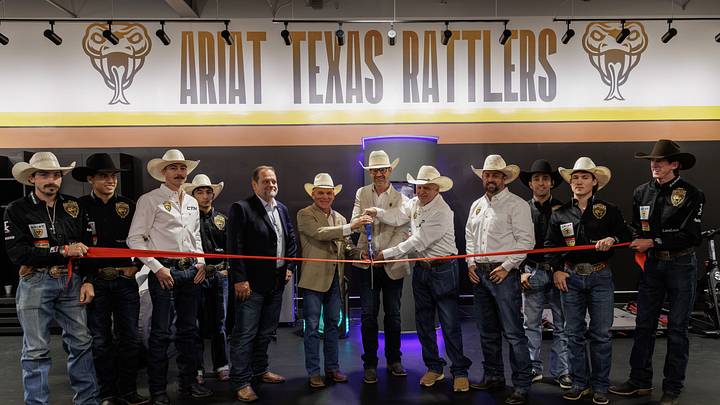
The ribbon cutting was a simple ceremony: a large cartoon-sized scissor slicing a red ribbon held by two cowboys inside the Fit-N-Wise Rehabilitation & Performance Center in Decatur, Texas.
The objective behind the ribbon represented something more consequential for professional bull riding. The Ariat Texas Rattlers have opened a 3,000-square-foot Performance Center in Decatur, the first dedicated high-performance training and recovery center built specifically for a professional bull riding team.
The Rattlers under head coach Cody Lambert are already established high performers: they won the PBR Teams Championship (2023); co-lead the most rides in league history (307, with the Arizona Ridge Riders); and recorded the first 5-for-5 perfect game (three total, tied for first) and longest ride streak (Daniel Keeping with 10).

As the stakes get higher in a growing league planning its second expansion for the 2027 season, Lambert and company are not ones to settle. Their new performance center aims to help the athletes get stronger, train more consistently, and recover faster as they run toward a second title.
Of course, bull riders don’t literally run. But Rattlers President and GM Chad Blankenship uses a running analogy to explain the team’s investment.
For more than a century before the mid-1950s, doctors and experts believed it was physically impossible for a human being to run a mile in under four minutes. Then, in 1954, Roger Bannister famously broke the barrier. Since the Englishman showed it could be done, more than 2,000 runners have achieved the four-minute mile – including 35 high school athletes. Bannister did not make the feat easy; he made it imaginable and achievable, Blankenship points out.
Team bull riding is a much younger sport than running, and team bull riding is younger still. No one can predict where its limits are, but every team coach and front office executive worth their salt is going to try to move the goalposts on how good bull riders can get.
That’s the wager behind the Rattlers’ new Performance Center: to create the daily conditions, shared knowledge and rider development needed to more consistently survive the most unpredictable, chaotic and challenging eight seconds in sports.
“In this new team format, we’re continually learning how to gain an edge,” Blankenship said. “Providing our team with 24-hour access to elite training and recovery resources prevalent in other top tier professional team facilities gives the Ariat Texas Rattlers a competitive advantage to push through boundaries and lead the way as our sport reaches new heights.”
That infrastructure includes an approximately 2,000-square-foot training and recovery area built to accommodate the team’s riders simultaneously, along with lockers, physical therapy and rehabilitation space, nutrition and film-review areas, coaching and management offices, specialized bull-riding equipment and hot-and-cold plunge tubs. A public-facing gallery called the “Snake Den” promotes the Rattlers’ championship history and Texas identity.
For recovery – crucial when bull riders routinely experience the physical equivalent of a car crash – a new partnership with CTN USA gives the team state-of-the-art recovery technology systems, including cryotherapy, red light therapy, and hyperbaric recovery systems.

For a sport that, before the Teams league launched in 2022, was built around individual riders figuring things out on their own, the team environment has helped riders find greater success against their bull opponents.
In Teams, wins and losses are the ultimate measure of performance. The aggregate of team points after five outs is more important than any single rider’s score. Qualified rides matter most; two workmanlike 85-point rides from one team will beat the other’s epic 96-point trip. The better a team can prepare all five athletes, the more opportunities it creates to put a qualified ride score on the board and generate wins.
The numbers show ride percentages have increased; riders in Teams competition now convert at a 39% rate. Ten years ago, before team bull riding, the success rate was 30%.
There are a variety of reasons explaining why riders are making the eight more frequently, even as bulls get stronger and faster.
In PBR Teams, coaches can pair riders with bulls that better fit their styles versus the sometimes-maddening draw of the computer in individual PBR Unleash The Beast competition.
Riders have teammates and coaches around them to share the triumphs of their success and the suffocating pressure of failure. More consistent training and mental preparation will often turn good intentions into repeatable habits.
A team can also keep winning when one rider suddenly goes cold, giving that struggling athlete better head space for wrapping his hand in another bull rope without each buck-off feeling like he’s no longer varsity material, as Junior Soprano might say.

The Rattlers’ new center brings those elements under one roof. A rider can easily move from a strength session to rehabilitation, film review or a conversation with Lambert or assistant coach Brady Oleson.
Small improvements can be magnified across a season, when a single additional qualified ride can change a game, a seeding position or a championship chase.
Blankenship is already putting a target metric on the investment. He estimates that more consistent access to structured workouts, rehabilitation and recovery could yield five to 10 percent more qualified rides per season. That could be the difference between a third-place and first-place regular-season finish.
The Rattlers’ commitment to giving the human athletes new tools when the bulls – growing more difficult to ride with each generation of enriched bloodlines – is also taking shape at the league level as well.
PBR Teams is making biomechanics testing mandatory, using force and jump testing, motion capture, balance work, peripheral-vision assessments and other controlled exercises to build a more useful picture of each rider.
The work is being led in part by Kait Jackson, a biomechanist whose efforts focus on force transfer, vestibular function, coordination, movement asymmetries and the ability to know where the body is in space.
Jackson’s question is deceptively simple: “How do you control your body in space when you’re on stable ground? How do you transfer force through your body?”
Her tests can identify strengths, flag potential limitations and give coaches a practical starting point for performance enhancement, injury-mitigation work and rider development.
Of course, sophisticated testing and performance center training cannot ensure a rider will cover a bull. These are the most ridiculously mismatched athletes in sports, taking on powerful bovines ten times their size, who appear, as one celebrity fan in Austin noted last weekend as if they were created by AI.
As the Goliaths in the back pens breed and beef up, the Davids of the Rattlers are now part of a holistic plan to help them arrive at the arena healthier, manage the mental stress inherent in a sport where injury is guaranteed, and build habits that allow them to stifle the innate human instinct for self-protection when the chute gate cracks open.
At the current conversion rate of riding two of five bulls, even a modest increase in success will add qualified rides often enough to alter the outcome of games.

Decatur is the hub for that effort. The Rattlers are based in Fort Worth, but many professional bull riders call Decatur (just 45 minutes northwest) home – more than half of the league’s top 50 riders live there. The Nashville Stampede also train in Decatur, using The Ranch at NRS as the team’s training facility and outreach hub.
The Rattlers’ investment coincides with the league’s growth plans. They have already shown they can win a championship. Their new Performance Center is a bet that the next era of greatness in PBR Teams will be won by organizations that treat athlete development as seriously as they treat recruiting, coaching and game strategy.
The ribbon and the cameras marked the opening. The real test will come when the Rattlers try to turn countless hours of hard work into even more reliable 8-second bursts of greatness.
 Add us as a preferred source on Google
Andrew Giangola, who has held high-profile public relations positions with Pepsi-Cola, Simon & Schuster, Accenture, McKinsey & Co., and NASCAR, now serves as Vice President, Strategic Communications for PBR. In addition to serving in high-profile public relations positions over the past 25 years, Andrew Giangola is the author of the critically acclaimed books The Weekend Starts on Wednesday: True Stories of Remarkable NASCAR Fans and Love & Try: Stories of Gratitude and Grit in Professional Bull Riding, which benefits injured bull riders and was named the best nonfiction book of 2022 at the 62nd Annual Western Heritage Awards. Giangola graduated from Fordham University, concentrating in journalism, when he was able to concentrate. He lives in Brooklyn with his wife Malvina.