%22%3E%0A%3Cpath%20d%3D%22M5.6289%2014.2312H0V8.81885H17.6397V14.2312H12.0108V27.9458H5.61948V14.2312H5.6289Z%22%20fill%3D%22white%22%2F%3E%0A%3Cpath%20d%3D%22M19.042%208H25.2451V15.022C26.2052%2013.7889%2027.7018%2012.6688%2029.8103%2012.6688C32.9542%2012.6688%2034.9215%2014.749%2034.9215%2018.1V27.927H28.7184V20.0861C28.7184%2018.806%2027.956%2018.0624%2027.0241%2018.0624C26.0922%2018.0624%2025.2451%2018.7966%2025.2451%2020.0861V27.927H19.042V8Z%22%20fill%3D%22white%22%2F%3E%0A%3Cpath%20d%3D%22M36.3057%2020.5661V20.5096C36.3057%2016.0573%2039.4966%2012.6687%2043.9772%2012.6687C49.2766%2012.6687%2051.7334%2016.3585%2051.7334%2020.8861C51.7334%2021.2156%2051.7334%2021.6015%2051.7051%2021.9216H42.1228C42.5558%2023.2299%2043.6006%2023.9171%2044.9373%2023.9171C46.0574%2023.9171%2046.9893%2023.3994%2047.9682%2022.3828L51.3004%2025.0372C49.8225%2026.948%2047.7235%2028.2846%2044.5043%2028.2846C39.619%2028.2846%2036.3151%2025.1972%2036.3151%2020.5567L36.3057%2020.5661ZM46.0762%2019.2012C45.935%2017.7799%2045.0879%2016.961%2043.996%2016.961C42.9041%2016.961%2042.2169%2017.8364%2042.0287%2019.2012H46.0668H46.0762Z%22%20fill%3D%22white%22%2F%3E%0A%3Cpath%20d%3D%22M65.3066%2014.2312H59.6777V8.81885H77.3175V14.2312H71.6886V27.9458H65.2972V14.2312H65.3066Z%22%20fill%3D%22white%22%2F%3E%0A%3Cpath%20d%3D%22M77.1946%2023.7102V23.6537C77.1946%2020.6792%2079.4066%2019.0132%2082.8706%2019.0132C84.1225%2019.0132%2085.7415%2019.2861%2086.391%2019.5591V19.3144C86.391%2017.9495%2085.5438%2017.1588%2083.633%2017.1588C82.1081%2017.1588%2080.8186%2017.4883%2079.5102%2018.006L78.4183%2013.8832C80.1408%2013.2243%2082.1081%2012.7913%2084.6967%2012.7913C87.7276%2012.7913%2089.6949%2013.4219%2091.0033%2014.7303C92.1234%2015.8504%2092.5564%2017.3%2092.5564%2019.4556V27.946H86.3533V26.4399C85.3179%2027.56%2083.9248%2028.2943%2082.0611%2028.2943C79.1901%2028.2943%2077.1758%2026.6564%2077.1758%2023.7102H77.1946ZM86.4475%2022.4206V21.79C86.0898%2021.6488%2085.5438%2021.5452%2085.0261%2021.5452C83.793%2021.5452%2083.1153%2022.2794%2083.1153%2023.2113V23.2678C83.1153%2024.1432%2083.746%2024.7174%2084.5366%2024.7174C85.6285%2024.7174%2086.4475%2023.842%2086.4475%2022.4206Z%22%20fill%3D%22white%22%2F%3E%0A%3Cpath%20d%3D%22M94.4297%208H100.633V17.6105L103.824%2013.0265H110.573L105.904%2019.0884L110.657%2027.9365H104.021L101.866%2023.8419L100.633%2025.4232V27.9365H94.4297V8Z%22%20fill%3D%22white%22%2F%3E%0A%3Cpath%20d%3D%22M109.886%2020.5661V20.5096C109.886%2016.0573%20113.077%2012.6687%20117.557%2012.6687C122.857%2012.6687%20125.313%2016.3585%20125.313%2020.8861C125.313%2021.2156%20125.313%2021.6015%20125.285%2021.9216H115.703C116.136%2023.2299%20117.181%2023.9171%20118.517%2023.9171C119.637%2023.9171%20120.569%2023.3994%20121.548%2022.3828L124.88%2025.0372C123.403%2026.948%20121.304%2028.2846%20118.084%2028.2846C113.199%2028.2846%20109.895%2025.1972%20109.895%2020.5567L109.886%2020.5661ZM119.666%2019.2012C119.525%2017.7799%20118.677%2016.961%20117.585%2016.961C116.494%2016.961%20115.806%2017.8364%20115.618%2019.2012H119.656H119.666Z%22%20fill%3D%22white%22%2F%3E%0A%3Cpath%20d%3D%22M126.358%2020.5944V20.5379C126.358%2015.8127%20129.201%2012.6688%20132.722%2012.6688C134.99%2012.6688%20136.242%2013.6477%20137.202%2014.7208V8H143.405V27.9365H137.202V26.1104C136.195%2027.2023%20135.046%2028.2941%20132.778%2028.2941C129.173%2028.2941%20126.358%2025.1502%20126.358%2020.5944ZM137.334%2020.5097V20.4532C137.334%2018.9754%20136.27%2017.78%20134.849%2017.78C133.427%2017.78%20132.364%2018.9566%20132.364%2020.4532V20.5097C132.364%2022.0158%20133.427%2023.183%20134.849%2023.183C136.27%2023.183%20137.334%2022.0063%20137.334%2020.5097Z%22%20fill%3D%22white%22%2F%3E%0A%3Cpath%20d%3D%22M144.901%2020.5379V20.4814C144.901%2016.2738%20148.394%2012.6687%20153.316%2012.6687C158.239%2012.6687%20161.675%2016.2174%20161.675%2020.4249V20.4814C161.675%2024.6889%20158.183%2028.2941%20153.26%2028.2941C148.337%2028.2941%20144.901%2024.7454%20144.901%2020.5379ZM155.717%2020.5379V20.4814C155.717%2019.0036%20154.625%2017.827%20153.26%2017.827C151.895%2017.827%20150.86%2019.0036%20150.86%2020.4249V20.4814C150.86%2021.9592%20151.952%2023.1264%20153.316%2023.1264C154.681%2023.1264%20155.717%2021.9498%20155.717%2020.5284V20.5379Z%22%20fill%3D%22white%22%2F%3E%0A%3Cpath%20d%3D%22M161.591%2013.0264H167.521L169.055%2019.0319L170.853%2012.97H175.795L177.63%2019.0883L179.212%2013.0264H185.057L180.492%2028.0494H175.305L173.31%2021.658L171.258%2028.0494H166.1L161.591%2013.0264Z%22%20fill%3D%22white%22%2F%3E%0A%3Cpath%20d%3D%22M186.12%2013.0265H192.323V15.1067C193.283%2013.8737%20194.78%2012.6782%20196.888%2012.6782C200.032%2012.6782%20202%2014.7585%20202%2018.1094V27.9365H195.797V20.0956C195.797%2018.8154%20195.034%2018.0718%20194.102%2018.0718C193.17%2018.0718%20192.323%2018.806%20192.323%2020.0956V27.9365H186.12V13.0265Z%22%20fill%3D%22white%22%2F%3E%0A%3Cpath%20fill-rule%3D%22evenodd%22%20clip-rule%3D%22evenodd%22%20d%3D%22M211.368%204.36764C217.191%20-1.45588%20226.632%20-1.45588%20232.456%204.36764C238.279%2010.1912%20238.279%2019.6324%20232.456%2025.4559L221.912%2036L211.368%2025.4559C205.544%2019.6324%20205.544%2010.1912%20211.368%204.36764ZM214.009%207.55761C213.948%207.86849%20213.916%208.39718%20213.916%209.14566V10.4189C213.916%2011.1832%20213.948%2011.7198%20214.013%2012.0267C214.078%2012.3317%20214.278%2012.6168%20214.617%2012.8762C214.956%2013.1376%20215.403%2013.3316%20215.958%2013.4623C216.512%2013.593%20217.1%2013.6583%20217.837%2013.6583C218.573%2013.6583%20219.217%2013.591%20219.769%2013.4524C220.322%2013.3158%20220.761%2013.1178%20221.086%2012.8604C221.411%2012.6029%20221.605%2012.3178%20221.666%2012.0069C221.728%2011.6961%20221.759%2011.1674%20221.759%2010.4189V9.14566C221.759%208.38134%20221.728%207.84473%20221.662%207.53781C221.597%207.23287%20221.397%206.94972%20221.058%206.68834C220.72%206.42696%20220.272%206.23291%20219.718%206.10223C219.163%205.97154%20218.536%205.90619%20217.839%205.90619C217.102%205.90619%20216.459%205.97352%20215.906%206.11213C215.352%206.24875%20214.914%206.44677%20214.589%206.70418C214.265%206.9616%20214.071%207.24673%20214.009%207.55761ZM219.276%2024.8638C222.876%2024.8638%20224.557%2024.2064%20224.557%2021.862V21.858V21.3155C224.557%2019.6581%20223.516%2018.971%20220.252%2018.3136C219.278%2018.1136%20218.908%2017.9136%20218.908%2017.3136V16.9414C218.908%2016.6543%20219.177%2016.5117%20219.413%2016.5117C219.749%2016.5117%20219.918%2016.7137%20219.918%2016.9414V18.1136H224.391V17.3988C224.391%2015.4563%20223.347%2014.4266%20219.177%2014.4266C216.15%2014.4266%20213.896%2015.3414%20213.896%2017.3711V17.7433C213.896%2019.5155%20214.805%2020.3155%20218.201%2021.0303C218.28%2021.0472%20218.355%2021.063%20218.427%2021.0781C219.329%2021.2674%20219.647%2021.3341%20219.647%2021.9174V22.2897C219.647%2022.6619%20219.546%2022.8045%20219.142%2022.8045C218.67%2022.8045%20218.637%2022.5471%20218.637%2022.262V21.2897H213.894V21.7471C213.894%2024.149%20215.476%2024.8638%20219.276%2024.8638ZM225.424%2024.5569H229.925V14.7355H225.424V24.5569ZM226.955%2013.5019H229.925V6.06064H227.092V9.411L225.193%206.06064H222.359V13.5019H225.193V10.1199L226.955%2013.5019ZM218.269%2012.152C218.204%2012.2688%20218.055%2012.3262%20217.825%2012.3262L217.827%2012.3282C217.604%2012.3282%20217.459%2012.2767%20217.398%2012.1757C217.336%2012.0748%20217.305%2011.8074%20217.305%2011.3758V7.90068C217.305%207.51852%20217.352%207.28684%20217.445%207.20962C217.538%207.13239%20217.675%207.09279%20217.851%207.09279C218.059%207.09279%20218.198%207.14031%20218.265%207.23734C218.332%207.33239%20218.366%207.55416%20218.366%207.90068V11.3203C218.366%2011.7579%20218.334%2012.0352%20218.269%2012.152Z%22%20fill%3D%22white%22%2F%3E%0A%3C%2Fg%3E%0A%3Cdefs%3E%0A%3CclipPath%20id%3D%22clip0_15247_3686%22%3E%0A%3Crect%20width%3D%22237%22%20height%3D%2236%22%20fill%3D%22white%22%2F%3E%0A%3C%2FclipPath%3E%0A%3C%2Fdefs%3E%0A%3C%2Fsvg%3E%0A)
Mike Santana Relishing Second Chance At Life While Celebrating One Year In TNA (Exclusive)
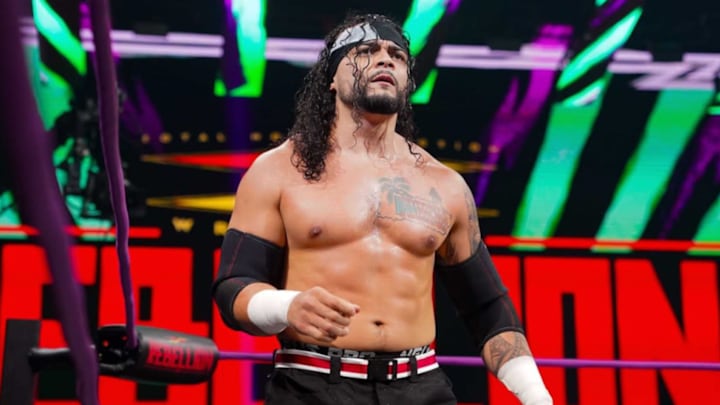
The imagery in TNA star Mike Santana’s words paints different pictures of the seminal moments of his past.
There are, of course, the best of those moments, like March 17, 1996. That was one of his favorites. He was just five years old, attending his first wrestling show with his father, a WWF house show at Madison Square Garden. In fact, he still carries that program with him, aged and worn, highlighting the main event of Bret Hart and The Undertaker vs. Shawn Michaels and Diesel (plus an advertisement for the World Wrestling Federation Credit Card).
“I’ll never forget that,” he says almost 30 years later, his voice lighting up.

Seminal moments, however, do not always come with superstar entrances and pink shades. Take that one day, less than a year later, as he walked into his grandmother’s Lower East Side apartment to find her convulsing.
“I didn't truly understand,” he said, describing his five-year-old self watching his mother’s mother overdose on drugs feet from him. “What I just remember, the image of her falling, and then her turning blue. And that's the image that lives with me.”
There are far more images like that in Santana’s life than the glitz and glam of a pro wrestling show. That’s naturally going to be the case when you are born and raised in the Jacob Riis Houses, the projects, bouncing New York City borough to borough at the mercy of the system and a young family waging war on life itself.
“My mom sold drugs when she was a teenager. She didn't have an education. That was her way of surviving and raising money so that she could get her own place,” he recalls, adding his mother was just 15 years old when she had him. “She was able to get her own place, so she moved all of us in with her. And at the time, she was with a man, which was my younger brother's father, and he was also a drug addict.”
Santana remembers seeing violence and abuse firsthand in his mother’s household, which would become a catalyst for his own eventual shortcomings.
“A lot of my anxiety and depression stemmed from that. Because growing up, I was always in that survival mode, and I wasn't taught how to speak about these things,” he said. “And my thing was just keep going, you know what I mean? I was always told that you don't care what happens at home. You keep going. And that was how I lived most of my life, until I couldn’t.”
That’s a motif that would follow Santana through both his personal and professional paths. Recurring battles with alcoholism and drug abuse have both fueled and plagued his successes and failures. Speak with him for an hour, and you will learn he is a man of character, even if said character spent much of his 33 years flawed and unfocused as a result of the survivalist nature embedded within him.
Santana has been in the wrestling industry since he was 17 years old, and has been showcased regularly on television across tenures in TNA and AEW over the past decade. He had his first breakout of success as part of LAX (later renamed Proud & Powerful in AEW), even jumping to the main event scene as a member of Chris Jericho’s Inner Circle group alongside his tag partner Ortiz.
Success is fickle in show business, and it can also become a mask for the layers that rest beneath it.

Many of Santana’s best qualities, he’ll tell you, come from his father’s side. Mark Sanchez. He’s the same man who took his son to that MSG house show nearly 30 years ago, and was an imperfect but present figure in his life. Mark just tried to do his best over the years, starting as a 17-year-old first-time father battling both blindness and addiction.
“He dealt a lot with depression and addiction and stuff like that while I was growing up. And while I was a teenager, our relationship was really up and down because I didn't really understand his side of things. And I didn't understand the addiction and depression that he was dealing with. So I saw him as just being an a**h***,” Santana said.
But his father’s side of the family provided a grounded presence he had never experienced much of otherwise. His dad’s mother, Raquel, became a guiding light and even first introduced Santana to wrestling, while his dad would begin to settle into a role of protector he wasn’t immediately prepared for.
They shared a real-life name, but additionally, a love for the squared circle.
“He loved WWF when [Steve] Austin started. Austin was his absolute favorite. He also loved WCW, because he loved guys like [Chris] Benoit and Eddie [Guerrero],” he said. “I remember watching Nitro with him, and those guys would come on, and he's like, ‘these are the real f***ing wrestlers.”
It’s the style Santana has tried to emulate as a performer himself. He’s brash. He’s aggressive. He’s real. If you watch Mike Santana wrestle a match, you’re seeing Mark Anthony Sanchez Sr. in larger-than-life form.

“We were more than just father and son. He was my older brother. He was my best friend. We spoke about everything,” he said. “I finally was able to understand where he was coming from and the things he was dealing with. I'm so, so thankful that I took that time to have that conversation, because that's something that I really hold on to now.”
Call it homage, if you’d like. But in actuality, it is more tribute.
Santana can no longer speak with his father. He passed away unexpectedly due to natural causes on New Year’s Day 2020. He was just 47 years old. Santana found out while at work for AEW at Daily’s Place in Jacksonville.
Check this Throwback!
— Mike SANTANA🇵🇷 (@Santana_Proud) March 13, 2025
Getting to wrestle at #MSG is something that I hold near and dear to my heart. One of the greatest accomplishments of my career. But above all, having my family there meant the world to me. It was the last time my father got to see me wrestle live before… pic.twitter.com/WNJurmKOTn
His father’s death left him without one of the few critical elements of structure he had left in his life. Shortly after, the COVID-19 pandemic struck, with AEW holding all of its closed-set tapings at the same venue he found out about the devastating news.
“Every single week, I was reminded of that day, and how I dealt with that,” he said. “I self-medicated. So that's when all of that happened, and I was just numbing myself, but I didn't realize it was becoming a problem.”
Pro wrestling has a vicious pattern of substance abuse that has killed or permanently damaged so many of the fortunate few who have made names for themselves in the industry. Santana was beginning to travel down a road reflective of those around him during his upbringing, turning to the same avenues that have paralyzed so many others.
“So when I was home, I was able to just, like, deal with it. All right? I'm good. I'm home for a couple of days, and then get right back to it when I'm gone,” he said. “But when I started doing it at home, and when the injury happened, it's like when it really became apparent.”
Santana was a part of Blood & Guts on June 22, 2022, wrestling as part of a squad consisting of Eddie Kingston, his partner Ortiz, and the Blackpool Combat Club, facing the Jericho Appreciation Society. Just minutes into the match, he attempted to plant Daniel Garcia into the mat with an uranage. His left leg buckled on him, tearing his ACL, MCL, and meniscus in one swoop.
Grief is inevitable after loss. It shackles its victims, as they become oppressed by its weight and authority. Now, in a two-year span, Santana had been stripped of his best friend and his livelihood.
His addiction worsened.
“I couldn't go more than a day and a half without anything because I was going into withdrawal right away,” he said. “When the injury happened and I didn't have wrestling to run to and hide, then it was like, ‘oh well, here we are.’”

“Here” was, in fact, nowhere. Santana was no longer a present figure in his family’s life. He became inconsistent in caring for his young daughter Ariana, and his relationship with his grandmother Raquel was strained.
“I would leave home, and I'd be out for a few days. I was usually the one that took my daughter to school and stuff in the morning. So when I wasn't showing up in the morning, then she's like, ‘Whoa, what the hell is going on?’
“I got to a point where it got so bad that, in my head, I'm not thinking that she's realizing any of these things. I'm thinking she's still a kid. She's not paying attention. She doesn't know what's going on. But boy, was I wrong.”

The holidays rolled around, and he was deeply distant from those who loved him. Ariana would write her Christmas list to Santa that year. Santana expected to find presents jotted down. But her top wish was for something more personal.
She wanted her dad to stop. She needed her father back.
At the same time, his grandmother texted him a letter begging him to find himself.

“She was like,’ I was scared I was going to lose you like your father,’ and those things. And then, you know, like, just everything, the people that were closest to me were the ones being hurt. And watching that letter from my daughter, man, that was my rock bottom,” he said. “I was like, ‘Oh no, I'm doing exactly what I swore I wouldn't do, and that's giving her the same life that I lived as a kid.”
We are our most raw selves when facing life or death. He could have chosen to follow through the pitfalls of his upbringing, becoming a victim of the social scale and leaving his family with another tragic loss.
Or there was the other route: survive, just as his father had fought to do for as long as he physically could.
1 YEAR SOBER. #ADayAtATime pic.twitter.com/6Hlg6WwlED
— Mike SANTANA🇵🇷 (@Santana_Proud) February 16, 2024
“The reason why I'm still sober today is because I wanted to get sober. I wanted to get clean,” he said. “I was fighting myself every day. But I couldn’t, because my body was already, like, used to it. So going to withdrawal was hell, you know? And I was just like, ‘Man, how am I going to do this?’”
Santana slowly began to pull himself off of substances, and focused on repairing his relationship with his family. At the same time, his relationship with Ortiz was becoming strained, and he made a conscious decision during rehab: it was time to consider a different professional route in wrestling.
“I also had the realization that when I get back to wrestling, it’s going to be a whole different journey for me. being that I was coming back on my own. And a big part of me was very excited for it,” he said.
“I told myself, after I completed my 30 days, I’m leaving the old me dead and buried in that place. So it was a total fresh start for my life and my career. Did I mourn the team? Yeah, in the beginning, but also I knew it was something I needed to do for myself. And I was willing to take the chance, because at the end of the day, I know the work that I’m willing to put in to get to where I want to be.”
That decision led to the breakup of Proud & Powerful, and his eventual departure from AEW (he also noted he wanted more opportunities for the team to grow that weren't coming). Today’s Santana, though, is redesigned. He is remade in the image of his hero, his father, and honors him by wearing a custom chain with his image. He missed 14 months of action in recovery, but celebrated one year since his TNA return on April 20.
Now, he feels he is becoming the best version of himself, climbing the card and thriving as a singles act on a large scale.
“I’ve pretty much established myself as one of the best wrestlers in the world, and I can honestly say that I'm proud of that,” he said. “It’s also a testament to what TNA has done for me, and given me the opportunities to really shine and really show what I can do, and believing in me.”
For a while, it appeared there was a real possibility that Santana would never have another one of those life-defining seminal moments again. Yet, surviving is embedded in his bloodline.
Two years sober, Mike Santana is indeed a survivor.
“Thinking back on it now, as an adult and as a father, I have to say that I'm thankful that I went through all those things because it taught me how to live better and how to do better, and give my daughter better,” he said.
“I’m sure I’ve got a hold of it where I'm giving my absolute all when it comes to being a father and being a man in general, and also being Santana, the performer, and the guy who people see on TV. It feels so good. It feels really good.”
The Latest On WWE, AEW & More
AEW Dynamite Results (4/23/25): FTR Gets New Manager, Joe Chokes Out Moxley, Hayter Advances
Exclusive: WrestleMania 41 Tag Title Win Meant A Lot To Kofi Kingston Because Of Heel Turn
New Report Details When & Who Made The Call To Turn John Cena Heel At WWE Elimination Chamber
 Add us as a preferred source on Google
Jon Alba is an Emmy Award and SPJ Award-winning journalist who has broken some of pro wrestling's biggest stories. In addition to writing for The Takedown on SI, he is the host of "The Extreme Life of Matt Hardy" podcast, and a host and contributor for Sportsnet New York. Additionally, he has been on beats for teams across MLB, the NFL, NBA, NHL, and MLS during more than a decade in the sports media sphere. Jon is a graduate of Quinnipiac University with a B.A. degree in Journalism.
Follow JonAlba