%22%3E%0A%3Cpath%20d%3D%22M0%205.37646H8.15061L17.4195%2016.8819V5.37646H26.0647V31.4412H18.3227L8.64523%2019.4196V31.4412H0V5.37646Z%22%20fill%3D%22white%22%2F%3E%0A%3Cpath%20d%3D%22M29.2041%205.37649H43.8064C47.4193%205.37649%2049.6989%206.1937%2051.2258%207.72059C52.1505%208.64533%2052.8172%2010.0002%2052.8172%2011.7851V11.8497C52.8172%2014.9465%2050.9462%2016.8389%2048.172%2017.8067C51.5269%2018.7744%2053.6774%2020.5594%2053.6774%2024.1293V24.1938C53.6774%2028.3659%2050.258%2031.4197%2043.6558%2031.4197H29.2041V5.35498V5.37649ZM44.258%2013.7637C44.258%2012.6024%2043.3333%2011.9787%2041.4623%2011.9787H37.6988V15.6346H41.5053C43.3763%2015.6346%2044.258%2015.011%2044.258%2013.8497V13.7852V13.7637ZM42.0859%2020.9895H37.6988V24.8605H42.0644C43.9569%2024.8605%2044.9247%2024.0863%2044.9247%2022.968V22.9035C44.9247%2021.7852%2043.9999%2021.011%2042.0859%2021.011V20.9895Z%22%20fill%3D%22white%22%2F%3E%0A%3Cpath%20d%3D%22M64.8174%205.18286H73.4627L84.452%2031.4411H74.9896L73.6132%2027.9357H64.4949L63.1615%2031.4411H53.8496L64.8389%205.18286H64.8174ZM71.4412%2021.7636L69.054%2015.441L66.6669%2021.7636H71.4412Z%22%20fill%3D%22white%22%2F%3E%0A%3Cpath%20d%3D%22M95.2695%205.37646H105.248C115.592%205.37646%20120.775%2010.4733%20120.775%2018.1938V18.2583C120.775%2025.9788%20115.485%2031.4412%20104.947%2031.4412H95.2695V5.37646ZM104.001%2012.9679V23.8497H105.463C109.442%2023.8497%20112.022%2022.2153%20112.022%2018.4518V18.3873C112.022%2014.6239%20109.463%2012.9894%20105.463%2012.9894H104.001V12.9679Z%22%20fill%3D%22white%22%2F%3E%0A%3Cpath%20d%3D%22M123.098%2011.1182H131.549V15.2258C132.711%2012.4731%20134.56%2010.6881%20137.915%2010.8387V19.8065H137.012C133.442%2019.8065%20131.528%2021.785%20131.528%2026.2797V31.4625H123.076V11.1182H123.098Z%22%20fill%3D%22white%22%2F%3E%0A%3Cpath%20d%3D%22M137.808%2025.6772V25.6127C137.808%2021.5482%20140.818%2019.2901%20145.55%2019.2901C147.27%2019.2901%20149.464%2019.6557%20150.345%2020.0428V19.6987C150.345%2017.8277%20149.184%2016.7524%20146.582%2016.7524C144.496%2016.7524%20142.754%2017.204%20140.969%2017.9137L139.485%2012.3008C141.829%2011.3975%20144.517%2010.8169%20148.044%2010.8169C152.173%2010.8169%20154.862%2011.6771%20156.646%2013.4621C158.173%2014.989%20158.776%2016.9675%20158.776%2019.9137V31.5052H150.324V29.4622C148.904%2030.9891%20147.012%2031.9999%20144.474%2031.9999C140.56%2031.9999%20137.808%2029.7633%20137.808%2025.7417V25.6772ZM150.431%2023.9138V23.0536C149.937%2022.86%20149.206%2022.7095%20148.496%2022.7095C146.818%2022.7095%20145.894%2023.7202%20145.894%2024.9891V25.0536C145.894%2026.2364%20146.754%2027.0321%20147.829%2027.0321C149.313%2027.0321%20150.431%2025.8493%20150.431%2023.9138Z%22%20fill%3D%22white%22%2F%3E%0A%3Cpath%20d%3D%22M162.883%2017.6345H160.496V11.1183H162.883C162.926%208.96778%20163.442%207.20433%20164.711%205.9355C166.088%204.55915%20167.872%204%20170.668%204C173.163%204%20174.69%204.21506%20175.851%204.55914V9.84951C175.034%209.65596%20174.217%209.54843%20173.141%209.54843C171.83%209.54843%20171.163%2010.0646%20171.163%2011.1829V11.3334H175.851V17.6345H171.335V31.4411H162.883V17.6345Z%22%20fill%3D%22white%22%2F%3E%0A%3Cpath%20d%3D%22M178.883%2024.6238V17.613H176.496V11.0968H178.883V6H187.335V11.0968H192.023V17.613H187.335V22.7528C187.335%2024.2797%20188.045%2024.8389%20189.378%2024.8389C190.152%2024.8389%20191.055%2024.6238%20191.937%2024.2152V30.7314C190.604%2031.4411%20188.582%2031.8927%20186.539%2031.8927C181.55%2031.8927%20178.862%2029.5916%20178.862%2024.6238H178.883Z%22%20fill%3D%22white%22%2F%3E%0A%3Cpath%20fill-rule%3D%22evenodd%22%20clip-rule%3D%22evenodd%22%20d%3D%22M201.368%204.36764C207.191%20-1.45588%20216.632%20-1.45588%20222.456%204.36764C228.279%2010.1912%20228.279%2019.6324%20222.456%2025.4559L211.912%2036L201.368%2025.4559C195.544%2019.6324%20195.544%2010.1912%20201.368%204.36764ZM204.009%207.55761C203.948%207.86849%20203.916%208.39718%20203.916%209.14566V10.4189C203.916%2011.1832%20203.948%2011.7198%20204.013%2012.0267C204.078%2012.3317%20204.278%2012.6168%20204.617%2012.8762C204.956%2013.1376%20205.403%2013.3316%20205.958%2013.4623C206.512%2013.593%20207.1%2013.6583%20207.837%2013.6583C208.573%2013.6583%20209.217%2013.591%20209.769%2013.4524C210.322%2013.3158%20210.761%2013.1178%20211.086%2012.8604C211.411%2012.6029%20211.605%2012.3178%20211.666%2012.0069C211.728%2011.6961%20211.759%2011.1674%20211.759%2010.4189V9.14566C211.759%208.38134%20211.728%207.84473%20211.662%207.53781C211.597%207.23287%20211.397%206.94972%20211.058%206.68834C210.72%206.42696%20210.272%206.23291%20209.718%206.10223C209.163%205.97154%20208.536%205.90619%20207.839%205.90619C207.102%205.90619%20206.459%205.97352%20205.906%206.11213C205.352%206.24875%20204.914%206.44677%20204.589%206.70418C204.265%206.9616%20204.071%207.24673%20204.009%207.55761ZM209.276%2024.8638C212.876%2024.8638%20214.557%2024.2064%20214.557%2021.862V21.858V21.3155C214.557%2019.6581%20213.516%2018.971%20210.252%2018.3136C209.278%2018.1136%20208.908%2017.9136%20208.908%2017.3136V16.9414C208.908%2016.6543%20209.177%2016.5117%20209.413%2016.5117C209.749%2016.5117%20209.918%2016.7137%20209.918%2016.9414V18.1136H214.391V17.3988C214.391%2015.4563%20213.347%2014.4266%20209.177%2014.4266C206.15%2014.4266%20203.896%2015.3414%20203.896%2017.3711V17.7433C203.896%2019.5155%20204.805%2020.3155%20208.201%2021.0303C208.28%2021.0472%20208.355%2021.063%20208.427%2021.0781C209.329%2021.2674%20209.647%2021.3341%20209.647%2021.9174V22.2897C209.647%2022.6619%20209.546%2022.8045%20209.142%2022.8045C208.67%2022.8045%20208.637%2022.5471%20208.637%2022.262V21.2897H203.894V21.7471C203.894%2024.149%20205.476%2024.8638%20209.276%2024.8638ZM215.424%2024.5569H219.925V14.7355H215.424V24.5569ZM216.955%2013.5019H219.925V6.06064H217.092V9.411L215.193%206.06064H212.359V13.5019H215.193V10.1199L216.955%2013.5019ZM208.269%2012.152C208.204%2012.2688%20208.055%2012.3262%20207.825%2012.3262L207.827%2012.3282C207.604%2012.3282%20207.459%2012.2767%20207.398%2012.1757C207.336%2012.0748%20207.305%2011.8074%20207.305%2011.3758V7.90068C207.305%207.51852%20207.352%207.28684%20207.445%207.20962C207.538%207.13239%20207.675%207.09279%20207.851%207.09279C208.059%207.09279%20208.198%207.14031%20208.265%207.23734C208.332%207.33239%20208.366%207.55416%20208.366%207.90068V11.3203C208.366%2011.7579%20208.334%2012.0352%20208.269%2012.152Z%22%20fill%3D%22white%22%2F%3E%0A%3C%2Fg%3E%0A%3Cdefs%3E%0A%3CclipPath%20id%3D%22clip0_15247_3640%22%3E%0A%3Crect%20width%3D%22227%22%20height%3D%2236%22%20fill%3D%22white%22%2F%3E%0A%3C%2FclipPath%3E%0A%3C%2Fdefs%3E%0A%3C%2Fsvg%3E%0A)
NBA Draft Scouting Report: Baylor's Tounde Yessoufou
In this story:
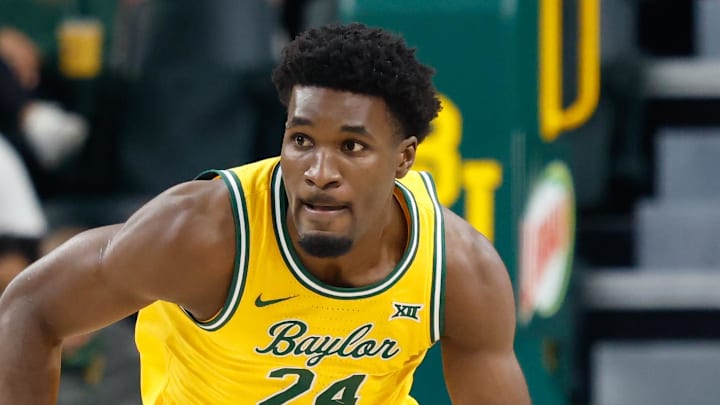
Baylor’s Tounde Yessoufou is a physically imposing wing prospect who has the tools to fit snugly into the NBA, but plenty of ironing out long-term to get there. Even still, he’s predicted to be a worthy project in the upcoming 2026 NBA Draft, having averaged 17.8 points on 47% shooting, 5.8 rebounds and 2.0 steals per game in his lone season with the Bears.
Yessoufou came in as a consensus five-star prospect, the No. 11 player per RSCI, having broken the California all-time scoring record for boys basketball in his time with St. Joseph.
His major strengths include his tools and motor, slashing, defensive-play-making and upside and shooting upside.
Strengths:
Physical Tools and Motor
Right off the bat, Yessoufou feels built in a lab to play on the wing in the NBA. He stands around 6-foot-5, weighing in at 215 pounds per Baylor. Outside of the on-paper measurements, it’s clear he’s a specimen and is able to use his bulky frame on the court to aid him in a variety of different ways: offensively, defensively and plenty of in-between areas.
There’s not yet a nailed-down wingspan for Yessoufou, though he’s obviously playing with plus length. His wide shoulders, strength and overwhelming physicality are the selling points here, though, helping him to get the better of collegiate competition, even when at a disadvantage, which can be somewhat often.
For his size and build, Yessoufou is generally fine as a mover, though he’s not of the quick-twitch mold, not allowing for true explosion both vertically and horizontally. He attempted 22 dunks across 32 games with Baylor, hitting on 18 of those while largely resorting to layups.
Additionally, his lateral movement isn’t elite, without the hip flexibility to twitch and turn on a dime defensively.
Still, Yessoufou shouldn’t stick out as a sore thumb athletically in the NBA, and his tools are made even better by his high motor. He is revving pretty much non-stop, looking to push the pace, crash the glass, attack on defense and more relentlessly. Some frame of references here include a positionally good 5.8 boards per game, and transition and put-backs making up two of his three biggest play-types. The strength is a real plus, helping him to crash the boards, post-up and more.
Ultimately, NBA-ready tools and motor help to set the framework for the project that is Yessoufou.
Slashing
Yessoufou’s slashing is currently his primary selling point as an offensive player, despite his own love for other scoring avenues, which we’ll touch on later.
With his blend of strength, speed and tenacity, Yessoufou had success attacking the rim in a variety of ways with Baylor. He shot 63% at the rim in total with the Bears, making 116 of his 183 total shots, converting on 82% of his dunks and a good 61% of his layups. His at-rim field goals, though, accounted for just 40% of his total shot diet.
For such a bulky player, Yessoufou does a good job of avoiding the unnecessary contract when driving, and is pretty good about powering through when met with it. The touch has generally been a little off-and-on, but I think ended up in a good place following his first season with room to grow.
Yessoufou’s two most efficient modes of offense — and two that could be there at the NBA level as well — were getting out in transition and cutting, the former having really good volume and the latter not so much. He shot 67% on transition twos — a mark made worse by pretty questionable pickup points — and 70% on cuts.
Yessoufou also posted up a lot, able to leverage his size and strength to displace weaker defenders and earn himself easy looks inside, where he shot 54% in total, good for his only excellent grade per Synergy alongside put-backs. That’s kind’ve a unique skill for a wing, but could be serviceable in the right configuration that allows him to exploit mismatches.
Yessoufou also shot 46% on spot-up twos and 38% as the pick-and-roll handler.
For as relentless and physical a driver as he is, Yessoufou’s free throw rate is somewhat concerning at just .28, though he shot around four per game and converted on 74%.
It should be noted that Yessoufou was a real focal point of the Baylor offense this year alongside Cameron Carr, and I think both the gravity of NBA stars and the ever-helpful NBA spacing stand to continue to help Yessoufou out in the slashing department, giving him more space to operate and slip under the radar as a driver.
There’s still work to be done to get this to a workable, truly effective point, but it feels like the most conceivable pathway toward impact.
Defensive Play-Making and Upside
Tounde Yessoufou’s defense is a bit of a loaded category, but in the least he’s exhibited some solid defensive play-making garnering steals and blocks, and has some longer-term upside given his physical profile on the wing.
Yessoufou’s face-value numbers are good: 2.0 steals per game is a good mark regardless of process, and half a block per game is livable as well, with a great steal percentage of 3.6 and a block percentage of 1.6. All in all, though, Baylor was spotty on this end of the floor as well in totality, with him posting a defensive box-plus-minus of just 1.6.
There’s plenty of general good here. Yessoufou’s combination of strength and quickness are the standouts, helping him to guard across a few different positions. He’s not easily displaced with his frame, and has really good hands for his size, able to prod the ball away with consistency.
When he’s engaged and moving, he’s able to stick with guards, or even hold his ground with position against bigger players.
Yessoufou has all the tools to be a theoretically great NBA wing defender, be it at the point of attack or just wreaking havoc off-ball. But I think the actual product leaves some to be desired for now.
There’s a lack of consistency overall. Off-ball there’s some ball-watching tendencies, and on the ball his lack of explosiveness and twitch can leave him a step behind the play.
Right now, Yessoufou’s able to continue to make plays via his natural tools and instincts, but some level of fundamentals and recognition could serve him a lot in the NBA.
Regardless, there’s obvious upside with Yessoufou here on defense if he develops further.
Shooting Upside
The final and potentially most theoretical of Tounde Yessoufou’s strengths would be his perimeter shooting upside, which feels somewhat attainable given the pure volume he’s working with.
Yessoufou fired up 5.4 triples per game with Baylor, good for 9.5 per 100 possessions, pretty aggressive levels of 3-point shot-taking. Despite that, he hit at just a 30% clip, tanking his overall efficiency in the process.
And the game-to-game outings were a little all over the place: 4-for-8 against Memphis, then 1-for-5 against Alcorn, 4-for-7 against Colorado, 2-for-8 against Iowa State, 5-for-8 against BYU, followed up directly by 1-for-7 against Louisville.
There’s a few things working for Yessoufou here and some reason for optimism. The first being cutting out the tougher stuff is a pretty big boon to his numbers. In purely catch-and-shoot situations, Yessoufou shot 34% from beyond the arc, which feels a lot more manageable. Going even further, he shot 42% on unguarded catch-and-shoot threes — which did not happen often, via Baylor’s so-so offense and lack of elite point guard play — and 30% on guarded shots.
Additionally, he shot 35% on spot-up threes, far-and-away what he should be doing the most in the NBA, while converting on just 29% of transition threes, and just 24% of off-screen threes, which should be cut out entirely.
Lastly, Yessoufou seems to be on an upward trajectory in terms of shooting. The numbers may not jump off the page as of March, 2026, but they do seem night and day from the player he was two years ago, which is a positive.
Tie all this together with what I believe to be workable mechanics — baking in some tuning up — his next-level confidence and reportedly incredible work ethic, you likely have a workable 3-point shooter.
In summary, cut out tougher shots, get Yessoufou NBA creators in NBA spacing, continue to refine the mechanics, and he should be able to capitalize better on open triples, then parlaying that into even better slashing.
Areas of Improvement:
Decision-Making and Shot-Selection
Far-and-away Tounde Yessoufou’s most important area of improvement, and really what feels like the only key to shoring up deficiencies and walking away with a really positive NBA player, is upgrading the decision-making and shot-selection.
We’ll start with the pure decision-making, which is step one of poor shot-selection, but can also bleed into areas such as passing, play-making, and even defense.
In looking holistically at Yessoufou’s shortcomings — broad inefficiency, a negative assist-to-turnover, an up-and-down shot diet — there’s some very real questions about his processing as a whole. Even in his slashing, which I’d consider a real plus, there’s some forcing, making things tougher than they are and ill-advised shots.
A higher turnover percentage than passing percentage and 55% true shooting on super high usage all feel pretty indicative of that. His passing processing in general could be a real deterrent for NBA teams if they don’t think they can pare down the offense in general — there’s a lot of missed reads and just a lack of real flexibility in facilitating.
There are flashes of the right process for Yessoufou, slowing down for clean outside jumpers, attacking space and using coordinated, right foot right hand mechanics, ball-moving and passing out of disadvantaged situations. All that offer hope he’ll be able to put things together down the line. But this is where the “project” wing stuff starts, as it feels like an uphill process to tighten up so many things at once.
In terms of the shot-selection, it’s likely as simple as cutting out off-the-dribble jumpers, and just paring things down.
We'll again preface this with the fact Yessoufou was effectively a star for Baylor this season, and some of this stems from their reliance on him to go take and make tough shots. But there’s a genuinely huge chunk of offense that is simply not going to be viable for him at an NBA level early in his career, and probably ever.
Had Yessoufou’s shot profile been everything we’ve mentioned so far — attacking the rim, catch-and-shoot triples, and seldom advantage-creating via his frame in posting-up — it would look fairly translatable. Instead, there’s this huge sample of dribble jumpers and tough mid-range looks kind’ve mucking things up and casting an air of doubt.
And there’s some genuinely interesting stuff strewn throughout these — where he can drive, separate and rise high for smooth-ish jumpers — but it isn't likely that a Tounde Yessoufou mid-range jumper is ever going to be the most effective offense for an NBA team, and his ability to be efficient could very well be tied to buying in on cutting down on things such as these.
The hope is that he buys into an NBA system, and a very pared down role — getting to the rim in easy ways and taking simple, open, catch-and-shoot threes — and that sort’ve unlocks this two-way impact. A la Luguentz Dort.
Handling
Yessoufou could also stand to improve his general handling, which is a pretty natural progression for a well-built, physical, transition-heavy wing.
In tandem with his lack of bend or twitchiness, his handle doesn’t afford him to truly access every spot on the floor. It’s serviceable in spaced-out areas, useable in the open floor and in simple drives toward the basket, but he’s typically more setting up ways to use his physicality than creating real space, which can be an issue all over. There’s just a real lack of true comfort in using it overall.
He doesn’t have a deep dribble arsenal, unable to pair multiple moves together with the right movement to create separation. A really good chunk of his total turnovers are getting loose with the handle and still trying to make plays instead of pulling up and resetting, or trying to pair dribble-moves together, which just isn’t effective at this point.
Even in some of these handling clips, keener decision-making would go a long way. Attacking better angles, knowing when to press the gas or decelerate, just generally kind’ve connecting everything. His pickup points — even despite fine at-rim numbers — can be really questionable, and some of that feels derived from not being able to keep the dribble going longer.
So-so handling shouldn’t be a deal-breaker if Yessoufou is to become a three-and-D slashing wing, but improving it could certainly add to his versatility as a whole, and maybe even help to legitimate some of the on-ball flashes.
Outlook:
Tounde Yessoufou is one of the harder evaluations in the entire 2026 NBA Draft class. There’s a lot about his profile and process right now that screams he’s going to have an uphill battle toward extended positive minutes in the NBA.
But there’s also tons of believable impact with his tools, slashing, upside as a defender and shooter. And all it will take is buy in on his end in the right system to fit all these puzzles pieces together with natural development.
For any teams in need of a high-upside, project energy wing, Yessoufou’s current range is likely to start somewhere in the twenties, and extend to the early second round. A few fits for Yessoufou include the Grizzlies, Heat and Nuggets, all teams that feel like they’ve have some developmental success, and could potentially have some runway to offer.
Range: Late-First to Early-Second
Role: Energy Wing
Impact: Late-Rotation, Rotation Upside
Swing Skills: Decision-Making, Shot-Selection, Handling
Best Fits: Grizzlies, Heat, Nuggets
 Add us as a preferred source on Google
Derek Parker covers the National Basketball Association, and has brought On SI five seasons of coverage across several different teams. He graduated from the University of Central Oklahoma in 2020, and has experience working in print, video and radio.
Follow DParkOK