%22%3E%0A%3Cpath%20d%3D%22M0%205.37646H8.15061L17.4195%2016.8819V5.37646H26.0647V31.4412H18.3227L8.64523%2019.4196V31.4412H0V5.37646Z%22%20fill%3D%22white%22%2F%3E%0A%3Cpath%20d%3D%22M29.2041%205.37649H43.8064C47.4193%205.37649%2049.6989%206.1937%2051.2258%207.72059C52.1505%208.64533%2052.8172%2010.0002%2052.8172%2011.7851V11.8497C52.8172%2014.9465%2050.9462%2016.8389%2048.172%2017.8067C51.5269%2018.7744%2053.6774%2020.5594%2053.6774%2024.1293V24.1938C53.6774%2028.3659%2050.258%2031.4197%2043.6558%2031.4197H29.2041V5.35498V5.37649ZM44.258%2013.7637C44.258%2012.6024%2043.3333%2011.9787%2041.4623%2011.9787H37.6988V15.6346H41.5053C43.3763%2015.6346%2044.258%2015.011%2044.258%2013.8497V13.7852V13.7637ZM42.0859%2020.9895H37.6988V24.8605H42.0644C43.9569%2024.8605%2044.9247%2024.0863%2044.9247%2022.968V22.9035C44.9247%2021.7852%2043.9999%2021.011%2042.0859%2021.011V20.9895Z%22%20fill%3D%22white%22%2F%3E%0A%3Cpath%20d%3D%22M64.8174%205.18286H73.4627L84.452%2031.4411H74.9896L73.6132%2027.9357H64.4949L63.1615%2031.4411H53.8496L64.8389%205.18286H64.8174ZM71.4412%2021.7636L69.054%2015.441L66.6669%2021.7636H71.4412Z%22%20fill%3D%22white%22%2F%3E%0A%3Cpath%20d%3D%22M95.2695%205.37646H105.248C115.592%205.37646%20120.775%2010.4733%20120.775%2018.1938V18.2583C120.775%2025.9788%20115.485%2031.4412%20104.947%2031.4412H95.2695V5.37646ZM104.001%2012.9679V23.8497H105.463C109.442%2023.8497%20112.022%2022.2153%20112.022%2018.4518V18.3873C112.022%2014.6239%20109.463%2012.9894%20105.463%2012.9894H104.001V12.9679Z%22%20fill%3D%22white%22%2F%3E%0A%3Cpath%20d%3D%22M123.098%2011.1182H131.549V15.2258C132.711%2012.4731%20134.56%2010.6881%20137.915%2010.8387V19.8065H137.012C133.442%2019.8065%20131.528%2021.785%20131.528%2026.2797V31.4625H123.076V11.1182H123.098Z%22%20fill%3D%22white%22%2F%3E%0A%3Cpath%20d%3D%22M137.808%2025.6772V25.6127C137.808%2021.5482%20140.818%2019.2901%20145.55%2019.2901C147.27%2019.2901%20149.464%2019.6557%20150.345%2020.0428V19.6987C150.345%2017.8277%20149.184%2016.7524%20146.582%2016.7524C144.496%2016.7524%20142.754%2017.204%20140.969%2017.9137L139.485%2012.3008C141.829%2011.3975%20144.517%2010.8169%20148.044%2010.8169C152.173%2010.8169%20154.862%2011.6771%20156.646%2013.4621C158.173%2014.989%20158.776%2016.9675%20158.776%2019.9137V31.5052H150.324V29.4622C148.904%2030.9891%20147.012%2031.9999%20144.474%2031.9999C140.56%2031.9999%20137.808%2029.7633%20137.808%2025.7417V25.6772ZM150.431%2023.9138V23.0536C149.937%2022.86%20149.206%2022.7095%20148.496%2022.7095C146.818%2022.7095%20145.894%2023.7202%20145.894%2024.9891V25.0536C145.894%2026.2364%20146.754%2027.0321%20147.829%2027.0321C149.313%2027.0321%20150.431%2025.8493%20150.431%2023.9138Z%22%20fill%3D%22white%22%2F%3E%0A%3Cpath%20d%3D%22M162.883%2017.6345H160.496V11.1183H162.883C162.926%208.96778%20163.442%207.20433%20164.711%205.9355C166.088%204.55915%20167.872%204%20170.668%204C173.163%204%20174.69%204.21506%20175.851%204.55914V9.84951C175.034%209.65596%20174.217%209.54843%20173.141%209.54843C171.83%209.54843%20171.163%2010.0646%20171.163%2011.1829V11.3334H175.851V17.6345H171.335V31.4411H162.883V17.6345Z%22%20fill%3D%22white%22%2F%3E%0A%3Cpath%20d%3D%22M178.883%2024.6238V17.613H176.496V11.0968H178.883V6H187.335V11.0968H192.023V17.613H187.335V22.7528C187.335%2024.2797%20188.045%2024.8389%20189.378%2024.8389C190.152%2024.8389%20191.055%2024.6238%20191.937%2024.2152V30.7314C190.604%2031.4411%20188.582%2031.8927%20186.539%2031.8927C181.55%2031.8927%20178.862%2029.5916%20178.862%2024.6238H178.883Z%22%20fill%3D%22white%22%2F%3E%0A%3Cpath%20fill-rule%3D%22evenodd%22%20clip-rule%3D%22evenodd%22%20d%3D%22M201.368%204.36764C207.191%20-1.45588%20216.632%20-1.45588%20222.456%204.36764C228.279%2010.1912%20228.279%2019.6324%20222.456%2025.4559L211.912%2036L201.368%2025.4559C195.544%2019.6324%20195.544%2010.1912%20201.368%204.36764ZM204.009%207.55761C203.948%207.86849%20203.916%208.39718%20203.916%209.14566V10.4189C203.916%2011.1832%20203.948%2011.7198%20204.013%2012.0267C204.078%2012.3317%20204.278%2012.6168%20204.617%2012.8762C204.956%2013.1376%20205.403%2013.3316%20205.958%2013.4623C206.512%2013.593%20207.1%2013.6583%20207.837%2013.6583C208.573%2013.6583%20209.217%2013.591%20209.769%2013.4524C210.322%2013.3158%20210.761%2013.1178%20211.086%2012.8604C211.411%2012.6029%20211.605%2012.3178%20211.666%2012.0069C211.728%2011.6961%20211.759%2011.1674%20211.759%2010.4189V9.14566C211.759%208.38134%20211.728%207.84473%20211.662%207.53781C211.597%207.23287%20211.397%206.94972%20211.058%206.68834C210.72%206.42696%20210.272%206.23291%20209.718%206.10223C209.163%205.97154%20208.536%205.90619%20207.839%205.90619C207.102%205.90619%20206.459%205.97352%20205.906%206.11213C205.352%206.24875%20204.914%206.44677%20204.589%206.70418C204.265%206.9616%20204.071%207.24673%20204.009%207.55761ZM209.276%2024.8638C212.876%2024.8638%20214.557%2024.2064%20214.557%2021.862V21.858V21.3155C214.557%2019.6581%20213.516%2018.971%20210.252%2018.3136C209.278%2018.1136%20208.908%2017.9136%20208.908%2017.3136V16.9414C208.908%2016.6543%20209.177%2016.5117%20209.413%2016.5117C209.749%2016.5117%20209.918%2016.7137%20209.918%2016.9414V18.1136H214.391V17.3988C214.391%2015.4563%20213.347%2014.4266%20209.177%2014.4266C206.15%2014.4266%20203.896%2015.3414%20203.896%2017.3711V17.7433C203.896%2019.5155%20204.805%2020.3155%20208.201%2021.0303C208.28%2021.0472%20208.355%2021.063%20208.427%2021.0781C209.329%2021.2674%20209.647%2021.3341%20209.647%2021.9174V22.2897C209.647%2022.6619%20209.546%2022.8045%20209.142%2022.8045C208.67%2022.8045%20208.637%2022.5471%20208.637%2022.262V21.2897H203.894V21.7471C203.894%2024.149%20205.476%2024.8638%20209.276%2024.8638ZM215.424%2024.5569H219.925V14.7355H215.424V24.5569ZM216.955%2013.5019H219.925V6.06064H217.092V9.411L215.193%206.06064H212.359V13.5019H215.193V10.1199L216.955%2013.5019ZM208.269%2012.152C208.204%2012.2688%20208.055%2012.3262%20207.825%2012.3262L207.827%2012.3282C207.604%2012.3282%20207.459%2012.2767%20207.398%2012.1757C207.336%2012.0748%20207.305%2011.8074%20207.305%2011.3758V7.90068C207.305%207.51852%20207.352%207.28684%20207.445%207.20962C207.538%207.13239%20207.675%207.09279%20207.851%207.09279C208.059%207.09279%20208.198%207.14031%20208.265%207.23734C208.332%207.33239%20208.366%207.55416%20208.366%207.90068V11.3203C208.366%2011.7579%20208.334%2012.0352%20208.269%2012.152Z%22%20fill%3D%22white%22%2F%3E%0A%3C%2Fg%3E%0A%3Cdefs%3E%0A%3CclipPath%20id%3D%22clip0_15247_3640%22%3E%0A%3Crect%20width%3D%22227%22%20height%3D%2236%22%20fill%3D%22white%22%2F%3E%0A%3C%2FclipPath%3E%0A%3C%2Fdefs%3E%0A%3C%2Fsvg%3E%0A)
NBA Draft Scouting Report: Baylor Wing Cameron Carr
In this story:
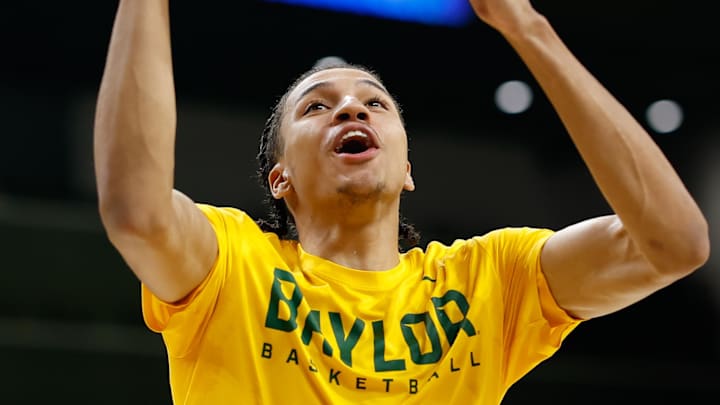
Cameron Carr has been one of college basketball’s breakout players this season, leading the Baylor Bears in scoring this year, albeit in a slightly down year for the program.
He’s a lengthy wing that was a top-60 recruit per RSCI out of Link Academy, but saw two essential non-factor seasons with Tennessee, playing just 18 games at 2.3 points per game. After an injury he would enter the portal, and has now fully broken out in his redshirt sophomore season with the Bears. He’ll be 21-and-a-half on draft night.
Carr is set to offer elite 3-and-D upside on the wing at the NBA level, with his major strengths being his combination of physical tools and athleticism, 3-point shooting, off-ball scoring and defensive upside.
Cameron Carr Scouting Report
Strengths:
Physical Tools and Athleticism
Carr’s a skilled played generally, but plenty of his NBA projection lies within his combination of physical tools and athleticism, which is pretty unique as far as scoring wings go.
Carr stands at 6-foot-5 and a slimmer 190 pounds per Baylor, with a wingspan just under 7-foot-2 per his sophomore season bio with Tennessee. It could very well be that long given his play-style and some telling numbers. But even if it’s not quite that long, he very obviously has long arms that he utilizes well.
In tandem with the length is his verticality, which is potentially second to none in this class as far as pure vertical pop and explosion goes. He’s a functional high-flier, able to utilize his leaping to elevate for dunks and finishes on offense, and even block shots on defense.
He’s dunked the ball 44 times and blocked 40 shots through 28 games, elite marks for a 6-foot-5 wing. I also think his rebounding is aided by this at a positionally great 5.6 per game.
Even more than his traditional athleticism, Carr’s a fluid mover with some bend to him. He takes long strides, can change directions quickly, and his north-south movement isn’t too far behind his verticality.
These things of course aren’t the end all for a prospect, but mixed with his production help paint the picture of how easy his NBA projection is in terms of size and role.
Shooting
The most immediately translatable skill for Carr, as well as one of his key selling points, would be his 3-point shooting, which is elite as far as more toolsy wings go.
Across his redshirt sophomore season with Baylor, he’s shooting 5.6 triples per game — good for 9.5 per 100 possessions — and hitting at about a 38% clip.
This is certainly not any sort of one-off season in terms of percentages. Carr has clear shooting feel and fluid, high-release mechanics. It’s not the quickest release, as he needs to wind up some given a lack of true strength, but it’s more than serviceable and stands to quicken over time, and he can speed it up in a pinch.
He’s very balanced when getting into his shooting motion, displaying a lot of poise and focus generally while shooting. All the shot prep stuff is good.
Sixty-three percent of Carr’s 3-point attempts so far this season have been catch-and-shoot, though he’s rarely completely stationary as one of Baylor’s top scorers, instead flying around shooting off movement at an elite level. His catch-and-shoot attempts have mostly been guarded, where he’s seen almost no drop-off from 40% unguarded to just 38% with contests. The rest of his 3-point diet is obviously off the dribble, and he’s still hitting at a great 36% mark on those.
In terms of play-types, he’s obviously spotting up the majority of the time, shooting 39% from three in those situations, and the rest is evenly spread across pick-and-roll handler, transition and off-screen reps. He’s notably shooting 50% from three as the PnR handler, pointing to some interesting upside there, and just 29% in transition, where he’s far more dangerous as a threat to get to the rim with the aforementioned athleticism.
The other note would be on his off-screen work, which should be an obvious NBA skill at 40% on so-so volume with Baylor, less than one attempt per game.
Again, he has premier focus while shooting on the move, a skill that should add to his versatility plenty at the NBA level, in addition to generally easier looks that will be created for him.
Even more, Carr’s showcases a lot of confidence here with genuinely limitless range, able to extend far beyond even the NBA 3-point with real consistency. This, in tandem with his consistency across so many different shots, are a few legs up that he has over other notable shooters.
All in all, Carr’s general 3-point versatility is an obvious weapon, and only set to be aided by the spaced-out NBA.
Off-Ball Scoring
Shooting obviously fits into Carr’s off-ball scoring package, but all of the aforementioned pros — tools, athleticism and 3-point gravity — allow him to be a really potent off-ball scorer in general, getting out in transition, slashing and more.
Carr has a scorer’s mentality, not just looking to get into his 3-point shot, but aiming to get downhill as well, utilizing his athleticism to finish at the rim, or even lift for pull-up jumpers, making him a genuine three-level threat.
Carr has a great feel for when to attack, be it mashing the gas pedal in transition, or pinpointing space in the half court, with a fine handle that’s already seen improvement, but could stand just a little bit more.
Given his perimeter gravity Carr is great at attacking closeouts or parlaying his movement right into cuts toward the basket. At this point you’ve obviously seen the explosive dunk package, but he’s a phenomenal finisher in general at 68% overall, 88% on a high volume of dunks, and 61% on layups. His flexibility and body control is really on display here, as he can elevate, warp around contests or take nice angles toward the ring. His non-dunk finishing is pretty feathery given how explosive the dunking is, and he’s even shown flashes of a usable floater which would be a pretty unreal counter for a player of his type.
Carr’s scored the bulk of his total points spotting up and getting out in transition. Where he was a little more hot and cold, respectively, from three in these areas, he’s blistering from inside the arc in both.
He’s shooting 68% on spot-up two-pointers. He has a lightning-quick first-step when he recognizes a lane off the catch, and can also use pump-fakes to carve a path forward. He still shades more toward the 3-point spotting up, with about 68% percent of his shots coming beyond the arc, but his slashing here is a weapon.
The opposite is true in transition, where he likes to work downhill much more often, two-pointers accounting for over 70% of those attempts. He can turn on the nos, keeps his head up and is able to navigate space pretty well in the open floor.
The other aspect of Carr’s off-ball scoring is his cutting, which is elite at the collegiate level, albeit on slightly more limited volume than the other areas because of the gravity he brings and the necessity in which Baylor needs him on the ball.
Carr is shooting a blistering 91% on his cuts, 29-for-32 overall. If you give him space of any sort, or a path to the rim, there’s a good chance he’s either going to convert a dunk or easy layup, or at the very least is going to get fouled. Which is the mark of a true off-ball weapon that’s going to draw some attention in some capacity. He’ll certainly be a useable dunker-spot option with his athleticism, just adding to his versatility.
Overall, Carr’s an obvious off-ball weapon at all three levels who should be able to blend pretty seamlessly into NBA schemes with tools, efficiency and skill.
Defensive Upside
Carr isn't yet a good or even immediately average defender at the NBA level, but there’s clearly tons of upside here in both the tools and production that isn’t typical of wings that shade this much toward scoring.
All of the same rules apply for Carr on the defensive end of the court, he’s long, can fan out, move fluidly, and show off the vertical pop on contests. In terms of the pure numbers, he’s registering 2.3 stocks per game, 1.4 blocks and 0.9 steals.
To this point Carr’s mostly a disruptor on the defensive end, racking up steals and deflections in passing lanes with long arms, and soaring for both weak-side blocks, as well as getting a hand on shots on the perimeter, which are probably his best defensive skills at the moment.
This is really where you see Carr’s ground coverage come into play: he can eat it up quickly, closing out on the perimeter or closing gaps on the interior fast enough to help contest or blocks shots at a great rate positionally, posting a 4.2 block percentage so far this season.
You’d probably like to see a few more steals given just how long he is, but these things do lend themselves toward a pretty high floor and ceiling as an off-ball defender, mostly guarding across twos and threes.
Carr’s on-ball defense is mostly theoretical to this point. He’s not yet elite at the point of attack, and can be delayed navigating screens.
The upside portion for Carr lies within his 6-foot-5 frame, long arms, vertical pop and graceful movement, all tools that should give him a leg up in developing into a player that could guard across tons of different positions. Not just in the middle of the lineup but quicker guards or bulkier, strength-based forwards. A player that could potentially hound at the point of attack, or navigate screens better than he does now.
Adding strength will be far-and-away the most important aspect of this, as we’ll touch on.
Teams will ultimately need to weigh just how much they can add to his game defensively, but should be able to take solace in his off-ball skill and general play-making in steals and blocks.
Areas of Improvement:
Strength and Physicality
For NBA Draft on SI and plenty of other evaluators, added strength and physicality is the No. 1 area of improvement for Cameron Carr, given he’s pretty slight as it currently stands. The leap to the bigger-faster-stronger NBA, where plenty of players have measurements and athleticism closer to Carr, can be a big jump for many.
Adding strength and filling out a frame some should happen naturally through a prospect’s career, and that shouldn’t be any different for Carr, but there are some issues likely to pop up here and there due to current deficiencies. And while he’ll of course continue to develop for several seasons, his age at 21-and-a-half on draft night feels like a small hit to the ceiling in this area.
Adding strength stands to help him the most when he’s not in position to simply elevate over defenders when getting downhill, as well as generally playing better defense on the ball. There’s a myriad of other ways simply being sturdier helps, but not being bumped off spots, powering through contact at the rim, and maintaining position on defense would all be big plusses to Carr’s game when his tools and athleticism don’t fully bridge the gap.
Carr doesn't shy away from playing physical basketball by any means — dive-bombing the rim and sticking his nose in to block shots on defense — and for a leading scorer he’s got some real hustle and motor to him as well. But this is more a note that he’ll certainly need to continue that trend to maximize his skills at the NBA level. And again, things turn up a notch in the association.
Strength could be the difference between Carr being a true two-way handful on the wing, able to shoot, slash and guard well across different matchups, or simply playing well in a few areas in spite of his slight frame.
Shot-Selection and Decision-Making
The last thing to note here is Cameron Carr’s shot-selection and decision-making, and much like the aforementioned physicality. Neither of these things are necessarily bad right now, but they’ll both be crucial inflection points as to where he levels out as a role player in the NBA.
In terms of shot-selection, Carr can take some potentially ill-advised 3-pointers and contested layups. Some of this is simply his role with Baylor being a go-to scoring option, and some of it is likely his simple confidence in these shots on-ball, both of which are understandable. Ideally NBA systems will likely want to pare some of this down, and that takes some buy-in on the player’s end.
Carr’s decision-making is fairly solid. He shows pro-level process pretty often, he’s not a massively sticky player, flows well within the offense, and has showcased some intriguing passing with a baseline of ball-moving at 2.7 assists to 2.4 turnovers per game.
Again, where he lands as a decision-maker within an NBA scheme could raise or lower his floor and ceiling. The low-end is pretty good, but there’s certainly some room for added processing of the game overall.
Outlook:
Cameron Carr is set to offer a prototypical modern wing with some provenness across a variety of different areas: 3-point shooting, jump out of the gym athleticism, finishing, off-ball defensive impact. All of these things could be perfect additive to NBA rotations long-term.
There’s certainly improvement areas, continuing to build out his physical profile and shoring up areas such as shot-selection and decision-making, but these ultimately feel kind’ve like small potatoes in the grand scheme of things, offering a pretty nice high-floor wing with some upside.
There could be several late-lottery teams looking to contend that are in need of a scoring wing, and it wouldn’t be shocking if Carr heard his name called there. The more likely scenario is true freshmen will be slightly more coveted as upside swings, and he’ll fall to a team in the middle of the first round, with somewhere in the 20’s being his floor.
Some nice fits for Carr include the Toronto Raptors, Trail Blazers and Spurs, due to those organizations gravitation toward tools and long-term need for 3-point shooting.
Role: Off-Ball Scoring Wing
Range: Late-Lottery to Late-First
Impact: Late-Rotation, Starter Potential
Swing Skills: Strength
Best Fits: Raptors, Trail Blazers, Spurs
 Add us as a preferred source on Google
Derek Parker covers the National Basketball Association, and has brought On SI five seasons of coverage across several different teams. He graduated from the University of Central Oklahoma in 2020, and has experience working in print, video and radio.
Follow DParkOK