%22%3E%0A%3Cpath%20d%3D%22M0%205.37646H8.15061L17.4195%2016.8819V5.37646H26.0647V31.4412H18.3227L8.64523%2019.4196V31.4412H0V5.37646Z%22%20fill%3D%22white%22%2F%3E%0A%3Cpath%20d%3D%22M29.2041%205.37649H43.8064C47.4193%205.37649%2049.6989%206.1937%2051.2258%207.72059C52.1505%208.64533%2052.8172%2010.0002%2052.8172%2011.7851V11.8497C52.8172%2014.9465%2050.9462%2016.8389%2048.172%2017.8067C51.5269%2018.7744%2053.6774%2020.5594%2053.6774%2024.1293V24.1938C53.6774%2028.3659%2050.258%2031.4197%2043.6558%2031.4197H29.2041V5.35498V5.37649ZM44.258%2013.7637C44.258%2012.6024%2043.3333%2011.9787%2041.4623%2011.9787H37.6988V15.6346H41.5053C43.3763%2015.6346%2044.258%2015.011%2044.258%2013.8497V13.7852V13.7637ZM42.0859%2020.9895H37.6988V24.8605H42.0644C43.9569%2024.8605%2044.9247%2024.0863%2044.9247%2022.968V22.9035C44.9247%2021.7852%2043.9999%2021.011%2042.0859%2021.011V20.9895Z%22%20fill%3D%22white%22%2F%3E%0A%3Cpath%20d%3D%22M64.8174%205.18286H73.4627L84.452%2031.4411H74.9896L73.6132%2027.9357H64.4949L63.1615%2031.4411H53.8496L64.8389%205.18286H64.8174ZM71.4412%2021.7636L69.054%2015.441L66.6669%2021.7636H71.4412Z%22%20fill%3D%22white%22%2F%3E%0A%3Cpath%20d%3D%22M95.2695%205.37646H105.248C115.592%205.37646%20120.775%2010.4733%20120.775%2018.1938V18.2583C120.775%2025.9788%20115.485%2031.4412%20104.947%2031.4412H95.2695V5.37646ZM104.001%2012.9679V23.8497H105.463C109.442%2023.8497%20112.022%2022.2153%20112.022%2018.4518V18.3873C112.022%2014.6239%20109.463%2012.9894%20105.463%2012.9894H104.001V12.9679Z%22%20fill%3D%22white%22%2F%3E%0A%3Cpath%20d%3D%22M123.098%2011.1182H131.549V15.2258C132.711%2012.4731%20134.56%2010.6881%20137.915%2010.8387V19.8065H137.012C133.442%2019.8065%20131.528%2021.785%20131.528%2026.2797V31.4625H123.076V11.1182H123.098Z%22%20fill%3D%22white%22%2F%3E%0A%3Cpath%20d%3D%22M137.808%2025.6772V25.6127C137.808%2021.5482%20140.818%2019.2901%20145.55%2019.2901C147.27%2019.2901%20149.464%2019.6557%20150.345%2020.0428V19.6987C150.345%2017.8277%20149.184%2016.7524%20146.582%2016.7524C144.496%2016.7524%20142.754%2017.204%20140.969%2017.9137L139.485%2012.3008C141.829%2011.3975%20144.517%2010.8169%20148.044%2010.8169C152.173%2010.8169%20154.862%2011.6771%20156.646%2013.4621C158.173%2014.989%20158.776%2016.9675%20158.776%2019.9137V31.5052H150.324V29.4622C148.904%2030.9891%20147.012%2031.9999%20144.474%2031.9999C140.56%2031.9999%20137.808%2029.7633%20137.808%2025.7417V25.6772ZM150.431%2023.9138V23.0536C149.937%2022.86%20149.206%2022.7095%20148.496%2022.7095C146.818%2022.7095%20145.894%2023.7202%20145.894%2024.9891V25.0536C145.894%2026.2364%20146.754%2027.0321%20147.829%2027.0321C149.313%2027.0321%20150.431%2025.8493%20150.431%2023.9138Z%22%20fill%3D%22white%22%2F%3E%0A%3Cpath%20d%3D%22M162.883%2017.6345H160.496V11.1183H162.883C162.926%208.96778%20163.442%207.20433%20164.711%205.9355C166.088%204.55915%20167.872%204%20170.668%204C173.163%204%20174.69%204.21506%20175.851%204.55914V9.84951C175.034%209.65596%20174.217%209.54843%20173.141%209.54843C171.83%209.54843%20171.163%2010.0646%20171.163%2011.1829V11.3334H175.851V17.6345H171.335V31.4411H162.883V17.6345Z%22%20fill%3D%22white%22%2F%3E%0A%3Cpath%20d%3D%22M178.883%2024.6238V17.613H176.496V11.0968H178.883V6H187.335V11.0968H192.023V17.613H187.335V22.7528C187.335%2024.2797%20188.045%2024.8389%20189.378%2024.8389C190.152%2024.8389%20191.055%2024.6238%20191.937%2024.2152V30.7314C190.604%2031.4411%20188.582%2031.8927%20186.539%2031.8927C181.55%2031.8927%20178.862%2029.5916%20178.862%2024.6238H178.883Z%22%20fill%3D%22white%22%2F%3E%0A%3Cpath%20fill-rule%3D%22evenodd%22%20clip-rule%3D%22evenodd%22%20d%3D%22M201.368%204.36764C207.191%20-1.45588%20216.632%20-1.45588%20222.456%204.36764C228.279%2010.1912%20228.279%2019.6324%20222.456%2025.4559L211.912%2036L201.368%2025.4559C195.544%2019.6324%20195.544%2010.1912%20201.368%204.36764ZM204.009%207.55761C203.948%207.86849%20203.916%208.39718%20203.916%209.14566V10.4189C203.916%2011.1832%20203.948%2011.7198%20204.013%2012.0267C204.078%2012.3317%20204.278%2012.6168%20204.617%2012.8762C204.956%2013.1376%20205.403%2013.3316%20205.958%2013.4623C206.512%2013.593%20207.1%2013.6583%20207.837%2013.6583C208.573%2013.6583%20209.217%2013.591%20209.769%2013.4524C210.322%2013.3158%20210.761%2013.1178%20211.086%2012.8604C211.411%2012.6029%20211.605%2012.3178%20211.666%2012.0069C211.728%2011.6961%20211.759%2011.1674%20211.759%2010.4189V9.14566C211.759%208.38134%20211.728%207.84473%20211.662%207.53781C211.597%207.23287%20211.397%206.94972%20211.058%206.68834C210.72%206.42696%20210.272%206.23291%20209.718%206.10223C209.163%205.97154%20208.536%205.90619%20207.839%205.90619C207.102%205.90619%20206.459%205.97352%20205.906%206.11213C205.352%206.24875%20204.914%206.44677%20204.589%206.70418C204.265%206.9616%20204.071%207.24673%20204.009%207.55761ZM209.276%2024.8638C212.876%2024.8638%20214.557%2024.2064%20214.557%2021.862V21.858V21.3155C214.557%2019.6581%20213.516%2018.971%20210.252%2018.3136C209.278%2018.1136%20208.908%2017.9136%20208.908%2017.3136V16.9414C208.908%2016.6543%20209.177%2016.5117%20209.413%2016.5117C209.749%2016.5117%20209.918%2016.7137%20209.918%2016.9414V18.1136H214.391V17.3988C214.391%2015.4563%20213.347%2014.4266%20209.177%2014.4266C206.15%2014.4266%20203.896%2015.3414%20203.896%2017.3711V17.7433C203.896%2019.5155%20204.805%2020.3155%20208.201%2021.0303C208.28%2021.0472%20208.355%2021.063%20208.427%2021.0781C209.329%2021.2674%20209.647%2021.3341%20209.647%2021.9174V22.2897C209.647%2022.6619%20209.546%2022.8045%20209.142%2022.8045C208.67%2022.8045%20208.637%2022.5471%20208.637%2022.262V21.2897H203.894V21.7471C203.894%2024.149%20205.476%2024.8638%20209.276%2024.8638ZM215.424%2024.5569H219.925V14.7355H215.424V24.5569ZM216.955%2013.5019H219.925V6.06064H217.092V9.411L215.193%206.06064H212.359V13.5019H215.193V10.1199L216.955%2013.5019ZM208.269%2012.152C208.204%2012.2688%20208.055%2012.3262%20207.825%2012.3262L207.827%2012.3282C207.604%2012.3282%20207.459%2012.2767%20207.398%2012.1757C207.336%2012.0748%20207.305%2011.8074%20207.305%2011.3758V7.90068C207.305%207.51852%20207.352%207.28684%20207.445%207.20962C207.538%207.13239%20207.675%207.09279%20207.851%207.09279C208.059%207.09279%20208.198%207.14031%20208.265%207.23734C208.332%207.33239%20208.366%207.55416%20208.366%207.90068V11.3203C208.366%2011.7579%20208.334%2012.0352%20208.269%2012.152Z%22%20fill%3D%22white%22%2F%3E%0A%3C%2Fg%3E%0A%3Cdefs%3E%0A%3CclipPath%20id%3D%22clip0_15247_3640%22%3E%0A%3Crect%20width%3D%22227%22%20height%3D%2236%22%20fill%3D%22white%22%2F%3E%0A%3C%2FclipPath%3E%0A%3C%2Fdefs%3E%0A%3C%2Fsvg%3E%0A)
NBA Draft Scouting Report: Duke's Cameron Boozer
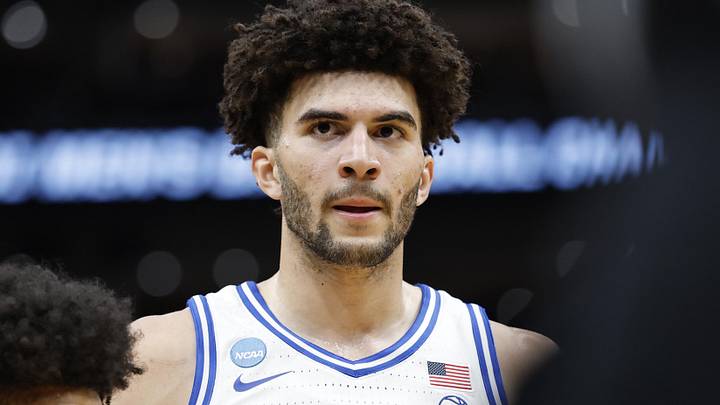
Duke’s Cameron Boozer put together one of the best collegiate seasons ever seen for a true freshman, making an unprecedented impact statistically while leading the Blue Devils to an Elite Eight appearance that ended in heartbreak.
He’s a forward who ranked No. 3 per RSCI, standing at about 6-foot-9, and a very stout 250 pounds. There are no official wingspan measurement, though there’s some unofficial listings out there that it’s in the 7-foot range, which would back up his otherworldly production. He averaged 22.5 points, 10.2 rebounds, 4.1 assists and 1.4 steals per game while shooting 56% overall, 39% from three and 79% from the line.
Boozer’s major strengths include his pure strength and motor, scoring versatility, passing and play-making, feel for the game and high basketball IQ.
Strengths:
Strength and Motor
Cameron Boozer’s first strength is just that, his overwhelming functional strength that, when paired with a motor that doesn’t quit, fueled the single most productive freshman we’ve ever seen.
His pure strength bleeds into just about every area of his game in positive ways. While he doesn’t have elite height for a big, he has a wide, sturdy, pro-ready frame that belies a much older, bigger prospect.
Boozer takes the fight to the opposition often, going right through defenders or wisely angling his shoulders and elbows to create space. He has a true love for physicality, and is among the tougher more composed players while playing through contact that I’ve seen, which the numbers bear out across the board.
Boozer can also just anchor down and position himself, be it on a post-up, while defending in the paint on or off-ball, and especially rebounding. He’s an immoveable force in these scenarios, with tree trunk legs that can help him maintain position regardless of the size mismatch. He’s really good about keeping his pivot foot down, which was especially notable given his volume at Duke.
Boozer was one of the more prolific rebounders in college basketball, grabbing 10.2 per game, 6.9 on the defensive glass and 3.4 on offense. He posted a 17.6 total rebounding percentage, 22% defensive rebounding percentage and 12.5 offensive rebounding percentage, all truly elite numbers.
He is a gravitational rebounder, not using elite verticality, but rather his combination of strength, positioning, instincts and grapple-hook hands.
All of this is made better by Boozer’s motor, which is just relentless as he runs the floor both ways, posts up, stretches to the perimeter, crashes the glass and more.
One under-discussed aspect of this area is that Boozer is still-18, with years and years to continue developing physically. He may be physically closer to his peak than some of his peers, but there’s little question he’ll still mature somewhat being just 18.
Plenty point to this area as a reason that Boozer won’t be able to succeed at the next level, naming it as the sole reason he’s been able to dominate at the collegiate level. That’s largely untrue, as there’s plenty of strong players unable to bear even a slight resemblance to Boozer’s production.
But even if it was a big reason, that’s not necessarily a bad thing. You would be hard-pressed to name any of the NBA’s top players that don’t use strength to advantage create on a night-to-night basis. And Boozer also has plenty of skill, which we’ll get into, but his strength is certainly a catalyst for a lot of his production.
Scoring Versatility
Boozer’s earned a “bully ball,” reputation at the college level. But there’s plenty more than meets the eye here, with genuine scoring versatility across the board.
Having averaged 22.5 points on 56% shooting as an 18-year-old true freshman, there’s effectively no way Boozer was simply bullying his way to that level of production, though his strength-based creation does make up the majority of his advantages. There’s tons of skill layered across his game too, with him functioning as an algorithmic terminator capable of spitting out the right play nine times out of ten.
Boozer split his time feasting on the interior and facing up, processing the entire floor in both ways. Sixty four percent of his field goals came at the rim, and 28% coming on various jumpers.
Boozer has a wizened interior game, shooting 64% at the rim in total on very high volume. He shot 60% on 289 layups and 95% on dunks, mostly functioning as a below the rim finisher, though lifting on occasion at 38 dunks across 38 games. Despite that lack of vertical explosion, he has tons of crafty footwork, post moves and a touch-y finishing arsenal, going off the glass, using hook shots and floaters, scoops and plenty more. Perhaps most importantly he can finish expertly with either hand.
His interior scoring is largely built on technique and fundamentals, and when paired with the raw strength creates a real handful.
The versatility part of the equation comes in the various ways that Boozer prospered with Duke. Plenty of that was posting up, scoring 171 points on elite 62% shooting. But he also graded excellent per Synergy cutting, in transition, on put-backs and spotting up, with other viable play-types being rolling, handling and even isolation.
Boozer shot 71% on cuts, largely navigating toward open space with acute court awareness. He got out in transition and hit at 60% with great mobility for his size, crashed the glass on offense and timed tips well at 72%, He largely shot from distance while spotting up, but also has the ability to attack off the dribble, using simple but effective moves to slice downhill with quickness to get by fellow bigs. He shot 53% as the roll-man, 42% as a 6-foot-9 pick-and-roll handler and 51% in isolation.
At some level, Boozer does kind’ve work the strength creation into every area. Plays with him as the handler can look akin to a more stretched-out version of posting up if you’re squinting as he’s backing someone down from the free throw line. But there’s also a lot of skill, a lot of craft and feel.
And NBA teams will be able to use and deploy him in so many different ways to get him into 1-on-1 matchups that he can exploit, be it slow-footed bigs or smaller players. Especially seeing as plenty of Boozer’s best stuff is complimentary, off-ball impact.
Shooting
The 1B to Boozer’s scoring versatility is what really makes all the offensive puzzle pieces fit together in his perimeter shooting, which is among the best ever among big prospects.
Boozer shot 39% from three on 3.6 attempts per game, already placing himself among elite floor-stretching prospects. He doesn’t have the single most aesthetic shot form, but he has very replicable mechanics, the volume, confidence and touch to project this to be a continued weapon.
Boozer’s at his best simply catching-and-shooting, hitting on 41% of his catch-and-shoot shots, being largely unbothered by contests at 39% guarded and 42% unguarded on similar volume. Despite his best work being stationary, he did shoot a great 37% on dribble-jumper threes, primarily on one-to-two dribble counters that gave him the necessary room to fire shots off.
Most importantly, Boozer was massively effective in all the ways he’ll be used as a floor stretcher in the NBA: 49% spotting up, 42% as the pick-and-roll handler — taking advantage of bigs dropping too quickly — and 44% on pick-and-pops.
Play-types like 27% from three in transition, 23% off-screen and 33% in isolation brought his already good percentages down somewhat. And aren’t likely to be his top options in the association anyways.
Ultimately, Boozer is a proven shooter, offering a highly valuable skill as a floor-stretching big, with the potential to parlay that into an even more dangerous downhill game.
Passing and Play-Making
Boozer’s passing and play-making is one of the centerpieces of his game, boasting 4.1 assists to 2.5 turnovers per game, a positive ratio of 1.6 and an assist percentage of 26% — all truly elite numbers for a big of his archetype.
Boozer doesn’t have the flashiest passing mixtape you’ll ever lay eyes on, but much like his scoring, he can input the game and make the right play time and again.
He’s a highly-connective passer, able to process the game at lightning speed. He makes smart reads time and again, expertly surveying the floor. He’s consistently accurate in hitting shooting pockets, and able to put a ton of zip and velocity on his passes, be it simple ball-moving or grabbing-and-going in transition, where his outlet passes are truly elite. He’s at his best stationary, reading and reacting while offense flows, but he can also pass on the move, which is especially impressive given his size.
As a play-maker, Boozer has hub upside, likely as soon as his rookie season. He can truly quarterback offense, parlaying his own scoring gravity very naturally into making players for others. He’s anticipatory and manipulative, all things rarely seen in a player of his size and position.
Boozer can run dribble-handoffs with his wide frame and sturdy screens. He can operate big-big actions in the pick-and-roll or in high-low actions in the high-post. He’s elite in the short roll with feathery touch to cutters or quick-fire accuracy to shooters. His post-game is made all the more versatile by his ability to read the help and immediately make the right play — be it near or far. And that could help to make post-ups even more viable, as teams won’t be able to double-him in disadvantaged situations without him capitalizing.
Boozer did get a little turnover prone down the stretch of the season, as competition ramped up and teams sold out to stop him. He averaged 4.1 turnovers per game across seven games in the ACC and NCAA tournaments, though still maintained a positive assist-to-turnover ratio. And one would expect the spaced-out NBA, pro weapons and added time as a play-maker will continue his growth in this area.
Boozer’s passing and play-making is just another layer of what makes him such a unique player at 6-foot-9.
Feel for the Game
If you hadn’t guessed by now, Boozer has premier feel for the game, which branches across his skillset. From his counter-laden, versatile scoring game, his efficiency at every level, the formulaic passing and ability to win in all the in-between areas, such as rebounding, screening and more.
It’s easy to envision Boozer as a floor-raiser on just about any team, with his game being both highly-complimentary, but offering plenty of upside as well. He won’t be pigeonholed to any one scheme, with adaptability across a several play-styles offensively given his passing, shooting and rebounding.
Accolades are to be taken with a grain of salt in terms of NBA context, but Boozer’s truly been a winning machine for the last half-decade, rattling off four-straight high school titles, multiple AAU accomplishments, gold medals with Team USA, and finally a 35-3 record with Duke that yielded an Elite Eight appearance and a likely National Player of the Year win for Boozer himself.
Some are quick to place a ceiling on Boozer for the limitations we’ll touch on shortly, and there’s plenty of merit to some of it. But players with this level of feel for the game also have a way of pushing past limitations, and Boozer feels of that mold with his production and affinity for winning.
Areas of Improvement:
Athleticism
Boozer’s areas of improvement all start with athleticism, which spans to both his offense and defense. This could also be labeled as more an area to consider, opposed to improve, given how hard to can be to simply become a better athlete. Though there are a handful of positive cases.
Boozer’s burly frame is a major plus, but his more traditional athleticism leaves plenty to be desired. As previously stated, he lacks vertical explosiveness and is not a consistent above the rim athlete, which does hurt some in a really rangy, vertical NBA.
More concerning is the certain level of stiffness, and lack of real bend and flexibility that is layered across his movement in general. Boozer is not a twitchy athlete, with so-so foot speed and limited hip flexibility made better by his processing and decision-making. He instead relies on his coordination and IQ to gain advantages, and it can lead to a lack of aesthetics on his game overall.
In tandem with the fact that Boozer is a bit of an odd size for a true NBA big at 6-foot-9, it can create several questions marks about how he’s going to replicate all of his success in the bigger, faster, stronger NBA.
Defense
Boozer’s lesser athleticism rears its head the most on the defensive end of the court, where most of those questions marks hang around.
For context, Boozer split his time at Duke playing as the essential five, but also playing alongside a rim-protector in Patrick Ngongba.
For the record, Boozer was a great defender at the college level, and the numbers bear that out: 1.4 steals and 0.6 blocks per game for 2.0 stocks in total, an elite 2.5 steal percentage that highlight his adept hands and instincts for disruption. And a defensive box-plus minus of 6.0 — which paint the picture of how his feel bleeds into this area.
Boozer continues to be disciplined and technical on this end. His processing and game-reading carries right over into positioning, where his 1-of-1 strength helps. He understands how offense is flowing when surveying on defense as well, able to rotate and play anticipatory team defense with the best of them.
Despite all the verifiable good, there’s also some bad.
Far-and-away the biggest concern would be pure rim protection, as none of the measure-ables, stats or eye test confirm that Boozer will be able to protect the rim at a high or even mediocre level in the NBA. He posted just 0.6 blocks per game, good for a 2.2% block percentage, which even accounting for time spent at the four, isn’t great.
There’s no real concerns from a strength and physicality perspective, but his ability to consistently alter, much less block interior shots are certainly up in the air given the lack of elite height and vertical pop.
Positionally, that likely makes Boozer best suited to be a four who will need to defend more mobile players, potentially on the perimeter. While there’s certain to be numerous players of his size and mold that he can match up fine against, there will also be plenty in that scenario that are entirely perimeter-based.
Enter: defensive problem No. 2. Boozer’s feel, anticipation and active hands allowed him to switch on the perimeter plenty at the college level. But his projection at the NBA level is murkier given the limitations, namely the lack of elasticity that would allow for truly hanging with quick handlers.
Plenty expect Boozer to be serviceable in stints at the five, and defensively a wash or even impactful in stints at the four due to his level of feel for the game. But there will be almost certainly be a learning curve here, and it’s clear his pure upside is the least of his No. 1 counterparts here.
Outlook:
Cameron Boozer’s put together one of the most prolific seasons we’ve ever seen as a teenager in college basketball, notwithstanding an Elite Eight run that was a hero-shot away from a Final Four berth.
He brings endless winning skills and drive within a pro-ready frame wrapped up in a high-feel bow. Most of cons across his profile — save for rim protection — don’t even show up statistically, really just in broad projections about how his scoring and defense will transfer over.
That sounds like plenty of the non-uber athletic stars that have made their way through the draft ranks and just found a way to make things work at the NBA level. And one shouldn't be quick to be the one to hard-cap Boozer’s potential.
There will be NBA teams in accord with that thought process, with a potential need for production pushing him to No. 1 on some boards. There will also rightfully be teams enamored with the more engine-like, creation-slanted players like AJ Dybantsa and Darryn Peterson, who if ironed out have more theoretical upside, and that’s going to place his range as low as No. 3.
In terms of fit, Boozer genuinely fits just about everywhere, but these three jump out the most. The Kings could use the most sure-fire pick in some time, an immediate blue-chip building block with which to start. Boozer’s fit alongside Alex Sarr, who protects the rim at an elite level is a great onbe. And a potential Pacers quartet alongside Tyrese Haliburton, Pascal Siakam and Ivica Zubac, could help him to moonlight between three, four and five.
Range: No. 1 to No. 3
Role: Play-Making Hub
Impact: Star, Superstar Upside
Swing Skills: Athleticism, Defense
Best Fits: Kings, Wizards, Pacers
 Add us as a preferred source on Google
Derek Parker covers the National Basketball Association, and has brought On SI five seasons of coverage across several different teams. He graduated from the University of Central Oklahoma in 2020, and has experience working in print, video and radio.
Follow DParkOK