%22%3E%0A%3Cpath%20d%3D%22M0%205.37646H8.15061L17.4195%2016.8819V5.37646H26.0647V31.4412H18.3227L8.64523%2019.4196V31.4412H0V5.37646Z%22%20fill%3D%22white%22%2F%3E%0A%3Cpath%20d%3D%22M29.2041%205.37649H43.8064C47.4193%205.37649%2049.6989%206.1937%2051.2258%207.72059C52.1505%208.64533%2052.8172%2010.0002%2052.8172%2011.7851V11.8497C52.8172%2014.9465%2050.9462%2016.8389%2048.172%2017.8067C51.5269%2018.7744%2053.6774%2020.5594%2053.6774%2024.1293V24.1938C53.6774%2028.3659%2050.258%2031.4197%2043.6558%2031.4197H29.2041V5.35498V5.37649ZM44.258%2013.7637C44.258%2012.6024%2043.3333%2011.9787%2041.4623%2011.9787H37.6988V15.6346H41.5053C43.3763%2015.6346%2044.258%2015.011%2044.258%2013.8497V13.7852V13.7637ZM42.0859%2020.9895H37.6988V24.8605H42.0644C43.9569%2024.8605%2044.9247%2024.0863%2044.9247%2022.968V22.9035C44.9247%2021.7852%2043.9999%2021.011%2042.0859%2021.011V20.9895Z%22%20fill%3D%22white%22%2F%3E%0A%3Cpath%20d%3D%22M64.8174%205.18286H73.4627L84.452%2031.4411H74.9896L73.6132%2027.9357H64.4949L63.1615%2031.4411H53.8496L64.8389%205.18286H64.8174ZM71.4412%2021.7636L69.054%2015.441L66.6669%2021.7636H71.4412Z%22%20fill%3D%22white%22%2F%3E%0A%3Cpath%20d%3D%22M95.2695%205.37646H105.248C115.592%205.37646%20120.775%2010.4733%20120.775%2018.1938V18.2583C120.775%2025.9788%20115.485%2031.4412%20104.947%2031.4412H95.2695V5.37646ZM104.001%2012.9679V23.8497H105.463C109.442%2023.8497%20112.022%2022.2153%20112.022%2018.4518V18.3873C112.022%2014.6239%20109.463%2012.9894%20105.463%2012.9894H104.001V12.9679Z%22%20fill%3D%22white%22%2F%3E%0A%3Cpath%20d%3D%22M123.098%2011.1182H131.549V15.2258C132.711%2012.4731%20134.56%2010.6881%20137.915%2010.8387V19.8065H137.012C133.442%2019.8065%20131.528%2021.785%20131.528%2026.2797V31.4625H123.076V11.1182H123.098Z%22%20fill%3D%22white%22%2F%3E%0A%3Cpath%20d%3D%22M137.808%2025.6772V25.6127C137.808%2021.5482%20140.818%2019.2901%20145.55%2019.2901C147.27%2019.2901%20149.464%2019.6557%20150.345%2020.0428V19.6987C150.345%2017.8277%20149.184%2016.7524%20146.582%2016.7524C144.496%2016.7524%20142.754%2017.204%20140.969%2017.9137L139.485%2012.3008C141.829%2011.3975%20144.517%2010.8169%20148.044%2010.8169C152.173%2010.8169%20154.862%2011.6771%20156.646%2013.4621C158.173%2014.989%20158.776%2016.9675%20158.776%2019.9137V31.5052H150.324V29.4622C148.904%2030.9891%20147.012%2031.9999%20144.474%2031.9999C140.56%2031.9999%20137.808%2029.7633%20137.808%2025.7417V25.6772ZM150.431%2023.9138V23.0536C149.937%2022.86%20149.206%2022.7095%20148.496%2022.7095C146.818%2022.7095%20145.894%2023.7202%20145.894%2024.9891V25.0536C145.894%2026.2364%20146.754%2027.0321%20147.829%2027.0321C149.313%2027.0321%20150.431%2025.8493%20150.431%2023.9138Z%22%20fill%3D%22white%22%2F%3E%0A%3Cpath%20d%3D%22M162.883%2017.6345H160.496V11.1183H162.883C162.926%208.96778%20163.442%207.20433%20164.711%205.9355C166.088%204.55915%20167.872%204%20170.668%204C173.163%204%20174.69%204.21506%20175.851%204.55914V9.84951C175.034%209.65596%20174.217%209.54843%20173.141%209.54843C171.83%209.54843%20171.163%2010.0646%20171.163%2011.1829V11.3334H175.851V17.6345H171.335V31.4411H162.883V17.6345Z%22%20fill%3D%22white%22%2F%3E%0A%3Cpath%20d%3D%22M178.883%2024.6238V17.613H176.496V11.0968H178.883V6H187.335V11.0968H192.023V17.613H187.335V22.7528C187.335%2024.2797%20188.045%2024.8389%20189.378%2024.8389C190.152%2024.8389%20191.055%2024.6238%20191.937%2024.2152V30.7314C190.604%2031.4411%20188.582%2031.8927%20186.539%2031.8927C181.55%2031.8927%20178.862%2029.5916%20178.862%2024.6238H178.883Z%22%20fill%3D%22white%22%2F%3E%0A%3Cpath%20fill-rule%3D%22evenodd%22%20clip-rule%3D%22evenodd%22%20d%3D%22M201.368%204.36764C207.191%20-1.45588%20216.632%20-1.45588%20222.456%204.36764C228.279%2010.1912%20228.279%2019.6324%20222.456%2025.4559L211.912%2036L201.368%2025.4559C195.544%2019.6324%20195.544%2010.1912%20201.368%204.36764ZM204.009%207.55761C203.948%207.86849%20203.916%208.39718%20203.916%209.14566V10.4189C203.916%2011.1832%20203.948%2011.7198%20204.013%2012.0267C204.078%2012.3317%20204.278%2012.6168%20204.617%2012.8762C204.956%2013.1376%20205.403%2013.3316%20205.958%2013.4623C206.512%2013.593%20207.1%2013.6583%20207.837%2013.6583C208.573%2013.6583%20209.217%2013.591%20209.769%2013.4524C210.322%2013.3158%20210.761%2013.1178%20211.086%2012.8604C211.411%2012.6029%20211.605%2012.3178%20211.666%2012.0069C211.728%2011.6961%20211.759%2011.1674%20211.759%2010.4189V9.14566C211.759%208.38134%20211.728%207.84473%20211.662%207.53781C211.597%207.23287%20211.397%206.94972%20211.058%206.68834C210.72%206.42696%20210.272%206.23291%20209.718%206.10223C209.163%205.97154%20208.536%205.90619%20207.839%205.90619C207.102%205.90619%20206.459%205.97352%20205.906%206.11213C205.352%206.24875%20204.914%206.44677%20204.589%206.70418C204.265%206.9616%20204.071%207.24673%20204.009%207.55761ZM209.276%2024.8638C212.876%2024.8638%20214.557%2024.2064%20214.557%2021.862V21.858V21.3155C214.557%2019.6581%20213.516%2018.971%20210.252%2018.3136C209.278%2018.1136%20208.908%2017.9136%20208.908%2017.3136V16.9414C208.908%2016.6543%20209.177%2016.5117%20209.413%2016.5117C209.749%2016.5117%20209.918%2016.7137%20209.918%2016.9414V18.1136H214.391V17.3988C214.391%2015.4563%20213.347%2014.4266%20209.177%2014.4266C206.15%2014.4266%20203.896%2015.3414%20203.896%2017.3711V17.7433C203.896%2019.5155%20204.805%2020.3155%20208.201%2021.0303C208.28%2021.0472%20208.355%2021.063%20208.427%2021.0781C209.329%2021.2674%20209.647%2021.3341%20209.647%2021.9174V22.2897C209.647%2022.6619%20209.546%2022.8045%20209.142%2022.8045C208.67%2022.8045%20208.637%2022.5471%20208.637%2022.262V21.2897H203.894V21.7471C203.894%2024.149%20205.476%2024.8638%20209.276%2024.8638ZM215.424%2024.5569H219.925V14.7355H215.424V24.5569ZM216.955%2013.5019H219.925V6.06064H217.092V9.411L215.193%206.06064H212.359V13.5019H215.193V10.1199L216.955%2013.5019ZM208.269%2012.152C208.204%2012.2688%20208.055%2012.3262%20207.825%2012.3262L207.827%2012.3282C207.604%2012.3282%20207.459%2012.2767%20207.398%2012.1757C207.336%2012.0748%20207.305%2011.8074%20207.305%2011.3758V7.90068C207.305%207.51852%20207.352%207.28684%20207.445%207.20962C207.538%207.13239%20207.675%207.09279%20207.851%207.09279C208.059%207.09279%20208.198%207.14031%20208.265%207.23734C208.332%207.33239%20208.366%207.55416%20208.366%207.90068V11.3203C208.366%2011.7579%20208.334%2012.0352%20208.269%2012.152Z%22%20fill%3D%22white%22%2F%3E%0A%3C%2Fg%3E%0A%3Cdefs%3E%0A%3CclipPath%20id%3D%22clip0_15247_3640%22%3E%0A%3Crect%20width%3D%22227%22%20height%3D%2236%22%20fill%3D%22white%22%2F%3E%0A%3C%2FclipPath%3E%0A%3C%2Fdefs%3E%0A%3C%2Fsvg%3E%0A)
NBA Draft Scouting Report: Guard Mikel Brown Jr.
In this story:
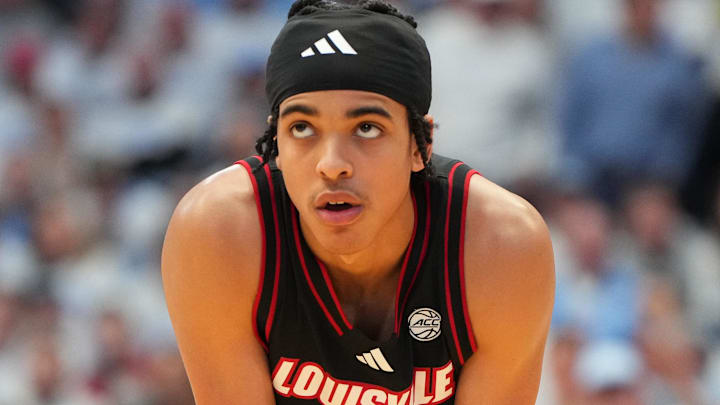
Louisville guard Mikel Brown Jr. entered the college basketball season as one of the highest-rated prospects in the country, but saw a roller-coaster season highlighted by both highs and lows that have made him a tough prospect to evaluate from a draft perspective.
Brown stands at around 6-foot-5, with a reported but unconfirmed wingspan in the range of about 6-foot-7, all of which seems to be pretty close to realistic. He’s a point guard able to moonlight off the ball due to his skills, and was the No. 7 player in the class per RSCI, ranking as Louisville’s highest-rated recruit ever.
Brown averaged 18.2 points, 4.7 assists and 1.2 steals per game across just 21 games, seeing his lone season of college basketball cut short due to a lingering back injury, which is sure to play into his stock.
Strengths:
Positional Size and Athleticism
The first plus in Mikel Brown Jr.’s pocket is his aforementioned positional size at 6-foot-5, which does set him apart somewhat from his 2026 guard peers.
Of the guards listed in the 2026 draft, Brown is not only the tallest among lead guard options, but seems to be the most verifiable at this point, with a few different outlets pointing to growth spurts, and him being in the range of 6-foot-3 without shoes, realistically placing him at about 6-4 or 6-5. While his wingspan isn’t yet confirmed, he does seem to be working with plus length.
In an NBA that is moving toward positional size and length, him being the biggest of the bunch is pretty unignorable, giving him perhaps the best template to work with and develop.
In addition to the pure size, Brown also has some of the best vertical athleticism seen among the 2026 guard class. He posted 10 dunks on 12 tries in 21 games, showing off some real leaping ability, which played into solid finishing overall. His 10 dunks were more than Darius Acuff Jr., Labaron Philon, Bennett Stirtz and Christian Anderson, and just one less than Kingston Flemings, in far less games than all the players mentioned.
Dunks aren’t everything, as referenced by a player like Keaton Wagler’s ability to thrive completely without them. But when looking at how guards will translate to the league, it’s certainly a nice feather in Brown’s cap to have above average size and verticality that can quell some of the concerns.
Shooting and Shot-Making Upside
Far-and-away the biggest draw with Mikel Brown Jr. is his 3-point shooting and shot-making upside, which is among the more prolific on both a season-long and game-to-game basis ever seen.
Across his 21 games, Brown shot 7.6 threes per game, taking a blistering 14.7 per 100 possessions, and hitting on 34% of them. In fact, at only 13 field goal attempts per game, that means 3-pointers made up about 58% of his shot diet. Which is an unreal amount of triples taken, and something NBA teams will be keen to add should they start going through at a higher rate.
Mechanically, Brown’s shot is clean, with touch in a variety of different shot-types and distances. He has limitless range, but does need to add strength to shoot it a little more seamlessly from deep.
As far as the numbers, Brown saw a fairly streaky shooting season with Lousville, which was lessened by a tough and sometimes questionable shot diet. He got off to a very rough start, hitting on just 17 of his 66 attempts through his first nine games for just a 26% clip. From there he would stabilize some, hitting on 40% of nearly eight attempts per game, including some real highs like 10 triples made versus NC State and six versus UNC that would drastically raise his percentages with one-game samples.
Brown shot just 34% on all jumpers, leaning about 55-45 toward dribble-jumpers opposed to catch-and-shoot, which played into the difficult shot diet, but also paints the picture of a potentially capable shot-maker. He shot 34% on 101 jumpshots off the dribble and 33% on 77 catch-and-shoot shots, hitting 34% guarded and interestingly just 30% unguarded.
In terms of shot-creation and off-the-dribble work, Brown has more than enough in his handling and athletic bag to create the necessary separation to get shots off, working quickly into his motion from the ground up. He’s comfortable shooting from side-steps, step-backs, off-movement and just about everything in between.
As far as play-types, Brown was shy about getting threes up in any situation, but notably hit 40% of his threes while operating in the pick-and-roll and 41% while spotting up. Other numbers weren’t so glamorous at 36% in transition, 25% in isolation, 19% off-screen and 25% on handoffs.
Notably, while Brown has the capability to hit mid-range shots, he largely cut that out of his shot diet, either driving to the rim or sitting back to fire threes. While the mid-range can be a nice counter, some NBA teams will also see this as a massive plus, with him cutting out some of the hardest, least-efficient shots.
Historically, Brown’s been known to be a white-hot 3-point shooter. He shot 49% from three in a seven-game U19 sample, and has seen multiple seasons and events in the 40% range dating back deep into high school.
Teams will need to be confident that Brown’s lesser shooting numbers across the board with Louisville were more of a one-off. But the vision of a Trae Young-esque shot diet packed within a 6-foot-5 lead guard is there. One that could add a lot of value both on and off-ball.
Handling and Creation Upside
The other side of Brown’s scoring, and more key for his potential as a lead guard, is his handling and creation ability, which was more effective at the college level, albeit on far less volume overall.
In addition to Brown’s size at 6-5 and vertical athletic tools, he’s also working with some decent horizontal athletic tools, which when paired with his solid handling ability create a player not only able to get shots off, but get downhill and finish at a great rate.
While Brown’s on-ball ability it built more on craft and pace than anything, his first-step, burst and acceleration aren’t bad as far as lead guard go, allowing him to create some real advantages, pressure the rim and make his outside shot even more dangerous. His straight-line speed is pretty good when he attacks, and paired with his lift makes him a dangerous finisher.
Again, it was far more limited volume than the outside work, but Brown shot a great 62% at the rim in total, pointing to both the size and athleticism, but also really nice interior finishing touch, which is on display in his tape.
Brown’s handling is yet All-World, but the signs are there in controlled but advanced dribble-moves that utilized change-of-speed, directional changes and freezing ability. He especially loves to decelerate, even when having gained an advantage, which may be an improvement point, but it also led to a good free throw rate at .45, with him getting to the line nearly six times per game and covering at 84%.
Sending ball-screens Brown’s way was the best way to help him get into his creation game, with him shooting 42% in total in the pick-and-roll, heavily favoring threes but shooting 45% on twos. He also shot 40% on 58 isolation possessions, hitting on 48% of his twos there, again pointing to better creation tools than the 3-point rate would show.
This side of Brown’s game helps to show off the on-ball upside, which even on lesser volume really shone at Louisville. And paints the picture of how he’ll be able to bomb threes, but also settle offense, run the pick-and-roll and even create points out of nothing.
Passing and Play-Making Upside
The final piece of the lead guard puzzle for Brown is his passing and play-making ability, which was flashed in his 4.7 assists per game at Louisville.
This could very well be the most singularly polarizing part of his game, and unfortunately one that his role will hinge on, be it as a combo guard that simply looks to score more, or a player that can truly commandeer an offense and make plays for others with consistency.
Brown’s near-five assists per game were met with over 3.0 turnovers per game, a really great assist percentage of 30.3, but a rough turnover percentage of 16%, all culminating in a 1.5 assist-to-turnover ratio, some high highs and low lows.
Brown may very well have the single highest passing flashes of the top guard group in the 2026 class, with premier feel in the pick-and-roll, as well as really nice vision that yields itself to open-court lasers and cross-court finds while on the move. Brown isn’t a highly accurate passer, moreso hitting wide targets than consistent pockets.
There are moments where everything sort’ve lines up and you can see the vision of what he can be as a play-maker — he’ll beat a defender off the line with good speed, re-direct with change-of-direction, draw attention, manipulate the defense and then deliver a well-placed strike two away.
The issue being, each of those moments are met with lowlights, which came in the form of three six-plus turnover games, and times where the process and decision-making simply overshadowed the talent.
Brown’s gravity as a handler and scorer will continue to open up play-making opportunities, but where he actually lands as a passer-play-maker long-term will be an inflection point for what he actually becomes.
Areas of Improvement:
Efficiency and Decision-Making
Moving on to Mikel Brown Jr.’s areas of improvement, which are a bit wide-ranging given just how polarizing his 21 games were. For the top area of improvement we've gone with improving the overall efficiency and decision-making, though these are used to blanket several different areas: general efficiency concerns, shot selection, turnovers and more.
At 41% from the field, 34% from three and 3.1 turnovers per game, there are obvious improvement points to Brown’s game, which can likely best be summed up by decision-making, which bleeds into shot-selection and overzealousness passing the ball.
Brown’s a simply streaky shooter, but it’s not made any easier by his difficult shot selection. His scorer’s mentality can be a great thing, but it can also lead to some head-scratching shot attempts. He has the tendency to rely on his 3-ball, and especially takes no issues pulling up the second he gets space. That partly played into his lesser early-season numbers, where his three simply wasn’t falling.
Additionally, he has no issue taking contested looks, or walking the ball down and firing with plenty left on the shot clock. Again, there’s some puzzling takes.
On the passing side, he’s not great about handling pressure, be it elite point-of-attack defense or doubles, and has a habit of sort’ve predetermining passes, which can lead one to wonder what he was trying to do. His passing-play-making timing can get out of sync, and when you pair that with his inaccuracies it can lead to some really bad tape.
Brown, more than any other prospect in the draft, just has a healthy amount of “what are we doing here? What were we trying? What was the end goal?” And that’s only going to be exacerbated by NBA defense.
In terms of how some of this stuff comes around, it’s kind’ve the age-old question. There’s equal parts star flashes and ill-advised decision-making, and it’ll likely be up to NBA teams to get to a place where he’s leaning more the former than the latter.
Brown’s sort’ve the ultimate process over results prospect, largely working from a mindset of trying to make the right play, trying to impact the game at a star-level, but his stats not quite bearing that out just yet on a broad level.
Strength and Defense
The last area of improvement for Brown is an area we’ve yet to touch on, which is defense, which directly ties into a sub-category here that I’d label strength and physicality.
On the season, Brown posted 1.2 steals per game and 0.1 blocks, going for 26 and 3 in total across his 21 games. More notably, he finished with a great steal percentage of 2.4, pointing to some instincts, as well as how his twitchiness allowed him to defend, with a defensive-box-plus-minus of just 1.7.
Much like the entire rest of his game, there’s some legitimate upside with Brown’s defense. Firstly, his size and length afford him a lot of grace, at least in theory, allowing him to cover up some deficiencies and guard across either backcourt spot. The good is highlighted by how Brown uses his toolkit on defense, quickly recognizing when to jump lanes, utilize his quick, active hands and generally defending at the point of attack when needed. There’s some great stuff scattered through there, with a little more bad in terms of NBA projection.
Brown’s strength is the biggest limiter defensively, and bleeds into his game overall, too. He’s very slight at 190 pounds with a slimmer frame, and will need to focus on strengthening both his upper and lower body early in his pro career. And that should help in a variety of ways, such as finishing around the rim, going through contact, defending on the ball and even navigating screens.
With his current stature, there’s going to be some hunt-ability, with him unable to really corral stronger matchups. A big point of emphasis given he’ll be needed to close games.
There’s also some general inattentiveness off-the-ball, which can be ironed out along with some of the other stuff that needs worked out. Otherwise, Brown again lands between a really nice template, but a player that has some lowlights strewn throughout.
Outlook:
Mikel Brown Jr., most simply, is one of the toughest and most polarizing evaluations in the class.
Save for the top quartet of players, Mikel Brown Jr. might very well have the highest upside of anyone in the 2026 draft class. A player that can easily rip triples, get downhill, create and play-make at 6-foot-5. On the flip side, there’s a player that, if not developed very deliberately and given time to work through issues, might not reach a high-end outcome.
That, as well as the lingering back injury, have caused Brown’s range to widen, with him a threat to go as high as the mid-lottery, but as low as the late-lottery. He should be a lottery pick on pure talent alone, with those that feel they can iron things out potentially taking him as high as No. 5 or 6.
Some good fits for Brown include the Hawks, who are still pretty geared for a Trae Young archetype, and they’d especially like one that stands at 6-5. The Nets also stand out should they fall, given they’ve prioritized positional size and perimeter prowess, as well as the Jazz if they land outside the top-four, taking a swing on a star-caliber guard that could play both backcourt positions alongside current options.
Range: Mid-to-Late Lottery
Role: Lead Guard, Secondary Creator
Impact: Star Upside, Starter, Rotation
Swing Skills: Decision-Making, Defense
Best Fits: Hawks, Nets, Jazz
 Add us as a preferred source on Google
Derek Parker covers the National Basketball Association, and has brought On SI five seasons of coverage across several different teams. He graduated from the University of Central Oklahoma in 2020, and has experience working in print, video and radio.
Follow DParkOK