%22%3E%0A%3Cpath%20d%3D%22M0%205.37646H8.15061L17.4195%2016.8819V5.37646H26.0647V31.4412H18.3227L8.64523%2019.4196V31.4412H0V5.37646Z%22%20fill%3D%22white%22%2F%3E%0A%3Cpath%20d%3D%22M29.2041%205.37649H43.8064C47.4193%205.37649%2049.6989%206.1937%2051.2258%207.72059C52.1505%208.64533%2052.8172%2010.0002%2052.8172%2011.7851V11.8497C52.8172%2014.9465%2050.9462%2016.8389%2048.172%2017.8067C51.5269%2018.7744%2053.6774%2020.5594%2053.6774%2024.1293V24.1938C53.6774%2028.3659%2050.258%2031.4197%2043.6558%2031.4197H29.2041V5.35498V5.37649ZM44.258%2013.7637C44.258%2012.6024%2043.3333%2011.9787%2041.4623%2011.9787H37.6988V15.6346H41.5053C43.3763%2015.6346%2044.258%2015.011%2044.258%2013.8497V13.7852V13.7637ZM42.0859%2020.9895H37.6988V24.8605H42.0644C43.9569%2024.8605%2044.9247%2024.0863%2044.9247%2022.968V22.9035C44.9247%2021.7852%2043.9999%2021.011%2042.0859%2021.011V20.9895Z%22%20fill%3D%22white%22%2F%3E%0A%3Cpath%20d%3D%22M64.8174%205.18286H73.4627L84.452%2031.4411H74.9896L73.6132%2027.9357H64.4949L63.1615%2031.4411H53.8496L64.8389%205.18286H64.8174ZM71.4412%2021.7636L69.054%2015.441L66.6669%2021.7636H71.4412Z%22%20fill%3D%22white%22%2F%3E%0A%3Cpath%20d%3D%22M95.2695%205.37646H105.248C115.592%205.37646%20120.775%2010.4733%20120.775%2018.1938V18.2583C120.775%2025.9788%20115.485%2031.4412%20104.947%2031.4412H95.2695V5.37646ZM104.001%2012.9679V23.8497H105.463C109.442%2023.8497%20112.022%2022.2153%20112.022%2018.4518V18.3873C112.022%2014.6239%20109.463%2012.9894%20105.463%2012.9894H104.001V12.9679Z%22%20fill%3D%22white%22%2F%3E%0A%3Cpath%20d%3D%22M123.098%2011.1182H131.549V15.2258C132.711%2012.4731%20134.56%2010.6881%20137.915%2010.8387V19.8065H137.012C133.442%2019.8065%20131.528%2021.785%20131.528%2026.2797V31.4625H123.076V11.1182H123.098Z%22%20fill%3D%22white%22%2F%3E%0A%3Cpath%20d%3D%22M137.808%2025.6772V25.6127C137.808%2021.5482%20140.818%2019.2901%20145.55%2019.2901C147.27%2019.2901%20149.464%2019.6557%20150.345%2020.0428V19.6987C150.345%2017.8277%20149.184%2016.7524%20146.582%2016.7524C144.496%2016.7524%20142.754%2017.204%20140.969%2017.9137L139.485%2012.3008C141.829%2011.3975%20144.517%2010.8169%20148.044%2010.8169C152.173%2010.8169%20154.862%2011.6771%20156.646%2013.4621C158.173%2014.989%20158.776%2016.9675%20158.776%2019.9137V31.5052H150.324V29.4622C148.904%2030.9891%20147.012%2031.9999%20144.474%2031.9999C140.56%2031.9999%20137.808%2029.7633%20137.808%2025.7417V25.6772ZM150.431%2023.9138V23.0536C149.937%2022.86%20149.206%2022.7095%20148.496%2022.7095C146.818%2022.7095%20145.894%2023.7202%20145.894%2024.9891V25.0536C145.894%2026.2364%20146.754%2027.0321%20147.829%2027.0321C149.313%2027.0321%20150.431%2025.8493%20150.431%2023.9138Z%22%20fill%3D%22white%22%2F%3E%0A%3Cpath%20d%3D%22M162.883%2017.6345H160.496V11.1183H162.883C162.926%208.96778%20163.442%207.20433%20164.711%205.9355C166.088%204.55915%20167.872%204%20170.668%204C173.163%204%20174.69%204.21506%20175.851%204.55914V9.84951C175.034%209.65596%20174.217%209.54843%20173.141%209.54843C171.83%209.54843%20171.163%2010.0646%20171.163%2011.1829V11.3334H175.851V17.6345H171.335V31.4411H162.883V17.6345Z%22%20fill%3D%22white%22%2F%3E%0A%3Cpath%20d%3D%22M178.883%2024.6238V17.613H176.496V11.0968H178.883V6H187.335V11.0968H192.023V17.613H187.335V22.7528C187.335%2024.2797%20188.045%2024.8389%20189.378%2024.8389C190.152%2024.8389%20191.055%2024.6238%20191.937%2024.2152V30.7314C190.604%2031.4411%20188.582%2031.8927%20186.539%2031.8927C181.55%2031.8927%20178.862%2029.5916%20178.862%2024.6238H178.883Z%22%20fill%3D%22white%22%2F%3E%0A%3Cpath%20fill-rule%3D%22evenodd%22%20clip-rule%3D%22evenodd%22%20d%3D%22M201.368%204.36764C207.191%20-1.45588%20216.632%20-1.45588%20222.456%204.36764C228.279%2010.1912%20228.279%2019.6324%20222.456%2025.4559L211.912%2036L201.368%2025.4559C195.544%2019.6324%20195.544%2010.1912%20201.368%204.36764ZM204.009%207.55761C203.948%207.86849%20203.916%208.39718%20203.916%209.14566V10.4189C203.916%2011.1832%20203.948%2011.7198%20204.013%2012.0267C204.078%2012.3317%20204.278%2012.6168%20204.617%2012.8762C204.956%2013.1376%20205.403%2013.3316%20205.958%2013.4623C206.512%2013.593%20207.1%2013.6583%20207.837%2013.6583C208.573%2013.6583%20209.217%2013.591%20209.769%2013.4524C210.322%2013.3158%20210.761%2013.1178%20211.086%2012.8604C211.411%2012.6029%20211.605%2012.3178%20211.666%2012.0069C211.728%2011.6961%20211.759%2011.1674%20211.759%2010.4189V9.14566C211.759%208.38134%20211.728%207.84473%20211.662%207.53781C211.597%207.23287%20211.397%206.94972%20211.058%206.68834C210.72%206.42696%20210.272%206.23291%20209.718%206.10223C209.163%205.97154%20208.536%205.90619%20207.839%205.90619C207.102%205.90619%20206.459%205.97352%20205.906%206.11213C205.352%206.24875%20204.914%206.44677%20204.589%206.70418C204.265%206.9616%20204.071%207.24673%20204.009%207.55761ZM209.276%2024.8638C212.876%2024.8638%20214.557%2024.2064%20214.557%2021.862V21.858V21.3155C214.557%2019.6581%20213.516%2018.971%20210.252%2018.3136C209.278%2018.1136%20208.908%2017.9136%20208.908%2017.3136V16.9414C208.908%2016.6543%20209.177%2016.5117%20209.413%2016.5117C209.749%2016.5117%20209.918%2016.7137%20209.918%2016.9414V18.1136H214.391V17.3988C214.391%2015.4563%20213.347%2014.4266%20209.177%2014.4266C206.15%2014.4266%20203.896%2015.3414%20203.896%2017.3711V17.7433C203.896%2019.5155%20204.805%2020.3155%20208.201%2021.0303C208.28%2021.0472%20208.355%2021.063%20208.427%2021.0781C209.329%2021.2674%20209.647%2021.3341%20209.647%2021.9174V22.2897C209.647%2022.6619%20209.546%2022.8045%20209.142%2022.8045C208.67%2022.8045%20208.637%2022.5471%20208.637%2022.262V21.2897H203.894V21.7471C203.894%2024.149%20205.476%2024.8638%20209.276%2024.8638ZM215.424%2024.5569H219.925V14.7355H215.424V24.5569ZM216.955%2013.5019H219.925V6.06064H217.092V9.411L215.193%206.06064H212.359V13.5019H215.193V10.1199L216.955%2013.5019ZM208.269%2012.152C208.204%2012.2688%20208.055%2012.3262%20207.825%2012.3262L207.827%2012.3282C207.604%2012.3282%20207.459%2012.2767%20207.398%2012.1757C207.336%2012.0748%20207.305%2011.8074%20207.305%2011.3758V7.90068C207.305%207.51852%20207.352%207.28684%20207.445%207.20962C207.538%207.13239%20207.675%207.09279%20207.851%207.09279C208.059%207.09279%20208.198%207.14031%20208.265%207.23734C208.332%207.33239%20208.366%207.55416%20208.366%207.90068V11.3203C208.366%2011.7579%20208.334%2012.0352%20208.269%2012.152Z%22%20fill%3D%22white%22%2F%3E%0A%3C%2Fg%3E%0A%3Cdefs%3E%0A%3CclipPath%20id%3D%22clip0_15247_3640%22%3E%0A%3Crect%20width%3D%22227%22%20height%3D%2236%22%20fill%3D%22white%22%2F%3E%0A%3C%2FclipPath%3E%0A%3C%2Fdefs%3E%0A%3C%2Fsvg%3E%0A)
NBA Draft Scouting Report: Kansas Guard Darryn Peterson
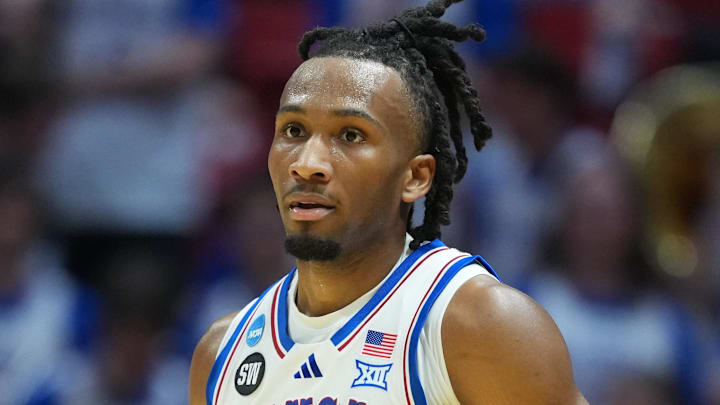
Darryn Peterson saw one of the weirder and more unique seasons we’ve ever witnessed in his singular campaign with Kansas, marred with various injuries and up-and-down availability, but one that still saw star output and top-tier play, all things considered.
Peterson is a 6-foot-6 guard who came in as the No. 2 player per RSCI, but was No. 1 on plenty of expert boards. He averaged 20.2 points on 44% shooting, lighting it up from beyond the arc while adding 4.2 rebounds, 1.4 steals and more.
Peterson’s major strengths include his size and athleticism, shooting and shot-making, defensive play-making and upside, as well as driving and finishing upside.
Strengths:
Size and Athleticism
We’re going to jump right into the deep end here with Darryn Peterson’s size and athleticism, what should continue to be a strength, but was also the main point of contention across his season with Kansas.
Peterson has prototypical guard size. He stands at a built 6-foot-6, with a reported plus-four wingspan of 6-foot-10. He’s on the leaner side, but still possesses that sneaky strength like so many NBA stars before.
Whether he does offer lead guard upside or shades more toward off-guard long-term, his blend of size, length, strength and more is a truly elite package.
The athleticism is the trickier part here, with this formerly being one of his major strengths, but seemingly lessened in his season with Kansas due to injury. To give proper context, Peterson reportedly dealt with a lingering hamstring injury, a quad injury, a sprained ankle, and full-body cramps which he himself described as traumatic.
Simply put, this combination of injuries caused Peterson to athletically look like a pretty different player at Kansas. Where he formerly had explosiveness, burst, acceleration and directional-change, he was instead left with a stiffer, flatter game that hampered several key areas.
He was largely unable to create separation on the ball, his first step, burst and acceleration were off all season, with him unable to turn the corner or really carve anything but wide and poor angles to the rim. His pacing largely felt out of sync, and just generally felt less zippy as a mover.
Once actually at the rim there were positive flashes of leaping and hang time, but there was some to be desired here too, as there were times his elevation and lift simply wasn’t the same.
Overall, this led to a totally different profile for Peterson. Many expected to see a real blend of driving and shot-making, much like his 13-game Prolific Prep sample that saw him largely on the ball, with 50% of field goals as jumpers, and 30% at the rim.
With Kansas though, he played off the ball often, with 66% of his field goals being jumpers, and just 20% at the rim. Peterson shot less at-rim in a 24-game slate with Kansas than he did with 13 games at Prolific Prep.
These numbers, in tandem with this side-by-side tape that portray Peterson as a much better mover previously, helps to paint a picture that there’s more in the tank here than the Kansas season lets on. And that’s a great thing, seeing as he was still one of the top players in the country when on-court.
Shooting and Shot-Making
Far-and-away the biggest development and most positive takeaway from Peterson’s time with Kansas, was that the seemingly different shot profile and style of play worked out. While he wasn’t expected to be primarily off the ball, he thrived there, functioning as a truly elite shooter and shot-maker.
Peterson attempted just shy of seven threes per game, good for a whopping 14 per 100 possessions, and he hit on 38% of those. His mechanics are squeaky clean, offering a lightning-fast release and compact consistency across tons of different shot types.
Peterson shot quickly and confidently off the catch, created off-the-dribble, shot while on the move and absolutely everything in between. He was largely unbothered by contests, and able to see shots through while unbalanced as well. Again, impressive for a player who wasn’t thought of to be this good of a shot-maker this quickly.
Peterson shot 40% on all jumpers with Kansas, a blistering 45% on all catch-and-shoot shots, and a good 36% on dribble-jumpers. About 65% of his 3-point shot diet was off the catch, though that doesn’t speak to the level of difficulty his shots had, seeing that Kansas was such an up-and-down offensive team with few elite creators.
His triples were spread very evenly across different play-types. Peterson was a spot-up weapon from beyond the arc, shooting a mind-numbing 53% on spot-up threes. He also played off-screen a good amount, hitting on 38% of those triples, and shot a blistering 47% on handoff threes as well.
Some of the lesser areas were 17% as the pick-and-roll handler, 33% in transition and 33% in isolation, all three areas you can point to that an athletic boost certainly could’ve helped.
Despite the alluded to lack of elite athleticism, he was still able to create a number of clean looks out of disadvantageous situations. He has real creativity in the mid-range, able to putter to spots, create separation with a shoulder and rise high. Peterson is especially good at creating the space necessary to get a shot off without dribbling, angling his body while preparing and leaning back on shots. He’s just a very manipulative shot-creator.
Peterson has long been a projectable three-level scorer. But again, coming into the season, his jumper was likely more in question than his driving ability. So for him to put together this type of shot-making season is really eye-opening to just how effective an off-ball player he can be.
Not only is off-ball scoring impact a really under-the-radar skill as far as star scorers go — offering high output without necessarily detracting from offense and shifting gravity on the floor — it also creates a vision for Peterson in a player that could still toggle between on and off-ball impact, both at elite levels.
Defensive Play-Making and Upside
Peterson isn’t known for his defense, but does offer a really nice baseline of play-making and upside as an on-ball defender long-term.
His build and athleticism, even while potentially hampered at Kansas, make him a pretty blend-able defensive player. His size and length at 6-foot-6 with the majorly plus wingspan project to give him early advantages, and when you mix in Peterson’s aggressiveness and instincts, you get a defender who can make plays and generally hold his own.
Peterson averaged a solid 1.4 steals and 0.6 blocks across his 29 minutes, good for two stocks per game despite high offensive output. He registered a great 2.9% steal percentage, a good 2.3% block percentage, and a very solid defensive box-plus-minus of 4.8, pointing to solid overall impact. Opposing players shot just 39% on field goals in Peterson’s vicinity.
He rarely guarded the opposing teams best player, but instead offered a high-floor team defender who made his living stunting opposing handlers, mucking up lanes with his long arms and getting hands on the ball on contests.
Peterson was overzealous in trying to nab steals and block on occasion, but this more often bled into a lot of engagement: fighting through screens, using effective contests and more.
His natural defensive instincts led to him making the right plays more than the wrong one, anticipating certain passes, or getting to spots before drivers. He has great hands, able to poke, prod or simply get a hand on the ball, even while airborne. Peterson has pretty exceptional shot-blocking ability for his size and position, and while it won’t rear its head as true secondary rim-protection, it’s certainly a plus in his back-pocket.
The upside of a potential stopper lies within Peterson’s elastic movement at peak athleticism, length with 6-foot-10 arms and keen instincts.
All of the makings of a plus defender are within Peterson’s reach. It’s unlikely he’ll be hunted due to his size. And while his offensive output may never afford him to be a truly elite defender, he does have the toolkit to become just that.
Driving and Finishing Upside
Peterson’s driving and finishing ability was likely what was most hampered by his athletic shortcomings with Kansas, and this section is the most projection among his four strengths on my part. But many still see this as a major weapon in Peterson’s arsenal, and one of a few reasons he’ll still be considered as the No. 1 pick by some teams.
As previously mentioned, Peterson’s shot-diet largely shifted to be jumper-heavy, rather than his previous blend of both downhill force and silky ranged shots. Again, just 20% of his total shots with Kansas came at the rim, and this likely also factored into even less free throws, despite him shooting 5.5 per game.
Once at the rim, the results weren’t as good as anticipated given the low volume. He managed to shoot 58%, still good per Synergy, though given his jumper-to-at-rim ratio was nearly 3-to-1, you’d expect slightly more efficient work. He shot an average 52% on layups and a poor 71% of dunks, hitting 28 of 54 lays and 10 of 14 dunks. For reference, Peterson dunked the ball 18 times in the 13-game sample with Prolific Prep.
There were certainly still glimpses of Peterson’s upside and former self: natural pace, an elite first step, very workable dribble-moves, genuinely special change-of-speed in the half and open-court and directional countering. Things that when working together make him a really unstoppable downhill force.
But there was also some jarring lack of separation, times where he avoided getting all the way to the rim in favor of tougher pull-ups, others where he simply didn’t elevate as he had before, and moments where he just couldn’t sync everything up.
Peterson has visible touch and some creative finishing ability, marked by a very usable float-game, but even that at times was hampered by his ability to lose defenders.
This doesn't excuse Peterson’s shortcomings. There were plenty of times that the process could’ve simply been better on his end — not every missed layup was a lack of burst and lift. But a lot was left on the table in this area, especially when evaluating it within the scope of his high school tape.
Areas of Improvement:
Play-Making and Decision-Making
The biggest area of improvement for Peterson is certain to be his play-making and decision-making, two of the areas that lagged behind somewhat in his time with Kansas, regardless of athletic shortcomings.
Peterson simply wasn’t used in the on-ball capacity that many thought he would at Kansas. And head coach Bill Self and Kansas aren’t necessarily at fault for that — making him an off-guard is a perfectly natural conclusion if he’s A) in and out of the lineup, and B) not 100% when on-court.
Even still, the lack of on-ball usage mixed with his pedestrian play-making numbers left a lot to be desired in his college season, and raised lots of questions about his general process. Peterson averaged 1.6 assists to 1.6 turnovers, 38-to-38 in total, with a pretty paltry 12.5 assist percentage. When pairing this with a 33.5 usage, it paints the picture Peterson was kind’ve a black hole in terms of shooting the ball.
That's not totally the case — one shouldn't be too concerned with the pure play-making numbers given he wasn’t put in stellar position to rack up assists systemically. But, it does point to a larger area of worry in his decision-making and more specifically processing, which not only affects passing and play-making, but bled into some poor shot-selection and a few other things as well.
Peterson was shown a lot of defensive pressure, and didn’t always handle it perfectly. There were times where he’d make the correct read, hit a contested shot or simply pass out for hockey assists, but for each of those it also felt like there were some missed passing reads and truly bad shot attempts.
It did at times feel like his processing was just a tick slow, not quite reading the floor or processing the game at an elite level. Peterson has 16 one or less assists game with Kansas. There were several instances of gathering much too early on drives, failing to play off two feet in the paint. He was blitzed and doubled a lot, which somewhat mitigated his passing numbers. But there was also a reason for that, and his anticipation of that defensive pressure wasn’t always up to par. Making the right play after drawing help is especially going to be a point of emphasis for Peterson.
If we were talking about a true two-guard this would largely be overblown. But in the fairness of painting Peterson as a combo-guard, there’s some pretty important stuff in here.
If an NBA team does think Peterson has more on-ball potential — which is essentially the crux of why they would be considering him over others at No. 1 — they’d have to feel pretty confident in his ability to not just fill it up, but widely make the right decisions too. And they’d have to be certain there’s a layer of feel and high-IQ that Peterson only showed in spurts with Kansas.
The good news is that given Peterson’s shot-making, and accounting for that elite athleticism returning and making him a better driving threat, he won’t need 1-of-1 passing and processing to capitalize on his scoring gravity. Plenty of players across the league rack of assists with simple kick-outs and pick-and-roll reads, and Peterson could fit snugly into that echelon, or potentially be even more given pre-Kansas flashes.
Handling
Even Peterson’s ball-handling ability could’ve been impeded by injury — allowing defenders to pressure him more without that needed level of separation — but if there’s more on-ball potential, or even lead potential to be tapped into here, handling will still need to be an area of improvement.
For the record, Peterson is a pretty great handler that projects to be better with time. He is exceptional about not losing his handle entirely. In hand-tracking his turnovers, there were maybe three of the 38 total that were handle-based, even some of those being stretches.
Even more, he’s pretty good about using a variety of dribble moves to get to his spots.
But, the difference in handling for NBA lead guards and off-guards is pretty stifling and worth nit-picking. And there were instances this season that showed where Peterson can grow here, namely in the amount of tough pull-ups and at-rim shots he settled for, but also the amount he was simply stopped at the point of attack and forced to pass out.
Peterson wasn’t put in advantageous position much as a lead handler with the Jayhawks, but NBA teams will need to feel confident in his ability to continue adding to his on-ball arsenal, especially given the results at KU.
Outlook:
Darryn Peterson’s season with Kansas is going to be remembered for its oddities. It just felt off, whether it was the lack of availability or clunky on-court play, it very seldomly felt crisp.
Despite that, Peterson still put together a No. 1-worthy campaign, and he did so in ways that weren’t expected. In a 2026 class that is this good, that every single question and sub-skill evaluation matters, especially near the top, it's understandable that Peterson could be chosen third, or even lower.
But we could be looking down the barrel of a genuine offensive superstar, with a floor of gravitational off-ball shot-maker, and a hidden ceiling of rhythmic driver. Packaged in a prototypical guard frame with high-floor defense. NBA teams will need to do their due diligence on medicals, work ethic and upside, but if everything comes back fine, that seems like a player who could hear their name first overall.
Some realistically nice fits for Darryn Peterson include the Pacers, who have an elite play-maker that could mitigate any early on-ball deficiencies, the Wizards, who could help him moonlight between point and shooting guard, as well as the Hawks, who have elite play-makers and could stand a star infusion in the backcourt.
Range: No. 1 to No. 3
Role: Primary Scoring Option, Off-Ball Shot-Maker
Impact: Star, Superstar Upside
Swing Skills: Decision-Making, Handling
Best Fits: Pacers, Wizards, Hawks
 Add us as a preferred source on Google
Derek Parker covers the National Basketball Association, and has brought On SI five seasons of coverage across several different teams. He graduated from the University of Central Oklahoma in 2020, and has experience working in print, video and radio.
Follow DParkOK