%22%3E%0A%3Cpath%20d%3D%22M0%205.37646H8.15061L17.4195%2016.8819V5.37646H26.0647V31.4412H18.3227L8.64523%2019.4196V31.4412H0V5.37646Z%22%20fill%3D%22white%22%2F%3E%0A%3Cpath%20d%3D%22M29.2041%205.37649H43.8064C47.4193%205.37649%2049.6989%206.1937%2051.2258%207.72059C52.1505%208.64533%2052.8172%2010.0002%2052.8172%2011.7851V11.8497C52.8172%2014.9465%2050.9462%2016.8389%2048.172%2017.8067C51.5269%2018.7744%2053.6774%2020.5594%2053.6774%2024.1293V24.1938C53.6774%2028.3659%2050.258%2031.4197%2043.6558%2031.4197H29.2041V5.35498V5.37649ZM44.258%2013.7637C44.258%2012.6024%2043.3333%2011.9787%2041.4623%2011.9787H37.6988V15.6346H41.5053C43.3763%2015.6346%2044.258%2015.011%2044.258%2013.8497V13.7852V13.7637ZM42.0859%2020.9895H37.6988V24.8605H42.0644C43.9569%2024.8605%2044.9247%2024.0863%2044.9247%2022.968V22.9035C44.9247%2021.7852%2043.9999%2021.011%2042.0859%2021.011V20.9895Z%22%20fill%3D%22white%22%2F%3E%0A%3Cpath%20d%3D%22M64.8174%205.18286H73.4627L84.452%2031.4411H74.9896L73.6132%2027.9357H64.4949L63.1615%2031.4411H53.8496L64.8389%205.18286H64.8174ZM71.4412%2021.7636L69.054%2015.441L66.6669%2021.7636H71.4412Z%22%20fill%3D%22white%22%2F%3E%0A%3Cpath%20d%3D%22M95.2695%205.37646H105.248C115.592%205.37646%20120.775%2010.4733%20120.775%2018.1938V18.2583C120.775%2025.9788%20115.485%2031.4412%20104.947%2031.4412H95.2695V5.37646ZM104.001%2012.9679V23.8497H105.463C109.442%2023.8497%20112.022%2022.2153%20112.022%2018.4518V18.3873C112.022%2014.6239%20109.463%2012.9894%20105.463%2012.9894H104.001V12.9679Z%22%20fill%3D%22white%22%2F%3E%0A%3Cpath%20d%3D%22M123.098%2011.1182H131.549V15.2258C132.711%2012.4731%20134.56%2010.6881%20137.915%2010.8387V19.8065H137.012C133.442%2019.8065%20131.528%2021.785%20131.528%2026.2797V31.4625H123.076V11.1182H123.098Z%22%20fill%3D%22white%22%2F%3E%0A%3Cpath%20d%3D%22M137.808%2025.6772V25.6127C137.808%2021.5482%20140.818%2019.2901%20145.55%2019.2901C147.27%2019.2901%20149.464%2019.6557%20150.345%2020.0428V19.6987C150.345%2017.8277%20149.184%2016.7524%20146.582%2016.7524C144.496%2016.7524%20142.754%2017.204%20140.969%2017.9137L139.485%2012.3008C141.829%2011.3975%20144.517%2010.8169%20148.044%2010.8169C152.173%2010.8169%20154.862%2011.6771%20156.646%2013.4621C158.173%2014.989%20158.776%2016.9675%20158.776%2019.9137V31.5052H150.324V29.4622C148.904%2030.9891%20147.012%2031.9999%20144.474%2031.9999C140.56%2031.9999%20137.808%2029.7633%20137.808%2025.7417V25.6772ZM150.431%2023.9138V23.0536C149.937%2022.86%20149.206%2022.7095%20148.496%2022.7095C146.818%2022.7095%20145.894%2023.7202%20145.894%2024.9891V25.0536C145.894%2026.2364%20146.754%2027.0321%20147.829%2027.0321C149.313%2027.0321%20150.431%2025.8493%20150.431%2023.9138Z%22%20fill%3D%22white%22%2F%3E%0A%3Cpath%20d%3D%22M162.883%2017.6345H160.496V11.1183H162.883C162.926%208.96778%20163.442%207.20433%20164.711%205.9355C166.088%204.55915%20167.872%204%20170.668%204C173.163%204%20174.69%204.21506%20175.851%204.55914V9.84951C175.034%209.65596%20174.217%209.54843%20173.141%209.54843C171.83%209.54843%20171.163%2010.0646%20171.163%2011.1829V11.3334H175.851V17.6345H171.335V31.4411H162.883V17.6345Z%22%20fill%3D%22white%22%2F%3E%0A%3Cpath%20d%3D%22M178.883%2024.6238V17.613H176.496V11.0968H178.883V6H187.335V11.0968H192.023V17.613H187.335V22.7528C187.335%2024.2797%20188.045%2024.8389%20189.378%2024.8389C190.152%2024.8389%20191.055%2024.6238%20191.937%2024.2152V30.7314C190.604%2031.4411%20188.582%2031.8927%20186.539%2031.8927C181.55%2031.8927%20178.862%2029.5916%20178.862%2024.6238H178.883Z%22%20fill%3D%22white%22%2F%3E%0A%3Cpath%20fill-rule%3D%22evenodd%22%20clip-rule%3D%22evenodd%22%20d%3D%22M201.368%204.36764C207.191%20-1.45588%20216.632%20-1.45588%20222.456%204.36764C228.279%2010.1912%20228.279%2019.6324%20222.456%2025.4559L211.912%2036L201.368%2025.4559C195.544%2019.6324%20195.544%2010.1912%20201.368%204.36764ZM204.009%207.55761C203.948%207.86849%20203.916%208.39718%20203.916%209.14566V10.4189C203.916%2011.1832%20203.948%2011.7198%20204.013%2012.0267C204.078%2012.3317%20204.278%2012.6168%20204.617%2012.8762C204.956%2013.1376%20205.403%2013.3316%20205.958%2013.4623C206.512%2013.593%20207.1%2013.6583%20207.837%2013.6583C208.573%2013.6583%20209.217%2013.591%20209.769%2013.4524C210.322%2013.3158%20210.761%2013.1178%20211.086%2012.8604C211.411%2012.6029%20211.605%2012.3178%20211.666%2012.0069C211.728%2011.6961%20211.759%2011.1674%20211.759%2010.4189V9.14566C211.759%208.38134%20211.728%207.84473%20211.662%207.53781C211.597%207.23287%20211.397%206.94972%20211.058%206.68834C210.72%206.42696%20210.272%206.23291%20209.718%206.10223C209.163%205.97154%20208.536%205.90619%20207.839%205.90619C207.102%205.90619%20206.459%205.97352%20205.906%206.11213C205.352%206.24875%20204.914%206.44677%20204.589%206.70418C204.265%206.9616%20204.071%207.24673%20204.009%207.55761ZM209.276%2024.8638C212.876%2024.8638%20214.557%2024.2064%20214.557%2021.862V21.858V21.3155C214.557%2019.6581%20213.516%2018.971%20210.252%2018.3136C209.278%2018.1136%20208.908%2017.9136%20208.908%2017.3136V16.9414C208.908%2016.6543%20209.177%2016.5117%20209.413%2016.5117C209.749%2016.5117%20209.918%2016.7137%20209.918%2016.9414V18.1136H214.391V17.3988C214.391%2015.4563%20213.347%2014.4266%20209.177%2014.4266C206.15%2014.4266%20203.896%2015.3414%20203.896%2017.3711V17.7433C203.896%2019.5155%20204.805%2020.3155%20208.201%2021.0303C208.28%2021.0472%20208.355%2021.063%20208.427%2021.0781C209.329%2021.2674%20209.647%2021.3341%20209.647%2021.9174V22.2897C209.647%2022.6619%20209.546%2022.8045%20209.142%2022.8045C208.67%2022.8045%20208.637%2022.5471%20208.637%2022.262V21.2897H203.894V21.7471C203.894%2024.149%20205.476%2024.8638%20209.276%2024.8638ZM215.424%2024.5569H219.925V14.7355H215.424V24.5569ZM216.955%2013.5019H219.925V6.06064H217.092V9.411L215.193%206.06064H212.359V13.5019H215.193V10.1199L216.955%2013.5019ZM208.269%2012.152C208.204%2012.2688%20208.055%2012.3262%20207.825%2012.3262L207.827%2012.3282C207.604%2012.3282%20207.459%2012.2767%20207.398%2012.1757C207.336%2012.0748%20207.305%2011.8074%20207.305%2011.3758V7.90068C207.305%207.51852%20207.352%207.28684%20207.445%207.20962C207.538%207.13239%20207.675%207.09279%20207.851%207.09279C208.059%207.09279%20208.198%207.14031%20208.265%207.23734C208.332%207.33239%20208.366%207.55416%20208.366%207.90068V11.3203C208.366%2011.7579%20208.334%2012.0352%20208.269%2012.152Z%22%20fill%3D%22white%22%2F%3E%0A%3C%2Fg%3E%0A%3Cdefs%3E%0A%3CclipPath%20id%3D%22clip0_15247_3640%22%3E%0A%3Crect%20width%3D%22227%22%20height%3D%2236%22%20fill%3D%22white%22%2F%3E%0A%3C%2FclipPath%3E%0A%3C%2Fdefs%3E%0A%3C%2Fsvg%3E%0A)
NBA Draft Scouting Report: Texas Tech Guard Christian Anderson
In this story:
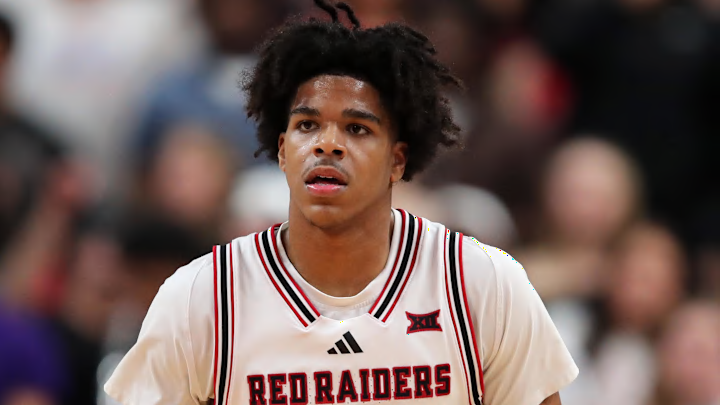
Texas Tech guard Christian Anderson has exploded onto the draft scene via his sophomore season with Texas Tech, coming on as one of the most exciting and most productive offensive players in the nation.
He stands at a spindlier 6-foot-2, listed at 178 per Tech. He’s been on general prospect radars for a little while now, having played in FIBA for Germany in U16, U18 and U19 action, where he saw plenty of success both individually and team-wise.
Anderson saw a fine debut season with the Red Raiders, but has rocketed his production and efficiency across the board to the tune of 19 points on 49% shooting, with 7.7 assists and 1.3 steals.
His major strengths include his 3-point shooting, off-the-dribble shot-making, play-making and feel, as well as driving and finishing upside.
Christian Anderson Scouting Report
Strengths:
Shooting:
There’s a few different places you could start in terms of Christian Anderson’s major strengths given how potent an offensive player he is, but his versatile 3-point shooting feels at the forefront of his skillset to me.
Anderson has long been a proven 3-point shooter , dating back to 38% on over five attempts in his freshman season, but he’s taken it to new heights in Year 2. He’s shooting 43% from deep on nearly eight attempts per game, good for 12.0 threes attempts per 100 possessions on blistering outside efficiency.
He’s very mechanically sound in terms of shooting, able to get shots off quickly and repeatably, with a kind’ve “know-it-when-you-see-it” touch to his jumper. His ball floats to the rim.
All of Anderson’s shot-preparation is great, he’s phenomenal about aiming himself regardless of position, and as we’ll touch on more in the next section, his balance and coordination stand out here a ton. He’s very specifically good at using really long steps on the catch to create space rather than a dribble, or using really long strides on his final dribble, which is pretty unique way to create a little extra separation. He’s really quick off the floor on one-to-two-dribble pull-up counters.
There’s effectively no 3-pointer in existence that Anderson can’t take and make, be it on or off-ball. Texas Tech has needed him to create a lot more in his sophomore season, so there’s a lot more off-the-dribble sample in his shot diet — which make the numbers even more absurd — but the catch-and-shoot numbers are really great, and his body of 3-point work makes it easy to envision him seeing consistent success off the ball as a shooter. I think he could stand to move a little more off the ball, but in the least you can reverse engineer this some given he can at least hit the shots.
On that note though, he has truly limitless range, being unafraid to take shots from the parking lot. You cannot give him a single inch of space or he’s going to shoot a confident shot.
Anderson has taken 232 total 3-point attempts through 29 games, at a nearly perfect 60-40 split of off-the-dribble and catch-and-shoot. He is shooting an elite 42% in both situations, with a pretty big gap between his guarded and unguarded catch-and-shoot attempts at 34 and 50%, respectively.
In terms of play-types, he has functioned as the pick-and-roll hander drastically more than everything else, leading to a little more inconsistency. He’s shooting 45% from three spotting up, but just 26% in transition, an area to note, as well as 30% in isolation, and 29% on handoffs. Notably, Texas Tech does not use him off-screen, per Synergy, at just one 3-point attempt on the year.
In conclusion, Anderson is just a blistering 3-point shooter, point blank period. There’s some rightful questions about the shot diet and level of on-ball work needed to sustain some of it, but again he feels pretty malleable both touch and numbers-wise, with the potential to kind’ve mold him into whatever “shooter” is needed.
Off-the-Dribble Shot-Making
In tandem with his shooting, but unable to go without a section of its own is Anderson’s off-the-dribble shot-making, which is potentially second to none in the country.
Anderson has taken 383 total field goal attempts through 29 games with Texas Tech, and a mind-bending half of those have come off-the-dribble, signaling a really needed next-level skill for a ball-dominant guard of his size.
Anderson is shooting 43% overall on dribble-jumpers, grading out excellent per Synergy with an effective field goal and true shooting percentage of 58. Tying this back into the previous section, about 75% of all of his shots taken off the dribble are beyond the arc, which makes plenty of sense given there’s more space to operate out there, and he has no problem knocking them down. He’s shooting a consistent 44% from two and 42% from three.
All of the earlier rules apply here in terms of his balance, coordination, fluidity and general ease in going from dribbling to shooting. Anderson just shows an unbelievable amount of poise and control in easing into these shots, using a level of craft and handling that almost feels specific to doing just this. He’s quick into shots, but almost in a deceptive way due to the smoothness of the full motion. His footwork is borderline ethereal and speaks to both his naturalness in this area, as well as what is probably a huge amount of work put in.
Again, any separation at all leads to shots for Anderson, and he’s able to create that with a good handle and some snappy movement, albeit not elite as far as burst, first-step and explosion goes. Perhaps the biggest footnote of this area, a strength for some but side-eye for others, would be the amount of off-the-dribble shots he’s taking purely out of the pick-and-roll, leading to some questions about how much space he’s able to create outside of ball screens.
Sticking with 3-pointers, Anderson has made 46 triples as the pick-and-roll handler — on a blistering 47% — but in sort’ve cross-referencing that with the 3-point dribble jumpers, only 20% are achieved without a ball-screen. And this matches up with the fact he’s hit six total in transition, four total in isolation, etc. Again, for some this won’t matter. Anderson has obvious lead guard tendencies across the board, and the NBA is not shy with its pick-and-rolls, but certainly an interesting note.
Off-the-dribble volume usually gravitates toward players that command a lot of offensive responsibility, but there’s certainly still a lot of value in doing something at an elite level that few players truly can.
Play-Making and Feel
One of the biggest boons to Anderson’s lead ability is his play-making, which is among the best in the class.
As Texas Tech’s lead play-maker, Anderson has dished out 7.7 assists per game — good for third in the entire country behind only Jeremy Fears Jr. and Braden Smith — to 3.4 turnovers per game. You’d certainly like the turnovers cut down some, but the assist totals, a two-and-a-quarter assist-to-turnover ratio, his absurd 36% assist percentage and the tape backs up his overall ability.
Players don’t average seven-plus assists without some level of passing versatility, and that’s absolutely true of Anderson, who has touch, vision, precision, a keen floor awareness and plenty more making up his overall facilitation ability.
Anderson’s feel for the game is imprinted all over this area. He has elite processing ability, able to leverage his own scoring gravity into opportunities for others. He can play with a real tempo, able to glide around the court, toggling between zip passes and lofty touch passes. He has really great accuracy, and isn’t afraid of zooming it through tight windows, sometimes to his detriment. He’s great off a live-dribble, adding to his versatility as an off-the-dribble player. He prefers his right hand and bounces passes in these situations, but isn’t totally pigeonholed to these.
Much like his other areas, Anderson can be somewhat beholden to ball screens to open up the space necessary to make plays, but again he’s so good at floor-reading in these situations it helps to quell those concerns. There are a ton of talented, truly elite pick-and-roll guards in this ’26 class, but Anderson’s vision and skill purely passing out of the pick-and-roll stands out.
Where others thrive on making the consistent and easy one-away passes to the roller or open shooter, Anderson’s able to thread the needle to cutters, loft cross-court passes with accuracy and throw some really nice high-velocity stuff, in addition to the easy stuff.
There’s not a ton of verifiable tape of Anderson purely ball-moving and connecting offense, but much like the others parts of his game he’s so good at the high-level stuff it should be easy to scale him down in other ways, ball-moving, connecting and secondary play-making.
While Anderson’s high-end stuff is among the best in the class, there are some real lowlights via his passing and play-making as well in the form of nearly three-and-a-half turnovers per game. The primary culprit of this seems to be him picking his dribble up too early due to lack of true blow-by speed, which lets taller, lengthier, stronger defenders hound Anderson into making tougher decisions. This will especially be a point of emphasis at the next level given how good point-of-attack defenders are.
Overall though, Anderson’s a clearly talented play-maker with day-one impact, with enough room to trim the fat.
Driving and Finishing Upside
We’ve covered at length Anderson’s ability to bomb from the perimeter and play-make for others, lets now look at one of his more momentous skills in his overall driving and finishing, and the upside that comes with it.
Again, Anderson’s diet is mostly catch-and-shoot threes or off-the-dribble shots, with at-rim attempts accounting for just 20% of his field goals. He has a fine handle, is instinctual and a fluid mover, but just does not have the explosive athleticism needed to teleport past matchups one on one. Despite that, he’s shooting 68% around the rim as a sophomore, grading out excellent per Synergy and pointing to his outside touch translating inward.
This is where you see a lot of Anderson’s patience, craft and feel shine. The footwork remains really incredible, he plays with great pace, able to keep defenders guessing when the pull-up is coming, only to turn it on. He’s very angular, able to sneak his way to the rim.
Once he’s actually there, he doesn’t have great vertical pop, but works well as a finesse finisher, using either hand to float it up, go high off the glass and everything in between with good body control.
By this point you know that a ball screen if obviously the best way to free Anderson up for a drive — he’s shooting a great 56% on pick-and-roll twos. There’s not a lot of volume for the other play-types, but he’s notably been meh as a spot-up driver at 41%, but good in transition at 50%.
Anderson clearly displays some craftiness and a lot of finishing touch, but given the lesser volume actually driving and finishing, as well as some athletic concerns going north-south and east-west, as well as actually elevating at the rim, there are some concerns here. NBA point-of-attack defenders and especially rim-protecters can offer some of the biggest challenges, especially for smaller guards.
In the absolute least, though, Anderson should project to capitalize via the gravity he creates as a shooter, an off-the-dribble shot-maker and a play-maker with fine consistency at the NBA level.
Areas of Improvement:
Strength and Physicality
Moving on to Anderson’s areas of improvements, the first is obviously adding strength and general physicality, something that will bleed into the rest of his skillset.
This kind’ve ties into the elephant in the room in that Anderson is among the smallest of the projected first-round guards, in a league that is seemingly moving away from undersized players in general and rightfully fascinated by jumbo handlers, essential 7-foot wings, etc.
For what it’s worth, there’s likely a place for guards of this size in the league, though Anderson again is among the slightest of the crop this year. He’s likely going to measure shorter than all of Kingston Flemings, Darius Acuff Jr., Mikel Brown Jr., Keaton Wagler, Labaron Philon and Bennett Stirtz, while being thinner and less naturally explosive than a player like Tyler Tanner.
All this to say, it’s imperative that Anderson adds some useable NBA strength and bulk, given he’s kind’ve started behind the curve at 6-foot-2, 175-pounds. He’s a very balanced and coordinated player, but adding strength would really help cool any of the aforementioned finishing concerns given his touch, and would especially help him out on the defensive end of the court, which probably stands to be his biggest challenge.
In terms of physicality, Anderson is a pretty physical player, you essentially just need to see that hold up at the NBA level.
Defensive Upside
Finally we’ll touch on Anderson’s defense, which is a potential deciding factor for NBA teams looking to bank on his high-octane scoring.
To start, Anderson is not near as bad as defender as you likely imagine when you hear 6-2, 175. Some of that is due to collegiate competition, but we should also note he’s played against some of the best guards in the country in the Big 12 on a game-to-game basis, and has shown genuine scrappiness, instincts and impact not often afforded to this type of player.
Starting with the good: Anderson’s plus wingspan here is a major positive. At Basketball Without Borders in 2024, he measured just shy of 6-foot, and has since grown, but already boasted a 6-4-and-a-half wingspan. This helps him to play slightly bigger than he is, though the strength is still a concern here.
Secondly, Anderson’s penchant for gliding and footwork works on this end. He’s anticipatory, able to stay step-for-step with lots of different handlers and maintain position in front of the ball. His screen navigation is surprisingly good, sometimes avoiding contact entirely by slipping through and always trying hard to contest.
Potentially the biggest factor is that if Anderson is the smallest of the first-round guard bunch, his defensive compete level is among the best. He has tons of care factor here, clawing through screens, closing out hard, just fighting hard constantly. Some of the numbers here can back that up: 1.3 steals per game, a defensive box-plus-minus of 2.3, he had a great 3.7 DBPM in his freshman season. This also feels like a fine time to mention that Anderson is in elite shape, playing nearly 39 minutes per game.
The defensive negatives here are pretty easy to guess: his height is just going to be a truly limiting factor in some situations. He’s going to be relegated to guarding exclusively one’s and two’s, likely to be outmatched size and strength-wise on a nightly basis. Now the aforementioned care and instincts can take him a little further than most, but there’s just going to be situations where he’ll be physically outmatched.
Anderson can be easy to displace with a well-placed shoulder on drives, and his height, even accounting for his plus-wingspan, can make it hard for him to truly affect shots on contests, especially when sizing up. Even more, truly elite speed guards can fly by him without his own elite athleticism to match.
One likely comes out of scouting Anderson’s defensive tape quite a bit more optimistic than when they went in, but in thinking ahead it’s still somewhat hard to envision a player of this mold playing 30-plus minutes a night in the modern NBA, or not being hunted on mismatches, at least without elite offensive impact, which could be possible.
Outlook:
Christian Anderson has put together a pretty unbelievable sophomore campaign centered around growth in tons of areas, and it makes him one of the more fun upside bets at the 2026 NBA Draft class.
Some of the other lead guard options will be gravitated toward a bit more due to size and freshman shine, but Anderson shouldn’t go unnoticed as potentially the best shooter in the class with play-making feels and scrappiness. If Anderson can shore up some general weaknesses, we’re looking at a prospect who can shoot the lights out, thrive off-the-dribble, set up rim-running and 3-point weapons and potentially hold his own within reason on defense.
That sounds like a player with the tools to become a potent secondary creator, potentially even a spark-plug sixth-man, or at the least one that can make things happen in the late-rotation.
Anderson’s range will likely start just a few spots out of the lottery, and extends to the end of the first round. A few fun fits include the Cleveland Cavaliers, Denver Nuggets and Timberwolves, due to currently or formerly employing a secondary creator of this type with success.
Range: Mid-to-Late First
Role: Secondary Play-Maker, Sixth-Man
Impact: Late-Rotation, Rotation
Swing Skills: Strength, Defense
Best Fits: Cavaliers, Nuggets, Timberwolves
 Add us as a preferred source on Google
Derek Parker covers the National Basketball Association, and has brought On SI five seasons of coverage across several different teams. He graduated from the University of Central Oklahoma in 2020, and has experience working in print, video and radio.
Follow DParkOK