%22%3E%0A%3Cpath%20d%3D%22M0%205.37646H8.15061L17.4195%2016.8819V5.37646H26.0647V31.4412H18.3227L8.64523%2019.4196V31.4412H0V5.37646Z%22%20fill%3D%22white%22%2F%3E%0A%3Cpath%20d%3D%22M29.2041%205.37649H43.8064C47.4193%205.37649%2049.6989%206.1937%2051.2258%207.72059C52.1505%208.64533%2052.8172%2010.0002%2052.8172%2011.7851V11.8497C52.8172%2014.9465%2050.9462%2016.8389%2048.172%2017.8067C51.5269%2018.7744%2053.6774%2020.5594%2053.6774%2024.1293V24.1938C53.6774%2028.3659%2050.258%2031.4197%2043.6558%2031.4197H29.2041V5.35498V5.37649ZM44.258%2013.7637C44.258%2012.6024%2043.3333%2011.9787%2041.4623%2011.9787H37.6988V15.6346H41.5053C43.3763%2015.6346%2044.258%2015.011%2044.258%2013.8497V13.7852V13.7637ZM42.0859%2020.9895H37.6988V24.8605H42.0644C43.9569%2024.8605%2044.9247%2024.0863%2044.9247%2022.968V22.9035C44.9247%2021.7852%2043.9999%2021.011%2042.0859%2021.011V20.9895Z%22%20fill%3D%22white%22%2F%3E%0A%3Cpath%20d%3D%22M64.8174%205.18286H73.4627L84.452%2031.4411H74.9896L73.6132%2027.9357H64.4949L63.1615%2031.4411H53.8496L64.8389%205.18286H64.8174ZM71.4412%2021.7636L69.054%2015.441L66.6669%2021.7636H71.4412Z%22%20fill%3D%22white%22%2F%3E%0A%3Cpath%20d%3D%22M95.2695%205.37646H105.248C115.592%205.37646%20120.775%2010.4733%20120.775%2018.1938V18.2583C120.775%2025.9788%20115.485%2031.4412%20104.947%2031.4412H95.2695V5.37646ZM104.001%2012.9679V23.8497H105.463C109.442%2023.8497%20112.022%2022.2153%20112.022%2018.4518V18.3873C112.022%2014.6239%20109.463%2012.9894%20105.463%2012.9894H104.001V12.9679Z%22%20fill%3D%22white%22%2F%3E%0A%3Cpath%20d%3D%22M123.098%2011.1182H131.549V15.2258C132.711%2012.4731%20134.56%2010.6881%20137.915%2010.8387V19.8065H137.012C133.442%2019.8065%20131.528%2021.785%20131.528%2026.2797V31.4625H123.076V11.1182H123.098Z%22%20fill%3D%22white%22%2F%3E%0A%3Cpath%20d%3D%22M137.808%2025.6772V25.6127C137.808%2021.5482%20140.818%2019.2901%20145.55%2019.2901C147.27%2019.2901%20149.464%2019.6557%20150.345%2020.0428V19.6987C150.345%2017.8277%20149.184%2016.7524%20146.582%2016.7524C144.496%2016.7524%20142.754%2017.204%20140.969%2017.9137L139.485%2012.3008C141.829%2011.3975%20144.517%2010.8169%20148.044%2010.8169C152.173%2010.8169%20154.862%2011.6771%20156.646%2013.4621C158.173%2014.989%20158.776%2016.9675%20158.776%2019.9137V31.5052H150.324V29.4622C148.904%2030.9891%20147.012%2031.9999%20144.474%2031.9999C140.56%2031.9999%20137.808%2029.7633%20137.808%2025.7417V25.6772ZM150.431%2023.9138V23.0536C149.937%2022.86%20149.206%2022.7095%20148.496%2022.7095C146.818%2022.7095%20145.894%2023.7202%20145.894%2024.9891V25.0536C145.894%2026.2364%20146.754%2027.0321%20147.829%2027.0321C149.313%2027.0321%20150.431%2025.8493%20150.431%2023.9138Z%22%20fill%3D%22white%22%2F%3E%0A%3Cpath%20d%3D%22M162.883%2017.6345H160.496V11.1183H162.883C162.926%208.96778%20163.442%207.20433%20164.711%205.9355C166.088%204.55915%20167.872%204%20170.668%204C173.163%204%20174.69%204.21506%20175.851%204.55914V9.84951C175.034%209.65596%20174.217%209.54843%20173.141%209.54843C171.83%209.54843%20171.163%2010.0646%20171.163%2011.1829V11.3334H175.851V17.6345H171.335V31.4411H162.883V17.6345Z%22%20fill%3D%22white%22%2F%3E%0A%3Cpath%20d%3D%22M178.883%2024.6238V17.613H176.496V11.0968H178.883V6H187.335V11.0968H192.023V17.613H187.335V22.7528C187.335%2024.2797%20188.045%2024.8389%20189.378%2024.8389C190.152%2024.8389%20191.055%2024.6238%20191.937%2024.2152V30.7314C190.604%2031.4411%20188.582%2031.8927%20186.539%2031.8927C181.55%2031.8927%20178.862%2029.5916%20178.862%2024.6238H178.883Z%22%20fill%3D%22white%22%2F%3E%0A%3Cpath%20fill-rule%3D%22evenodd%22%20clip-rule%3D%22evenodd%22%20d%3D%22M201.368%204.36764C207.191%20-1.45588%20216.632%20-1.45588%20222.456%204.36764C228.279%2010.1912%20228.279%2019.6324%20222.456%2025.4559L211.912%2036L201.368%2025.4559C195.544%2019.6324%20195.544%2010.1912%20201.368%204.36764ZM204.009%207.55761C203.948%207.86849%20203.916%208.39718%20203.916%209.14566V10.4189C203.916%2011.1832%20203.948%2011.7198%20204.013%2012.0267C204.078%2012.3317%20204.278%2012.6168%20204.617%2012.8762C204.956%2013.1376%20205.403%2013.3316%20205.958%2013.4623C206.512%2013.593%20207.1%2013.6583%20207.837%2013.6583C208.573%2013.6583%20209.217%2013.591%20209.769%2013.4524C210.322%2013.3158%20210.761%2013.1178%20211.086%2012.8604C211.411%2012.6029%20211.605%2012.3178%20211.666%2012.0069C211.728%2011.6961%20211.759%2011.1674%20211.759%2010.4189V9.14566C211.759%208.38134%20211.728%207.84473%20211.662%207.53781C211.597%207.23287%20211.397%206.94972%20211.058%206.68834C210.72%206.42696%20210.272%206.23291%20209.718%206.10223C209.163%205.97154%20208.536%205.90619%20207.839%205.90619C207.102%205.90619%20206.459%205.97352%20205.906%206.11213C205.352%206.24875%20204.914%206.44677%20204.589%206.70418C204.265%206.9616%20204.071%207.24673%20204.009%207.55761ZM209.276%2024.8638C212.876%2024.8638%20214.557%2024.2064%20214.557%2021.862V21.858V21.3155C214.557%2019.6581%20213.516%2018.971%20210.252%2018.3136C209.278%2018.1136%20208.908%2017.9136%20208.908%2017.3136V16.9414C208.908%2016.6543%20209.177%2016.5117%20209.413%2016.5117C209.749%2016.5117%20209.918%2016.7137%20209.918%2016.9414V18.1136H214.391V17.3988C214.391%2015.4563%20213.347%2014.4266%20209.177%2014.4266C206.15%2014.4266%20203.896%2015.3414%20203.896%2017.3711V17.7433C203.896%2019.5155%20204.805%2020.3155%20208.201%2021.0303C208.28%2021.0472%20208.355%2021.063%20208.427%2021.0781C209.329%2021.2674%20209.647%2021.3341%20209.647%2021.9174V22.2897C209.647%2022.6619%20209.546%2022.8045%20209.142%2022.8045C208.67%2022.8045%20208.637%2022.5471%20208.637%2022.262V21.2897H203.894V21.7471C203.894%2024.149%20205.476%2024.8638%20209.276%2024.8638ZM215.424%2024.5569H219.925V14.7355H215.424V24.5569ZM216.955%2013.5019H219.925V6.06064H217.092V9.411L215.193%206.06064H212.359V13.5019H215.193V10.1199L216.955%2013.5019ZM208.269%2012.152C208.204%2012.2688%20208.055%2012.3262%20207.825%2012.3262L207.827%2012.3282C207.604%2012.3282%20207.459%2012.2767%20207.398%2012.1757C207.336%2012.0748%20207.305%2011.8074%20207.305%2011.3758V7.90068C207.305%207.51852%20207.352%207.28684%20207.445%207.20962C207.538%207.13239%20207.675%207.09279%20207.851%207.09279C208.059%207.09279%20208.198%207.14031%20208.265%207.23734C208.332%207.33239%20208.366%207.55416%20208.366%207.90068V11.3203C208.366%2011.7579%20208.334%2012.0352%20208.269%2012.152Z%22%20fill%3D%22white%22%2F%3E%0A%3C%2Fg%3E%0A%3Cdefs%3E%0A%3CclipPath%20id%3D%22clip0_15247_3640%22%3E%0A%3Crect%20width%3D%22227%22%20height%3D%2236%22%20fill%3D%22white%22%2F%3E%0A%3C%2FclipPath%3E%0A%3C%2Fdefs%3E%0A%3C%2Fsvg%3E%0A)
NBA Mock Draft: First-Round Projections Following the Trade Deadline
In this story:
The NBA's trade deadline has officially passed, with some teams league-wide grabbing fresh faces in hopes of making a push for the postseason.
Other organizations were able to grab NBA Draft assets in the form of first and second-round picks, swaps and, in one case, the chance of landing a pick only in the No. 5-9 range.
With the dust now settled, the 2026 draft looks slightly different than it did days ago. And with college basketball continuing to offer some of the best prospect play we've seen in years, it's high time for another mock draft.
The draft order was created via a Tankathon spin on Sunday, Feb. 8:
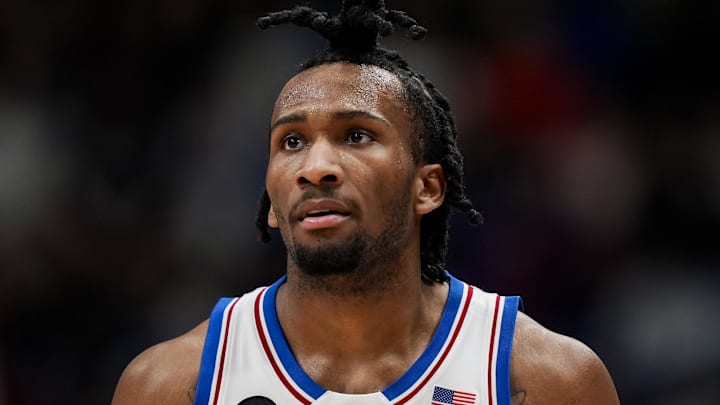
1. Washington Wizards: Darryn Peterson, Kansas
The Wizards were one of a few teams to involve themselves in a blockbuster at the deadline, grabbing former Mavericks’ forward Anthony Davis for a middling package. Now, they’re armed with Davis, Trae Young, and a host of talented up-and-coming young players.
Even still, the Wizards are sure to maintain their position in the race for the 2026 draft’s top picks, with Davis and Young set to sit the rest of the season. Here, they jump a few spots to nab No. 1, and subsequently take guard Darryn Peterson.
Peterson has continued to deal with injuries in his lone season with Kansas, but his No. 1 case is seen in flashes: a fiery first-half of play against BYU, and late shot-making versus Texas Tech.
He feels to have the best combination of skills among the top-tier prospects, with pro-level size and athleticism, X-factor and the stats to back it up. Washington sprints to the podium to grab their No. 1-scoring option for the foreseeable future.
2. Memphis Grizzlies: Cameron Boozer, Duke
Relative to the odds, the Grizzlies are the biggest winner of the mock, jumping four spots to nab Duke’s Cameron Boozer, though this could be indicative of the rest of their season given they’re fully repositioning around their younger core.
There’s merit to Memphis gambling on higher-upside prospects here, which may not be Boozer given his athletic limitations. But he profiles perfectly as a Grizzly, with size, strength, plus decision-making, efficient scoring and defense based around basketball IQ.
Boozer’s 23.3 points, 10.0 rebounds, 4.0 assists and 1.8 steals per game should make for another National Player of the Year candidate for Duke, and he’d be a great starting point for the Grizzlies’ newest era centered around Cedric Coward and Zach Edey.
3. Atlanta Hawks (via Pelicans): AJ Dybantsa, BYU
It seems the Hawks’ 2025 draft night is going to pay dividends in 2026, as the Pelicans remain one of the worst teams in the league, despite no real incentive to lose games. They currently have top-three odds at the No. 1 pick, and fans in Atlanta are hoping to tank race won’t include several teams passing New Orleans up.
A three-level scoring wing in Dybantsa is a no-brainer here, as the blue-chip version of a prospect they’ve hunted for. He’s certainly more than just a consolation prize, with potentially the highest-upside in the class at 24.0 points per game, and improving passing, defense and more.
Dybantsa could be a jumping off point for the Hawks to dive fully into a new era, or could even assimilate into the team’s current core of Jalen Johnson, Dyson Daniels, Nickeil Alexander-Walker and others.
4. Dallas Mavericks: Caleb Wilson, North Carolina
The new-look Mavericks jump up three spots, nabbing North Carolina’s Caleb Wilson with the No. 4 overall pick. Dallas' desperate need of a future point guard begs the question if anyone but Wilson can go fourth overall, but fresh off his performance against Boozer and Duke, it feels an uphill battle.
Given the Mavericks don’t own their picks in the years following, they’re fine to swing for the fences here, grabbing a uniquely athletic 6-foot-10 forward in Wilson who should contribute immediately and offer sky-high upside.
Wilson just posted 23 points on 67% shooting in a win over the Blue Devils, playing some solid defense against Boozer and showcasing his growing mid-range game in the process. He feels closer to tier one than tier three at this point, and any organizations valuing athleticism and upside could look to him in the top-tier.
Caleb Wilson vs Duke:
— NCAA March Madness (@MarchMadnessMBB) February 8, 2026
23 PTS
8-12 FG
Big game player. pic.twitter.com/aI3VQhu0tB
Alongside Cooper Flagg in Dallas, Wilson would help to create a potent two-way forward duo.
5. Sacramento Kings: Kingston Flemings, Houston
Despite the Kings’ top odds at the No. 1 pick, they fall to No. 5, grabbing Houston point guard Kingston Flemings.
Flemings is reminiscent of Sacramento’s former All-Star guard, with a speedy skillset centered around driving, elite passing, jump-shooting and better-than-expected defense. He’s been a breakout star for the Cougars averaging 17.1 points, 5.4 assists and 1.8 steals per game, and it’s easy to envision him being the first point guard to hear his name on draft night.
Sacramento is leaning into its young core of Dylan Cardwell, Nique Clifford and Maxime Raynaud to end the season, and needs talent of any kind as they enter their next era. Flemings not only fills a position of need, but offers likely the best prospect at this point.
6. LA Clippers (via Pacers): Keaton Wagler, Illinois
The Pacers and Clippers made one of the more interesting deals in recent memory this deadline, with Indiana sending out their 2026 first projected No’s 1-4 and 10-30 in a package centered around grabbing Ivica Zubac. Indiana currently has the second-best draft odds, meaning it would be an essential coin flip to send it to LA.
The Clippers, now without Zubac and new Cavalier guard James Harden, finally seem ready to punt on the Thunder trade and simply garner future assets. They let go of reigning MVP Shai Gilgeous-Alexander after just one season, making their selection of a spindly, 6-foot-6 handler all the more interesting here.
Illinois guard Keaton Wagler has been likely the fastest-rising player in the class, coming in as just a four-star on few radars. He’s now averaging 17.8 points for the fifth-ranked Illini, shooting a blistering 43% from three while dishing 4.2 assists per game.
Wagler could stand to show a little more separation while creating and shore up his defense, but his body of work, which includes a 46-point outing at Purdue, seems to have driven him into tier two.
7. Brooklyn Nets: Mikel Brown Jr., Louisville
Brooklyn seems to be slightly better than the other teams positioning themselves for the draft, but won’t need to do much to join the upper ranks. Here they land the No. 7 pick, grabbing a nice stylistic fit in lead guard Mikel Brown Jr.
The Louisville product is having a tough season from an efficiency and decision-making standpoint, but still offers one of the top pure talents in the class with size, shooting and passing — all things Brooklyn searched for at the ’25 draft.
If Brown can see some productive outings down the stretch of ACC play and into the NCAA tournament, he’s sure to be a top-10 lock on talent and potential alone. The Nets are sure to be patient as they move through this rebuild, making a gamble on Brown easier.
8. Utah Jazz: Darius Acuff Jr., Arkansas
The Utah Jazz were sneaky buyers at the deadline, sending out some hoarded draft capital for a former All-Star and Defensive Player of the Year in Jaren Jackson Jr. Now, they seem ready to move forward with a core of JJJ, Lauri Markkanen, Keyonte George, Ace Bailey and more.
Much like Washington, Utah wouldn’t have made the win-now move without its draft odds in mind, meaning they’re likely to maintain their position, if not push for an even better pick.
Should they land outside the top-five, a gamble on a star prospect feels in order with the “Go” button being pushed, and Arkansas’ guard Darius Acuff Jr. fits that bill.
Acuff is an interesting lead option, as the next in line of John Calipari guards to showcase elite talent. He’s averaging 20.5 points on 49% shooting, showing poise and readiness not often seen in true freshmen navigating the SEC.
Arkansas freshman Darius Acuff's last 4 games 😳
— B/R Hoops (@brhoops) February 7, 2026
▪️24 PTS | 8 AST | 5 REB | 1 TO
▪️22 PTS | 3 AST
▪️21 PTS | 10 AST | 0 TO
▪️31 PTS | 6 AST pic.twitter.com/f4BDuugAIf
George has seen a breakout season in Utah, but should be able to play off a lead guard, and there’s worse ideas than betting on Acuff’s handling and shot-making talent with a defense-dominated frontcourt.
9. Milwaukee Bucks: Nate Ament, Tennessee
For now, two-time MVP Giannis Antetokounmpo remains with the Milwaukee Bucks, and Cam Thomas’s signing makes that all the more interesting. But it does feel like the chances of a Summer blockbuster going down are high.
Regardless of Milwaukee’s position moving forward, they need talent, and gambling on Tennessee wing Nate Ament feels like a natural progression. He stands at 6-foot-10, and has a perimeter-based game with enormous upside.
The No. 4 prospect for most coming into the season, Ament’s seen an up-and-down Volunteers career thus far, but is trending up with hope of staying there.
In his last eight games — all tough SEC bouts — Ament is averaging 23.0 points on 47% shooting, with 6.4 rebounds and 2.4 assists to boot. It feels like he’s reclaiming some of his pre-season stock bit by bit, with the talent to coast to lottery land anyways.
10. Chicago Bulls: Jayden Quaintance, Kentucky
Rounding out the top-ten is Kentucky’s Jayden Quaintance, selected by the new-look Bulls.
Chicago razed its roster at the deadline, sending out veteran talent in favor of upside bets such as Rob Dillingham, Jaden Ivey, Leonard Miller and more. Now, they’ll look to make up ground in the race for the top picks in 2026.
Chicago seems to be betting on size and athleticism, referencing picks like Matas Buzelis and Noa Essengue, and now has need of a center after trading Nikola Vucevic to Boston. Quaintance is an easy add with size, athleticism and two-way upside at still-18.
Quaintance’s situation with Kentucky seems murky, but teams will be able to take solace in the fact he averaged 3.7 stocks per game at just 17-years-old with Arizona State.
11. Portland Trail Blazers: Labaron Philon, Alabama
Portland sits in interesting position, with a swath of young players that make up a budding core, but a bevy of win-now veterans and former stars as well. Smack dab in the middle sits current All-Star Deni Avdija. Here, they get what could be their last lottery pick for some time, taking a swing in a lead guard prospect in Alabama’s Labaron Philon.
Between Scoot Henderson, Jrue Holiday and Damian Lillard, the Trail Blazers have point guard options, but there’s no guarantee any of the three are elite in the long-term, making one more try plausible.
Philon’s been a revelation in his second season with the Tide, boosting his production to 21.5 points on 40% 3-point shooting, with 4.9 assists and 1.3 steals. He has a tight handle and shot-making instincts, and feels like a good bet at a solid all-around guard.
12. Charlotte Hornets: Koa Peat, Arizona
The Charlotte Hornets stand at No. 12, though they seemingly won’t be here long riding a nine-game win-streak and boasting the best net-rating in the new year. Kon Knueppel, Brandon Miller and LaMelo Ball create a potent combination on the perimeter, and seem worth moving forward with for the foreseeable future.
Given their outside options, a bet on a talented four makes sense, and Koa Peat stands on the board as a blue-chip option. At 6-foot-8, he's averaging 14.6 points, 5.6 rebounds and 2.6 assists per game, helping the undefeated Wildcats on the interior with touch and athleticism.
Peat’s 3-point shooting leaves plenty to be desired, but could be worth betting on for a Charlotte team with plenty of firepower already signed on.
13. OKC Thunder (via Clippers): Brayden Burries, Arizona
The defending-champion Thunder draft at No. 13 via the Clippers, who now have incentive for OKC to jump Indiana. It isn’t likely to change LA’s end-of-season strategy of trying to make the postseason, but does provide an interesting wrinkle.
Oklahoma City will continue to use their draft picks to backfill roster spots with cost-controlled players, making older and more ready-to-contribute players potentially more enticing. Still, it’s tough to pass on pure talent when choosing in the lottery, and that leads to a pick in Arizona’s Brayden Burries.
After a slow start to his collegiate career, Burries is now leading the undefeated, No. 1-ranked team in the country in scoring as a true freshman. He shades toward being a two-guard, but can handle the ball, score at all three levels, rebound, play-make and defend. Burries’ stock lands all over the place due to his age and position, but seems to possess the talent and malleability NBA teams look for.
Brayden Burries tonight vs No. 13 BYU:
— ESPN (@espn) January 27, 2026
29 PTS | 5 REB | 3 STL 🔥 https://t.co/nufsJ1aZnQ pic.twitter.com/UqZdo4x4Vh
All in all, he seems like the kind of talented, position-less player who could blend into a variety of Thunder lineups.
14. San Antonio Spurs (via Hawks): Karim Lopez, NZ Breakers
The San Antonio Spurs cap off the lottery, picking via the Hawks and nabbing the first international talent in Karim Lopez of the New Zealand Breakers.
The Spurs seem to have their backcourt and most of the frontcourt nailed down, with plenty of room to fill in the gaps in between. Here they get a 6-foot-8 handling wing capable of scoring and doing the in-between work.
Lopez has been touted as one of the top prospects in the class, and has raised his points, rebounds, assists, steals, blocks, field goal and 3-point percentage while playing in a great pro league. With the Spurs, he would be able to take advantage of mismatches, boosting his floor and ceilings as both a scorer and defender alongside Victor Wembanyama, as one does.
15. Miami Heat: Yaxel Lendeborg, Michigan
The Heat were quiet at this year’s trade deadline, aside from reported involvement in trying to snag Antetokounmpo from Milwaukee. With that being the case, it feels like they could be gearing up to offer even more around the time of the 2026 NBA Draft.
In that case, nabbing an immediate contributor — be it for themselves or Milwaukee — feels like a good bet, and Michigan’s Yaxel Lendeborg checks plenty of boxes.
He’s seen an up-and-down season with the Wolverines due to injuries and fit, but has a long history of two-way impact that’s sure to continue into the NBA. He stands at 6-foot-9 with a 7-foot-4 wingspan, and can score, pass, defend, rebound and meld into a variety of roles ranging from big wing to small-ball five.
Lendeborg’s immediate success could be tied to his 3-point shooting, but he’s shown flashes of real improvement. Lendeborg could step in for Ware in the event of a trade, or tag along and wear Green.
16. Golden State Warriors: Hannes Steinbach, Washington
The Warriors seem to have missed out on the Greek Freak sweepstakes, but it could be a blessing in disguise in terms of future roster-building. Here, they choose a talented young big in Washington’s Hannes Steinbach.
Steinbach’s been one of the more prolific freshman bigs in the country, averaging 17.5 points, 11.2 rebounds and more than a steal and block per game. He’s a sure-handed near-7-footer with premier touch on the inside, and is shooting a respectable 35% from three on low volume.
Most importantly, Steinbach is a truly elite offensive rebounder, and could be a real weapon in affording the Warriors extra possessions each game.
Golden State just gambled with the addition of Kristaps Porzingis as a stretch big with defensive potential, and Steinbach could be an extension of that, moreso in the long-term.
17. Memphis Grizzlies (via Magic): Bennett Stirtz, Iowa
Having already grabbed Boozer with the second pick, the Grizzlies get more risky here at No. 19, grabbing a stylized lead guard in Iowa’s Bennett Stirtz.
The 6-foot-4 senior has seamlessly translated to each level of collegiate basketball, and is ramping up in his lone season with Iowa, averaging 19.2 points on near-40% 3-point shooting, with 5.0 assists and 1.5 steals per game. He has a highly unique style of play, with a slower pace that can wear out pick-and-rolls into eventual smooth shot-making.
Stirtz won’t be a player for team and scheme, but for any organization on the lookout for players to build around, he could be a great starting point. Especially for one that’s looking to employ the hard-to-guard Edey for the long haul.
18. OKC Thunder (via 76ers): Joshua Jefferson, Iowa State
Where OKC grabbed a project in the lottery, here they grab a plug-and-play forward in Iowa State’s Joshua Jefferson that should be ready to hit the ground running with the Thunder system.
Jefferson’s one of the top upperclassmen not just in the loaded Big 12, but the country in general, averaging 17.2 points, 7.7 rebounds and 5.1 rebounds, displaying genuine point-forward ability. At 6-foot-9, he offers a unique size on the wing for OKC, and has shown real improvement as a 3-point shooter in his senior season.
The Thunder are likely gearing up to make roster changes in the upcoming offseason, and Jefferson is an easy choice given his feel for the game should help to assimilate quickly.
Jefferson’s defense blends in well within the Thunder’s team scheme, and he could handle hub-esque duties currently assigned to Isaiah Hartenstein and Jaylin Williams.
19. Charlotte Hornets (via Suns): Thomas Haugh, Florida
The Hornets grab another first-round pick via the Suns, taking Florida’s Thomas Haugh as a gluey bet at the forward position.
Haugh doesn’t claim elite skills in any singular area, outside of great verticality packed within a 6-foot-9 frame. But he’s scaled up his game across the board just a season after impacting a national championship-winning squad last year.
He’s averaging 17.8 points, 6.4 rebounds, 2.0 assists and a steal and block per game, doubling his 3-point attempts while maintaining his fine efficiency. Even more, he brings an energy and toughness than all 30 NBA teams would like to have from a draft pick.
20. Detroit Pistons (via Timberwolves): Chris Cenac Jr., Houston
The Pistons grabbed Kevin Huerter and Dario Saric from Chicago, nabbing a protected 2026 first-round swap in the process. In this case, it helps them move up nine spots to No. 20, grabbing Houston’s Chris Cenac Jr.
Boasting the second-best record in the league, Detroit isn’t likely speeding toward any situation without new All-Star Jalen Duren, an upcoming restricted free agent, but could still stand to bolster the frontcourt just in case.
Part of Houston’s five-star trio, Cenac saw a slow start with the Cougars highlighted by a lack of traditional skills on the interior. He’s shown real improvement in Big 12 play, though, averaging 11.1 points, 8.0 rebounds and 1.7 steals per game in his last nine tries.
Cenac’s draft case is built around his face up ability at 38% from the perimeter on good volume, which could help to add another layer to the Pistons’ offense.
21. Toronto Raptors: Cameron Carr, Baylor
The much-improved Raptors grab a breakout wing in Baylor’s Cameron Carr, hoping he can contribute right away.
Carr feels tailor-made from a tools perspective to fit into the Raptors core. They’ve seen several seasons worth of gambling on lengthy forwards, and here look to a high-flying wing. He saw two non-factor seasons with Tennessee, but is now one of the top players in the Big 12 averaging 19.6 points on 52% shooting.
Carr’s NBA case will be built around hitting triples — currently 41% on 5.5 attempts per game — and making highlight-level athletic plays via dunks and blocks. The Raptors could use both of these things as a bottom-five shooting squad with middling rim-protection.
Cameron Carr (@cameroncarr43) finally getting the chance to show the college basketball world who he is has been one of my favorite stories of the year.
— Matt (@HoopHound5) February 6, 2026
His length and grace jump off the screen, he plays with an exciting pace, shoots with confidence, and brings a… pic.twitter.com/vPTcgFYCHM
22. Atlanta Hawks (via Cavaliers): Braylon Mullins, UConn
The Hawks have already grabbed Dybantsa, and supplement any 3-point shooting lost at the deadline by grabbing UConn’s Braylon Mullins at No. 22.
A 6-foot-6 wing, Mullins has been a chameleon for the Huskies, blending seamlessly into the lineup with double-digit scoring, suave 3-point shooting and plenty more. He’ll bring immediate spacing and basketball IQ, with room for more given any available runway.
Atlanta will seemingly offer just that, with several play-makers that could help Mullins to thrive.
23. Philadelphia 76ers (via Rockets): Dailyn Swain, Texas
Texas’ 6-foot-8 guard-slash-forward Dailyn Swain is one of the fastest-rising prospects in the class, and a perfect match in the middle of the 76ers roster as it stands now.
Swain has a unique combination of size and athleticism, using it on both ends. He can play-finish in the athletic wing ways, while providing highly intruging flashes of guard-like ball-handling. Defensively, he’s a proven plus in the best league in the world, averaging 1.8 steals per game.
Swain’s a good bet to be an impactful role player, and is just a 3-point shot away from being more. A team like Philadelphia is likely hoping his stock doesn't soar further.
24. LA Lakers: Morez Johnson Jr., Michigan
The blueprint that the Dallas Mavericks set for building around Luka Doncic is simple: shooting and defense. Here they choose the back half of that equation, grabbing one of the best defenders in the country in Michigan’s Morez Johnson Jr.
As a sophomore, Morez has upped his stock majorly with Michigan, anchoring the team’s defense with 1.2 blocks and 0.8 steals, guarding across a variety of positions. He defends the pick-and-roll well, and despite his being 6-foot-9 can hold his own against bigger matchups with toughness and physicality.
Even more, Morez is a crisp fit next to Doncic on offense due to his effectiveness at finishing plays, most notably as the roll-man.
Morez Johnson Jr. vs. Nebraska
— Chip Williams (@chipwilliamsjr) February 8, 2026
17 points (5/6 FG | 1/2 3pt | 6/7 FT)
12 rebounds
2 assists
0 turnovers
Johnson is the only high-major NCAA player with a >20 usage and >70 TS%. The majority of his attempts are assisted, but he has been an elite play finisher dating back to his… pic.twitter.com/hT3MCNXSlB
There’s a chance his stock soars higher than this as the NCAA Tournament nears, but in this case he’s a no-brainer choice for the Lakers.
25. Boston Celtics: Patrick Ngongba II, Duke
The Boston Celtics finally got their guy at the deadline, grabbing Chicago’s center in Nikola Vucevic to help further anchor their interior. With the No. 25 pick, they’ll continue to bolster that unit with Duke’s Patrick Ngongba II.
Ngongba’s seen a predictable second-year boost with the Blue Devils, scoring double-digit points, taking down more than six boards, dishing two assists per game and showing off some savvy shot-blocking in spite of lesser athleticism.
For any team looking to pour into him, Ngongba could very well be a gem of a high-feel big hiding in plain sight. With scoring guards and wings galore, Boston feels like an natural fit.
26. Denver Nuggets: Tounde Yessoufou, Baylor
At No. 26, the Denver Nuggets grab one of the harder-to-place prospects in the entire class in Baylor wing Tounde Yessoufou.
The face-value stats for Yessoufou as a true freshman are great: 17.7 points, 5.7 rebounds and 2.1 steals while shooting 48% overall. He’s a physical specimen, being one of the more pro-ready players in that sense in some time.
Despite these things, his systemic fit can be a mess in a variety of ways. He shoots just 31% from three, albeit on five attempts per game, and lacks a level of general offensive polish that raises question marks about what he’ll be when he doesn’t have the ball. Additionally, his defense is up-and-down despite good numbers.
The Nuggets want ready-to-go prospects, but also haven’t been shy about taking and developing raw prospects, a la Peyton Watson, into legit players. The fully-realized version of Yessoufou would be a tough cover playing alongside Nikola Jokic.
27. New York Knicks: Aday Mara, Michigan
The Knicks ultimately, and rightfully, didn’t deal star Karl-Anthony Towns at this year’s deadline, but it feels like neither side sees the pairing as a long-term fit. In that case, New York could stand to add an insurance center in Michigan’s Aday Mara.
Mara stands at an unteachable 7-foot-3, scoring, rebounding and blocking shots as gargantuan players do. But he also has unique skill with the ball in-hand, primarily passing in the open court.
In the event Towns finds a new home, Mitchell Robinson will step in with starter-level impact for the Knicks. But betting on the lengthy Mara, given they employ one of the smallest stars in the league, wouldn’t be a bad option for New York.
ANOTHER three-ball from the 7-footer Aday Mara.
— CBS Sports College Basketball 🏀 (@CBSSportsCBB) February 8, 2026
Second of the game. Second of the season. pic.twitter.com/HPgFXmzYnY
28. Cleveland Cavaliers (via Spurs): Christian Anderson, Texas Tech
Christian Anderson is among the best players in college basketball right now, averaging nearly 20 points and 7.5 assists per game for a top-15 team in the nation.
He has claim to being the single best shooter in the class at 38% on a mind-bending 7.9 attempts per game, plenty of which are self-created. His frame at 6-foot-3 is somewhat concerning for his long-term defensive outlook, but this is familiar territory for Cleveland, who just shipped off Darius Garland to LA.
James Harden is a great short-term add for the Cavaliers, but Anderson could fit into the core down the line in some battle-tested ways.
29. Minnesota Timberwolves (via Pistons): Meleek Thomas, Arkansas
Minnesota finally grabbed potential guard help with the addition of Bulls’ Ayo Dosunmu at the deadline, and they’re likely to hold onto him for the future. Even more, in a shocking turn of events, veteran Mike Conley was traded, waived and is now likely to return to Minnesota.
While the Wolves may not have need of a true lead guard, they still need help in the backcourt in general, and chancing a pick on Arkansas’ combo guard Meleek Thomas makes sense on a few levels.
At 6-foot-5, Thomas has been impactful for the Razorbacks, averaging 15.0 points on 39% 3-point shooting, with 1.4 steals to boot. Even more, he’s dished 2.7 assists to just 0.9 turnovers next to Acuff, showing some secondary play-making ability.
His role wouldn’t be much different alongside Anthony Edwards, scoring form the outside, clogging passing lanes and seldomly creating offense himself.
30. Dallas Mavericks (via Thunder): Tyler Tanner, Vanderbilt
In the scenario that the Mavericks don’t take a lead guard with their top pick, a gamble with the newly-acquired Thunder pick makes sense. Vanderbilt’s Tyler Tanner fits the bill as a do-it-all guard with first-round stock.
Tanner’s amid a breakout season, averaging 18.6 points on 39% 3-point shooting, boasting mistake-free play-making and impeccable defense for his size at 2.5 steals per game. The only catch being he’s 6-foot tall, potentially entering a league that’s fading away from undersized guards.
Tanner’s athleticism and plus-defense makes his size less of a factor, but it’s still hard to make his case over other first-round guards. In a world where Dallas has both Cooper Flagg and Caleb Wilson backing him up, they’d likely feel just fine about risking this pick.
 Add us as a preferred source on Google
Derek Parker covers the National Basketball Association, and has brought On SI five seasons of coverage across several different teams. He graduated from the University of Central Oklahoma in 2020, and has experience working in print, video and radio.
Follow DParkOK