
How Will the NCAA House Settlement Affect the Future of College Softball?
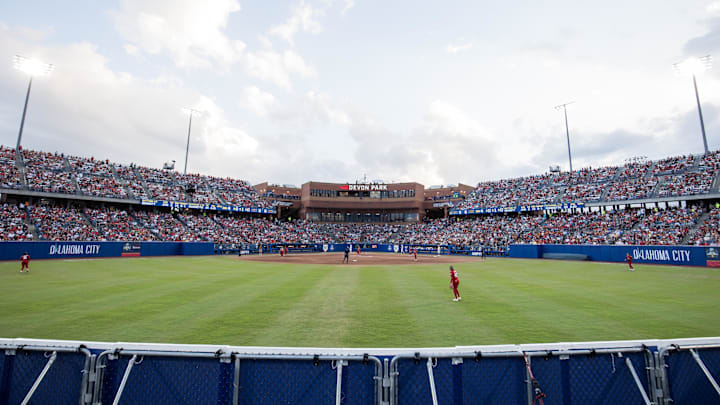
During Game 3 of the Women's College World Series, the landmark NCAA House Settlement was passed, which is expected to cause a seismic shift in the landscape of college sports and college softball.
In the settlement, the NCAA and its member institutions are now responsible for $2.8 billion in backpay money to former athletes who competed from 2016 to 2024 due to a loss of name, image, and likeness (NIL) compensation.
Additionally, starting July 1, schools can now directly pay athletes up to $20.5 million in the first year. Likely, that number will continue to grow as the cap is calculated by taking 22 percent of the average of certain power school revenues each year, and as TV deals and broadcasting rights continue to skyrocket, this number will rise.
What is interesting about both the back pay and new compensation model is that many schools have already determined that they will use the proposed equation to determine how this money is distributed among athletes in athletic departments, with 90 percent going to men's basketball and football. More specifically, the proposed formula would give 75 percent of the money to football athletes, 15 percent to men's basketball, five percent to women's basketball, and five percent to all other sports.
However, the settlement does not require schools to use this formula; each member institution can decide how it will distribute it amongst its athletes.
Also in the settlement were terms laid out about how a third-party entity will review all NIL deals from outside the university worth more than $600, to determine their legitimacy.
Lastly, the settlement moves to install roster limits for each sport, which will require schools and their teams to comply and only carry the allotted number of athletes. Thus, many programs began cutting players before the settlement as they saw the writing on the wall quickly approaching.
College athletics has officially entered a new era https://t.co/TMnwVO2FGy
— Sports Illustrated (@SInow) June 7, 2025
What Does the Settlement Mean for Olympic Sports like Softball?
Despite the growth of viewership, attention, and love to the collegiate game, the House Settlement could have a lastly detrimental impact, in my opinion. As a sport administration professor, I have studied college sports for over a decade and watched as it twisted and turned into a new and completely different model.
The fear now is, where does this new model prioritize women athletes, and the incredible growth that we have seen explode in the last decade, especially in a sport like softball? Furthermore, where does this put Olympic sports, when at best they receive five percent of the back pay and future payouts?
In the first part of this question, there is already a lawsuit being leveraged over the House Settlement dealing with Title IX equity issues.
According to Front Office Sports, eight women athletes have filed an appeal to the landmark settlement stating it violates Title IX as the institutions paying back pay and future compensation based on the proposed formula are in contempt of the equity Title IX protects. Furthermore, the appeal states that women athletes should receive $1.1 billion or almost half of the payout, as these institutions take in federal money--meaning they are beholden to the federal law of Title IX.
Breaking: A group of eight women has filed an appeal of the House v. NCAA settlement approval, arguing that it violates the Title IX gender equity statute, FOS has learned.
— Front Office Sports (@FOS) June 11, 2025
It’s the first appeal of the landmark settlement that was approved last week.
Story by @achristovichh ⬇️
In the second part of the question, is five percent a fair amount for Olympic sports? I do not think anyone is claiming that Olympic sports bring in the revenue, television contracts, or sponsorships of men's basketball and football, but are there cases where the formula is restrictive? Simply stated---yes.
For one, Olympic sports have never been allowed to see what their worth is in a free and fair market. Currently, the NCAA has bundled all Olympic sports and women's basketball in one broadcasting deal with ESPN that ends in 2032. So, how do we know that an Olympic sport like softball is only worth five percent if we have never given it a chance to see what it is truly worth, standing on its own?
There are also unique programs like Oklahoma softball, Tennessee softball, South Carolina and Stanford women's basketball, LSU and Vanderbilt baseball, LSU, Oklahoma, UCLA, and Utah gymnastics and the list goes on and on, that are unique to their universities, cities, and regions that draw massive fan fare, crowds, and sell out arenas and stadiums.
This should be considered and rewarded larger than five percent. and athletic directors and departments have the jurisdiction to take this into account and not simply fall in line with the proposed formula, but yet, think more creatively and inclusively about the value of their Olympic sports.
More News: How an NIL Loophole is Transforming Texas Tech Into a Softball Powerhouse
More News: Big Blow for Tennessee Softball as Infielder Taylor Pannell Enters the Portal
More News: Arkansas Softball Adds Power Bat in Cal Transfer Tianna Bell
 Add us as a preferred source on Google
Allison Smith is an expert in leadership and organizational behavior in collegiate and professional women’s sports. Smith is a professor (Georgia State University), researcher, and writer. Smith holds a Ph.D. from the University of Tennessee in Kinesiology and Sport Studies. Smith’s research centers on combatting the underrepresentation of women leaders in sport, lack of organizational structure for work life integration for sport employees, and lack of programming and oversight for preparing athletes to transition to life after sport. Since graduating with a bachelor’s in journalism in 2011, Smith has sought opportunities to write about sports as a contributing writer focused on the growth of women’s collegiate, Olympic, and professional sports in this new age and movement for multiple outlets including Athletic Director U, and now Forbes.com. As a former Division I and II pitcher and Division III pitching coach Smith will bring unique insight and expertise to Softball on SI.
Follow allisonbsmith15