
1938 Goudey Baseball Card Set: Rookies, Rarity, Hilarity
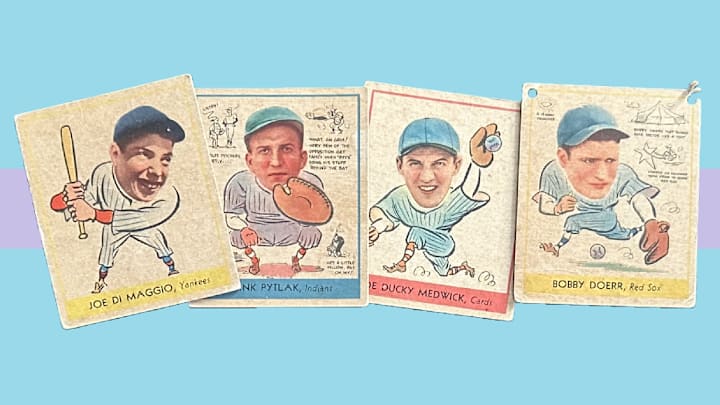
Many vintage collectors, when they first see the cards of the 1938 Goudey set, have a two-word reaction: "No thanks." After all, there is something utterly ridiculous if not creepy about the set's gigantic faces attached to tiny cartoon bodies in proportions only a bobblehead collector might appreciate. At the same time, these are cards that likely would have been received very differently back in 1938 as they offered young collectors up close and in color looks at the league's top stars and the closest thing to game action they could find outside of an actual ballpark, at least if they applied a bit of imagination.
Today, the set's appeal resides less in its aesthetics and more in the sorts of categories vintage collectors seek out in any vintage set: star power, rookies, and rarity. Marry that up with a little history and mystery, and the 1938 Goudey set takes on a far more serious Hobby profile than its goofy artwork might suggest.
RELATED: 1971 Topps Baseball: Vintage cards staying in strong demand
Rookie Cards

RELATED: Three cards on a budget for Ruth, Gehrig and DiMaggio!
Unlike today's card sets, where rookie cards are definitively identified by "RC" badges or logos, debate is often more heated and nuanced when it comes to the rookie cards of long ago stars. In most cases, discussion comes down to what sets collectors determine are "major enough" to yield rookie cards. As examples, the 1938 Goudey set (arguably) includes Hall of Fame rookie cards for Joe DiMaggio, Bob Feller, and Bobby Doerr. At the same time, all three of those players have cards in the 1936 Goudey Wide Pen Premiums (R314B-1) set that came out two years earlier, and of course DiMaggio has even earlier Pacific Coast League cards depicting him as a San Francisco Seal. So which is the true rookie card of each of these all-time greats? It honestly just depends who you ask, and the answer may well come down to which card they have!
Top Stars

RELATED: Five Vintage Baseball Card Bargains Under $500
Messrs. DiMaggio, Feller, and Doerr aside, the 1938 Goudey set also features cards of Hall of Famers Jimmie Foxx, Hank Greenberg, Joe "Ducky" Medwick, Al Lopez, Charlie Gehringer, and Ernie Lombardi, not bad at all for a set that includes only 24 different players on its checklist. Of these, Foxx and Greenberg are the most coveted. However, the Medwick cards are much tougher than his stat line might normally suggest. At least part of the premium on Medwick is that he has relatively few cards across the more mainstream sets of the era. The result is for some collectors demanding a Medwick in their Hall of Fame portfolio, their choices come down to a paltry two: 1934-36 Diamond Stars and 1938 Goudey.
Rarity

Compared to the other major issues of the decade, 1938 Goudey cards are quite tough. As an example, here are the PSA populations for Charlie Gehringer across several different sets.
- 1933 Goudey: 610
- 1934 Goudey: 507
- 1935 Diamond Stars: 389
- 1938 Goudey: 313
However, even those numbers only tell half the story. That's because each player in the 1938 Goudey set has two different cards: one with a plain background and one with a cartoon background. For Gehringer, the population breakdowns are 139 and 174 respectively. (Plain backgrounds are typically scarcer across the entire set, not just for Gehringer.)
Mystery

As the 1938 Goudey set includes only 48 cards, there is some oddity in the fact that a Jimmie Foxx card from the set might carry the number 249. Rather than employ a standard numbering of 1-48, the set somewhat mysteriously runs from 241-288. Conventional wisdom in the Hobby is that Goudey considered the set to be a sequel to its 1933 predecessor, numbered 1-240. This explanation is not wholly satisfying in that it ignores the various sets Goudey issued in the intervening years. Still, how else do collectors look at the numbering and make it make sense?

There is also a second mystery, or at least quick, related to the set's numbering. Card backs from the plain background cards (241-264) indicate a series of 288 cards while card backs from the cartoon background cards (265-288) indicate a series of 312 cards. The standard interpretation here is that after putting out the lower numbered series of 24 cards, Goudey must have imagined issuing not just a second series of 24 but a third one after that. For whatever reason, however, such a third series never materialized.
TOP TRENDING COLLECTIBLES ARTICLES:
 Add us as a preferred source on Google
Jason A. Schwartz is a collectibles expert whose work can be found regularly at SABR Baseball Cards, Hobby News Daily, and 1939Bruins.com. His collection of Hank Aaron baseball cards and memorabilia is currently on exhibit at the Atlanta History Center, and his collectibles-themed artwork is on display at the Honus Wagner Museum and PNC Park.