
1989 Upper Deck Ken Griffey, Jr. Rookie Card, A Buyer's Guide
In this story:
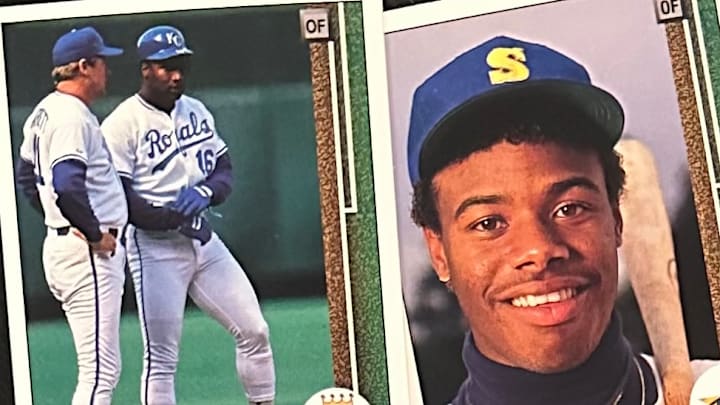
There was no better feeling in 1989 than pulling a Ken Griffey rookie card from pack of Upper Deck. The card wasn't serial numbered or short-printed, so it was a feeling that came with just about every box, sometimes more than once, but it never got even the slightest bit old. It's no wonder that today collectors continue to seek out unopened packs and boxes in search of that same high, not to mention the $5K payday that could come from landing a PSA 10.
RELATED: The Coolest Card in 1989 Upper Deck and it's not Griffey

Buy Low, Sell High

"Buy low, sell high" in this case refers to the Upper Deck low-numbered and high-numbered series that make up the 800-card set. If you're hunting for Jim Abbott cards, by all means buy the high numbers. After all, that's your only chance to pull the inspirational Angels ace, not to mention cards of Jerome Walton, Dwight Smith, and Todd Zeile. And hey, who couldn't use an extra card of Nolan Ryan throwing a football?
However, if it's Griffey you're after, boxes and packs of high numbers are a mistake. Yes, you can still pull a Griffey since the high-number packs included cards from both the standard 1-700 checklist and the extended 701-800 checklist. At the same time, every high number in the pack is a guaranteed non-Griffey. If you're looking to up your chances on card #1, ditch the high numbers and stay with the low.
Star Search
RELATED: 1989 Upper Deck Griffey Card Sales Skyrocketed in 2025 but What's Next?

When it comes to buying boxes of 1989 Upper Deck, unopened may not mean what you think it means. Yes, the packs are tamper-proof, at least if you believe what it says on the wrapper, and yes, those famous Upper Deck holograms provide an added level of authenticity, but a particular selling point from 1989 has not exactly aged well.
"Random Sequencing," read the wrappers and boxes, as if to assure buyers they aren't shelling out $30 for a 1981 Donruss-style rip where nearly every pack is Red Sox-Expos or Dodgers-Reds. At its best, random sequencing meant fewer duplicates, which was a huge win for anyone trying to build the entire set back in 1989. Unfortunately, it may today be a disaster for anyone chasing just one card.
Admittedly, opinions throughout the Hobby differ on this point but many collectors and dealers who were buying and selling in 1989 have stories of being able to predict the Griffey packs based on some not-at-all random sequencing Upper Deck regarded as random. Pull card #2 from a pack, and the pack above or below very likely had card #1, for example. Or, even without decoding any sequence, pull a Griffey from one pack and assume the rest of the packs are far less likely to include a second or third Griffey. Now consider how easy it is to stuff a box with 36 of these low probability Griffey packs. Good chance unless you're buying what's known as certified FASC ("From a Sealed Case"), the box you scoop up may be exactly these leftovers, in which case you're lowest numbered pull will be Luis Medina.
"Pack Fresh" Ain't What It Used To Be

In the old days, barring some calamity in transit, cards straight out of the pack were pretty much by definition mint. These days, grades of mint (and particularly gem mint) aren't handed out so easily. Open a pack of 2025 Topps and you might be lucky for even a handful of the cards to gem. Open a pack that's been sitting who knows where for 36 years, and your chances decrease considerably.
Obviously it would be incredible to pull a Griffey, have it come back a PSA 10, and know that you now have a $5,000 card. But chances are even if you do pull the Griffey you're much more likely looking at a PSA 9 or even 8 or 7, even if the card looks pretty much perfect to the naked eye. And unfortunately those grades aren't going to pay for your purchase. To say the card's value drops off a cliff once it falls below gem mint is an understatement. Here are the current values of the Upper Deck Griffey by grade (Source: CardLadder.com).
- PSA 9 - $336
- PSA 8 - $138
- PSA 7 - $83
Now none of the above is to talk anyone out of picking up some 1989 Upper Deck to rip. After all, there is plenty to enjoy about the game-changing set even without pulling its most famous card. But if it is the Mariners rookie outfielder you're after, pretty much exclusively, just know what you're getting yourself into. It's easy to imagine ending up with a couple of $5K cards, but that's not to say it's at all likely.
TOP TRENDING COLLECTIBLES ARTICLES:
 Add us as a preferred source on Google
Jason A. Schwartz is a collectibles expert whose work can be found regularly at SABR Baseball Cards, Hobby News Daily, and 1939Bruins.com. His collection of Hank Aaron baseball cards and memorabilia is currently on exhibit at the Atlanta History Center, and his collectibles-themed artwork is on display at the Honus Wagner Museum and PNC Park.