
A closer look at the iconic 1914-1915 Cracker Jack baseball card sets
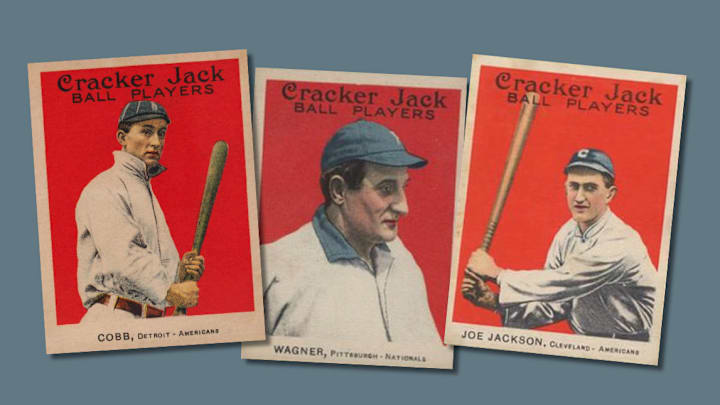
Three Iconic Sets
The word "iconic" is used a lot in the Hobby, probably too much. However, one place where it's probably used just about the right amount is in considering the great vintage baseball card sets of the Prewar Era. Here, many collectors agree there are three:
- 1909-1911 American Tobacco Company "White Borders" (T206)
- 1914-1915 Cracker Jack (E145)
- 1933 Goudey (R319)
RELATED: 1933 Goudey Babe Ruth, Which One is the Ultimate Grail Card?

That's not to say there aren't other outstanding sets. Old Judge, Diamond Stars, and Play Ball are just a few of the names that come to mind. Still, the T206, Cracker Jack, and Goudey sets are in a league of their own when it comes to sets issued before 1941.
RELATED: The Ultimate Cardboard Battle - T206 Honus Wagner vs. 1914 Babe Ruth RC

For many collectors, knowledge of these sets comes down to a handful of key cards. For example, the T206 set is best known for its Wagner, though its quartet of Ty Cobb cards is well known even to casual collectors of vintage cardboard. Similarly, the 1933 Goudey set is most famous for its four Babe Ruth cards, though collectors with an even deeper knowledge of the Hobby might single out its rare Napoleon Lajoie as the set's real prize. Finally, the Cracker Jack sets are best known for their cards of top-shelf Hall of Famers Ty Cobb and Honus Wagner, not to mention a certain non-Hall of Famer who batted .356 for his career.

With each of these sets, however, a lot of the fun comes in exploring their overall checklists, which in all cases are filled with oddities and surprises. In the case of the Cracker Jack sets, here are five fun facts that have nothing to do with Ty Cobb, Honus Wagner, or Shoeless Joe!
One Set or Two?
Because the cards issued by Cracker Jack in 1914 and 1915 are so similar, there is often confusion as to whether they constitute two sets or one. Notably, in his American Card Catalog, Hobby legend Jefferson Burdick assigned only a single entry to the sets: E145. In truth, it is not much of a stretch to see the cards as one set issued over two years. Compare, for example, the Zack Wheat cards from the 1914 (left) and 1915 (right) sets. Are they really that different?

Still, Hobby consensus today is to regard the 1914 and 1915 issues as distinct and to use the designators E145-1 and E145-2 as an alternative to Burdick's original nomenclature. That said, nearly every player in the 1914 issue returns in 1915 with the same card number, same bio, and same artwork.
The Flip Test
Though the cards are quite similar across the two years, there is one incredibly quick and easy way to distinguish a 1914 specimen from its 1915 counterpart. Just flip it over. While the 1914 versions maintain the orientation of their card fronts, the 1915 versions are inverted. And for collectors who want to be doubly sure, the small print at the card bottom differs as well. Most notably, the 1914 cards advertise 144 cards in the set while the 1915 cards advertise 176.

The Curious Case of Rollie Zeider
Over the course of Hobby history, it has not been the least bit unusual for a player to appear multiple times in the same set. Certainly the aforementioned T206 Ty Cobbs and 1933 Goudey Babe Ruths are just some of the many famous examples. But what about Rollie Zeider, who appears twice on the 1914 Cracker Jack checklist?

Was the double-dose of Zeider just a goof? Well, yes and no. More than likely, the second Zeider card was a correction to the first, which showed Zeider in a White Sox uniform. True, Zeider played for the Sox in early 1913, but that was two teams ago by the time the Cracker Jack cards came out. While it is unknown how many series the 1914 cards were issued in, a fair assumption is that the first Zeider card came out in one series and the second card was part of a later series.
Near-Identical Checklists
Though the 1915 checklist had 32 more cards than its predecessor, the two checklists were otherwise nearly identical when it came to cards 1-144. In fact, there were only five cards that didn't make the transition, card number and all, from the 1914 set to the 1915 set. The most famous of the 1914-only quintet was Chicago Cubs legend turned Yankee manager Frank Chance, whose card 99 on the 1914 checklist was replaced in 1915 by Hal Chase.

Team Changes
Eleven players on both checklists changed teams from one set to the other. In two cases (Nap Lajoie and Sherry Magee), artwork was adjusted ever so slightly to reflect the new team. For example, the "CLEVELAND" lettering across Lajoie's uniform in 1914 is no longer visible on his 1915 card where he is a member of the Philadelphia Athletics. For the nine other players who changed teams between sets, artwork remained identical.

The Christian Gentleman is Twice as Nice
While the 1915 set recycled as much as possible, whether this meant bringing over 139 of the 144 cards on the 1914 checklist and reusing artwork even when teams had changed, the Cracker Jack brain trust made one exception to their frugality. When it came to the New York Giants legend Christy Mathewson, Cracker Jack went with all new artwork for 1915. Where the Christian Gentleman's 1914 card showed him in action, ready to send his deadly fadeaway to an outmatched batter, his 1915 card portrayed him in distinguished portraiture.

How Many Cards??
It's well known that the 1914 Cracker Jack set included 144 cards, but just how many of each card were there? A small clue on the back of each card may hold the answer.

In the category of "big if true," the 1914 cards clearly state that "Our first issue is 10,000,000 pictures." One possible reading is that Cracker Jack printed ten million of each card. More conservatively, one might interpret ten million as the total print run across the entire set, which woudl translate into an average of just under 70,000 copies per card. At the moment, the average PSA population per card is right around 40. Even if collectors assume only one in fifteen surviving Cracker Jack cards has gone the route of PSA, this still means fewer than 1% of these incredible cards have survived the test of time.
 Add us as a preferred source on Google
Jason A. Schwartz is a collectibles expert whose work can be found regularly at SABR Baseball Cards, Hobby News Daily, and 1939Bruins.com. His collection of Hank Aaron baseball cards and memorabilia is currently on exhibit at the Atlanta History Center, and his collectibles-themed artwork is on display at the Honus Wagner Museum and PNC Park.