
Cards Were Made to Be Seen: Inside the Rise of Sports Card Displays
In this story:
You finally land your dream card. Now what? For a growing number of collectors, the answer is no longer to bury it in a dark box.
Historically, the best cards in a personal collection rarely saw the light of day. They sat hidden in safes, closets, or carrying cases. Maybe they were shared once on social media before being locked away again. For decades, this was the standard way to protect high-value cardboard.

But a shift is happening within the hobby. Collectors are moving past viewing cards strictly as investments or part of a PSA set registry. More collectors are treating their collections as artwork.
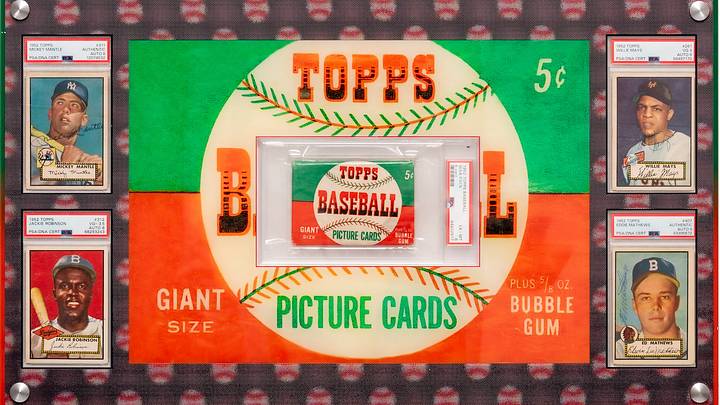
As a result, collectors are becoming more creative with their sports card displays. Custom showcases are blending cards, jerseys, autographs, and artwork. Collectors want to see what they worked so hard to acquire.
How Presentation Impacts the Hobby
David Schwartz, co-founder of 5D Sports Displays, builds custom displays for collectors. He has seen this trend grow firsthand, noting that treating cards like art is deeply tied to social media.
In past generations, a collection was mostly private. It was shared with immediate family, close friends, or local collectors at a weekend show. Today, a collector can post a photo of their cards online and instantly reach thousands of people.

This digital showroom has shifted the psychology of the hobby. A rare card is no longer just something to own. It is also something to share. Complete parallel "rainbows," signed sets, and player-specific runs become exponentially more impressive when displayed as a single, cohesive image.
In fact, Schwartz notes that the desire for a beautiful presentation is actively influencing buying habits. "I’ve had people tell me they are now chasing rainbows or specific sets strictly because of the bragging rights a completed display offers," he says. The display itself has become the final chapter of the project.

Schwartz recalls a client who showcased a complete set in a custom wall unit: “They felt the presentation generated an extra $10,000 to $20,000 in interest just because it had that powerful, high-end look.”

This premium look is especially valuable at modern card shows and trade nights, where the social element often outpaces actual transactions. "At many high-end vintage trade nights, almost no trading actually happens," Schwartz observes. "It’s a room of dedicated collectors socializing, having a drink, and showing off their favorite pieces."
The Emotional Side of Displaying a Collection
For collector John McDermott of New York, displaying his collection is tied directly to what baseball cards mean to him. Growing up with limited funds to collect, McDermott remembers checking boxes in magazines and filling out order forms for items he could only dream of owning but not acquire.

Now, at 60 years old, he is finally able to acquire the baseball cards that matter to him. For McDermott, the appeal is not simply the item's value. It is the story behind it.
“I love baseball,” McDermott says. “I love the stories a team-signed item or a single autograph tells. Just knowing a player took the time and held that piece in their hand. I hate keeping anything hiding in a drawer.”

McDermott said he is drawn to the art and stories behind cards, photos, magazines, and memorabilia, especially pieces from the 1980s and 1990s that remind him of his childhood. Baseball, he said, was often a calming presence in his life.
“The memorabilia I buy, whether $4 or $4,000, I don’t take for granted,” McDermott said.

McDermott’s sentiment highlights why modern collectors are rethinking traditional storage. A collector’s favorite cards are not just about population reports, grades, or recent sales data. These cards represent memories, personal stories, and sports history. While protecting rare vintage cards and autographs remains critical, collectors are realizing that a card never seen is a card never fully experienced.
A Basement Built Around the Hobby
For collector Joe Kohls, displaying his collection is a massive part of the fun. Desiring a dedicated space to showcase his items, Kohls and his wife made a simple compromise.
“Everything from the top basement step up she gets to decide on decor,” Kohls explains. “Everything from the steps down I got to decorate.”

For Kohls, the display has nothing to do with financial investment. It is about the simple joy of seeing the items he loves. “What’s the point of collecting if you can’t actively see it?” Kohls says. “I’m in it for the love of the hobby, not the investment side, so sitting packed away in row boxes does me no good. Have fun and collect what you love.”
Kohls especially appreciates the art and design of vintage cards, from the bold colors to the classic logos. His current centerpiece is a cabinet display featuring a helmet autographed at his first meeting with Joe Montana, Montana’s personal cleats, and authentic ticket stubs spanning Notre Dame, San Francisco, and Kansas City.

Importantly, Kohls built the room with preservation in mind. He purposefully chose a traditional basement to limit sunlight and outside access. Small windows are covered with blackout curtains, the room utilizes LED lighting, and everything is protected by UV-resistant glass or plexiglass.
For his most expensive cards, Kohls keeps the originals in a bank safety deposit box, displaying exact-size printed photos in their place. This proves that collectors can protect their assets while still enjoying the visual hobby room experience.
Modular Stands Give Collectors an Easier Display Option

Not every collector has the space or budget for a massive custom wall unit. For those looking for a cleaner, more flexible option, companies like Slab Tree offer modular card stands that showcase cards without taking up the entire room.
"As the hobby continues to grow, I think collectors are looking for more unique ways to display their cards," Garrett Jericoff from Slab Tree notes. "By displaying their cards for everyone to see, it helps to generate conversation about the hobby and share mutual interests."
The biggest appeal of these smaller systems is flexibility. Collectors can rotate cards in and out whenever they want to feature a new pickup, a hot player, or a shifting theme. When a collector wants to switch things up, they can simply remove the cards from the stand and slide in a fresh set of cards.
The Rise of the Hobby Room

This desire for presentation has fueled the explosion of dedicated "hobby rooms.” These spaces are also referred to as card rooms and man caves. They serve as personal museums, blending cards seamlessly with jerseys, signed baseballs, vintage magazines, ticket stubs, and bats to tell a specific story.
For vintage purists, a wall might be a curated tribute to legends like Mickey Mantle, Willie Mays, and Roberto Clemente. For modern collectors, it might feature a pristine rookie card rainbow of a player like Jayden Daniels.

For Schwartz, his displays are extremely personal to the collector. Multiple drafts are drawn up for each collector until it is perfect. “These are personal collections,” Schwartz says. “It’s important to them. They’re never planning to sell. Now what are they doing with it?”
That mindset is also why custom displays can feel more like artwork than storage.“Every piece we do is one-of-one custom art,” Schwartz says.

Historically, cards were kept separate from larger memorabilia; jerseys and photos went into frames, while cards stayed hidden in boxes. Custom displays change that dynamic, allowing cards to finally step out of the dark and become a central part of a sports room.
 Add us as a preferred source on Google
David is a collector based in Georgia and a lifelong fan of the New York Yankees, New York Giants, and New York Knicks. He is an avid sports card collector with a strong passion for vintage baseball cards and vintage on-card autographs. David enjoys obtaining autographs through the mail and loves connecting with other knowledgeable collectors to discuss the history and evolution of the hobby. He also previously wrote about the New York Giants for GMENHQ.com