
Five Mysteries of the 1934 Goudey Baseball Card Set
In this story:
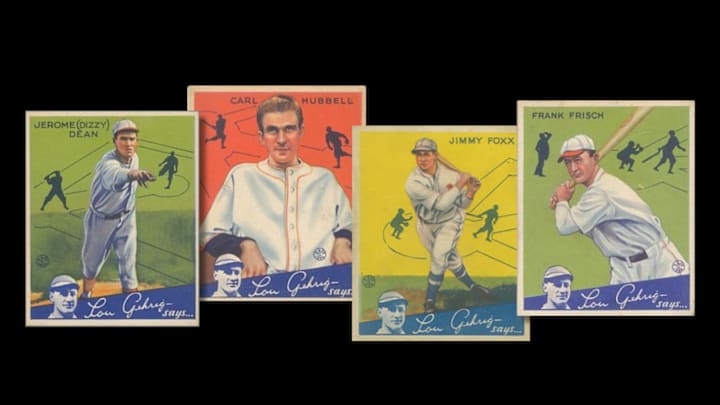
The baseball cards produced by the Goudey Gum Company in 1933 literally check off all the boxes. At 240 cards, the set was large enough to include just about every star of the National and American leagues, not to mention multiple cards of superstars such as Babe Ruth (four cards), Lou Gehrig (two cards) and Jimmie Foxx (2 cards). The cards also boasted a simple yet classic design often imitated but never replicated in the near century since. As overused as the word iconic has become in the Hobby, the 1933 Goudey set 100% warrants the label. Quite simply, it is one of the greatest trading card sets ever produced. Could collectors be blamed for hoping something even bigger and better was heading their way in 1934?

Where's the Babe?
RELATED: Five Hidden Treasures of the 1933 Goudey Set

The first thing collectors today notice about the 1934 Goudey checklist is that there's no Babe Ruth card. Back in 1934, this is not something collectors would have noticed quite so quickly. As was the norm in the early days of the Hobby, the Goudey set was issued in multiple series, meaning that even as collectors kept buying cards throughout the season and seeing no Ruth, there was always hope the Bambino would make it into the next series, perhaps with even more than one card. Of course that never happened, but why? While no definitive evidence seems to exist, the leading (and highly plausible) theory is that Ruth's agent Christy Walsh either didn't grant Goudey permission to use Ruth or put too great a price tag on the Yankee slugger's head.
Two Lous?
RELATED: Lou Gehrig's Most Iconic Cards

Collectors well versed in their Hobby history (or ancient history, as it's becoming) know that the 1934 Goudey checklist boasts two Lou Gehrig cards, but what they may not realize is that it also includes two Lou Gehrigs. Wait, what? Isn't that the same thing? Not quite. The Gehrig pair in this case is the smaller version of the Iron Horse alongside the card banner's "Lou Gehrig says..." caption. Why the change mid-set? Again, there is no definitive answer known for the revision. Look closely at the first Gehrig, however, and you'll notice what appears to be a black eye. Perhaps the switch was as simple as wanting the set's front-man to look like he didn't just walk into the photo shoot from a bar fight.
What the Chuck?

While the 1934 Goudey set is often known as the "Lou Gehrig says..." set due to the prominence of the aforementioned banner across the set's cardboard, there are a dozen exceptions, all in the set's final series. For cards 80-91, Gehrig has been replaced by Chicago Cubs slugger Chuck Klein. Why the change? Again, collectors may never know the answer with certainty. What is known, however, is that Klein, like Ruth and Gehrig, was a client of agent Christy Walsh, whose fingerprints are all over the set. A quick review of the checklist also shows that Gehrig kept the 12 American Leaguers in the set's final 24-card series while Klein took the 12 National Leaguers. In all likelihood then, Walsh negotiated the arrangement with Goudey in an attempt to boost Klein's profile. As for why it didn't kick in until the fourth series, the reason for that is simple, at least if certain sources are to be believed: Walsh didn't sign Klein as a client until midseason.
Deja Vu All Over Again?

A funny thing happened on the way to putting together the first series of 1934 Goudey. Apart from the most minor of tweaks, artwork for all 24 cards was identical to that of the 1933 set. For collectors hoping for new, different, bigger, and better, this must have proved quite a shock. On the bright side, the set's first series was loaded with star power, encompassing 13 of the set's 20 Hall of Famers. One common reason cited for recycling every one of these images is that it likely saved the gum maker money. Still, an even more likely theory (though both can be true) is that the image reuse saved Goudey time. In 1933 there was plenty of competition where baseball "gum cards" were concerned. What better way to be first onto shelves in 1934 than to issue a first series requiring as little work as possible!
Only 96?

Following 240 cards in 1933, why on Earth would Goudey shrink its sequel down to only 96 cards? As usual, the only true answer is that collectors will never know for sure. However, one strong possibility is that the 1934 set was small precisely because the 1933 set was large. To understand this, pause to consider the 1934 Goudey set not so much as a sequel as an extension, somewhat like the Topps Traded sets of the 1980s.
A deeper look at the Goudey checklist provides strong support for this recasting of the set. Take away the set's first series, likely a hurry-up just to hit shelves ahead of the competition. Of the remaining 72 cards, a full 67 fit the Update set model. 64 of them featured entirely new players not present in the 1933 offering while three others placed 1933 players onto their new teams. Apart from that there were the two Gehrig cards and only three other true repeats: all-stars Kiki Cuyler, Bill Hallahan, and Tommy Bridges. In other words, maybe the point of the 1934 offering was to expand the 1933 checklist rather than replicate it.
 Add us as a preferred source on Google
Jason A. Schwartz is a collectibles expert whose work can be found regularly at SABR Baseball Cards, Hobby News Daily, and 1939Bruins.com. His collection of Hank Aaron baseball cards and memorabilia is currently on exhibit at the Atlanta History Center, and his collectibles-themed artwork is on display at the Honus Wagner Museum and PNC Park.