%20%20--%3E%0A%3Csvg%20version%3D%221.1%22%20id%3D%22Layer_1%22%20xmlns%3D%22http%3A%2F%2Fwww.w3.org%2F2000%2Fsvg%22%20xmlns%3Axlink%3D%22http%3A%2F%2Fwww.w3.org%2F1999%2Fxlink%22%20x%3D%220px%22%20y%3D%220px%22%0A%09%20width%3D%2239px%22%20height%3D%2240px%22%20viewBox%3D%220%200%2039%2040%22%20enable-background%3D%22new%200%200%2039%2040%22%20xml%3Aspace%3D%22preserve%22%3E%0A%3Cpath%20fill%3D%22%23FFFFFF%22%20d%3D%22M38.5%2C7H28.2v26h10.3V7z%22%2F%3E%0A%3Cpath%20fill-rule%3D%22evenodd%22%20clip-rule%3D%22evenodd%22%20fill%3D%22%23FFFFFF%22%20d%3D%22M26.1%2C25.5c0%2C5.8-4.1%2C7.5-12.9%2C7.5C3.9%2C33%2C0%2C31.2%2C0%2C25.2v-1.1h11.6%0A%09v2.4c0%2C0.7%2C0.1%2C1.4%2C1.2%2C1.4c1%2C0%2C1.2-0.4%2C1.2-1.3v-0.9c0-1.6-0.9-1.6-3.5-2.2C2.2%2C21.7%2C0%2C19.7%2C0%2C15.3v-0.9C0%2C9.3%2C5.5%2C7%2C12.9%2C7%0A%09c10.2%2C0%2C12.8%2C2.6%2C12.8%2C7.4v1.8h-11v-2.9c0-0.6-0.4-1.1-1.2-1.1c-0.6%2C0-1.2%2C0.4-1.2%2C1.1v0.9c0%2C1.5%2C0.9%2C2%2C3.3%2C2.5%0A%09c8%2C1.6%2C10.5%2C3.3%2C10.5%2C7.5V25.5z%22%2F%3E%0A%3C%2Fsvg%3E%0A)
MLB's ABS Challenge System Is Coming to College Baseball, With One Key Difference
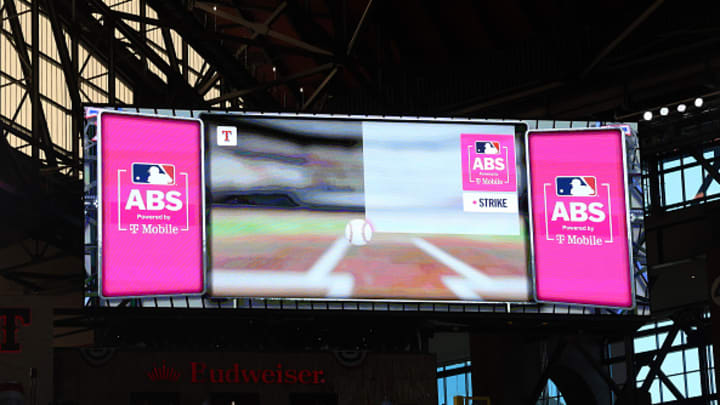
The SEC baseball tournament, set to be held from May 19-24, is going to resemble professional baseball in one aspect, as MLB's popular ABS challenge system will be utilized on an experimental basis for each game of the tourney, the conference on Monday announced.
“The introduction of this challenge system at the SEC Tournament reflects our continued commitment to innovation,” SEC Commissioner Greg Sankey said in the news release. “This addition represents a continued step forward for our game, aligns more closely with the professional level and supports the development of our student-athletes as they prepare for success at the next level.”
The ABS challenge system allows teams to challenge called balls or strikes that they disagree with using a camera-aided, ball tracking system that displays the exact location of each pitch in a strike zone adjusted to the batter's height. The system was first experimented with in the minor leagues in 2019, then a part of various levels of the minors since 2022 before it was tested at the big-league level during spring training in 2025.
For the first time in MLB history, the ABS challenge system is in use in regular season play, and it's been well-received by fans and players, while also proving to be an adjustment for some home-plate umpires.
ABS challenge system rules for SEC baseball
Hawk-Eye cameras will be set up throughout The Hoover Met, the site of the SEC tournament, which will track the location and movement of the baseball. Just as in MLB, the heights of every SEC player will be measured to determine each player's personalized strike zone.
Here's where things get different from pro baseball. In MLB, teams have two challenges entering a game. SEC teams will be allotted three challenges per game. Otherwise, the SEC will utilize the exact same rules as MLB. Both teams will receive one challenge per inning in extra innings, but the challenge cannot be carried over into the next inning if left unused. Challenges will be initiated by a player tapping his helmet or cap, and only a catcher, hitter and pitcher are permitted to challenge a called ball or strike. Players must initiate a challenge immediately after a pitch. If a challenge is successful, the team will retain it, whereas if unsuccessful, the team will lose the challenge.
Just as in MLB, any placement of baserunners—for a example, during a stolen base attempt—after a call is overturned will be up to the discretion of the umpiring crew.
How could the ABS challenge system affect the SEC baseball tournament?
Well for starters, there will be far less gnashing of teeth from the dugouts during the SEC tournament, as teams are now equipped with a live strike zone adjudicator to settle any disputes between team and umpire. While it shouldn't be too noticeable of a change—the whole process of a challenge takes about 15 seconds—games in the SEC tournament are likely to be a tad longer, depending on how many challenges are initiated by teams.
According to Baseball America, college programs around the country had experimented with the ABS challenge system during scrimmages, familiarizing players with the process. That said, initiating a challenge in a scrimmage is one thing, but entirely another in a live, meaningful game. Some players may be reluctant to initiate a challenge while others, perhaps due to a common movement of reaching for their cap or helmet, may accidentally initiate a challenge, as we've already seen in MLB. Players will also have to get accustomed to the strategy of when—and when not—to utilize a challenge.
The ABS challenge system also figures to add some theater to the SEC tournament, as the suspense that briefly builds up to the animated graphic displaying the results of the challenge generally crescendoes into a crowd reaction, making for memorable moments.
Finally, one can expect that certain SEC players will be better at challenging than others, depending on their position.
Here's how the three position groups allowed to challenge balls and strikes have fared in MLB in 2026, according to roughly a month of data collected by MLB.
Catcher | Hitter | Pitcher |
|---|---|---|
60% | 46% | 40% |
Roughly 53% of calls have been overturned thus far during MLB's regular season. Depending on how the ABS challenge system fares during its trial run in the SEC tournament, we could see it implemented on a larger scale in college baseball.
More from Sports Illustrated
 Add us as a preferred source on Google
Tim Capurso is a staff writer for Sports Illustrated, primarily covering MLB, college football and college basketball. Before joining SI in November 2023, Capurso worked at RotoBaller and ClutchPoints and is a graduate of Assumption University. When he's not working, he can be found at the gym, reading a book or enjoying a good hike. A resident of New York, Capurso openly wonders if the Giants will ever be a winning football team again.
Follow TimCapurso