
Hobby Education: How to Effectively Buy Cards Online and What to Avoid
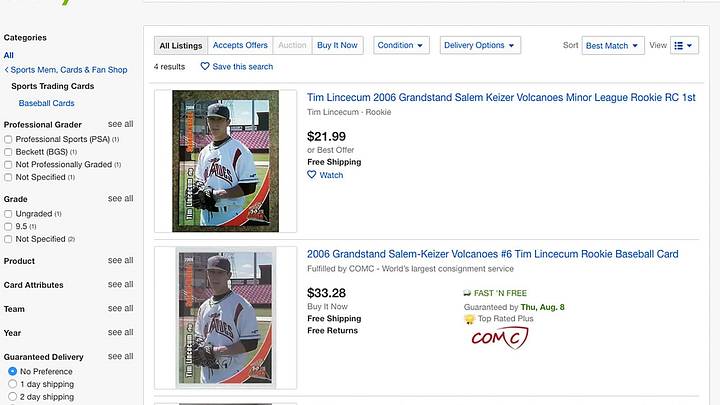
Making card purchases online, with nothing to go on but a couple of photos, is sometimes a necessary risk. While about 80 percent of the country lives in or near urban areas, 20 percent live in sparsely populated areas, often far from a local card shop or even within a few hours of the next card show. So there are plenty of collectors out there who rely on the internet for their card purchases and sales.
While not ideal (and there are definitely some problems you need to deal with), you can be smart about buying cards online to increase your chances of buying good, clean cards.
The More Photos the Better

While it sounds obvious, it makes sense. The more photos you have to view and inspect, the better. One of the biggest red flags in a listing is a single photo of the front of the card. When a listing has only a single photo, it raises the question... what could they be hiding?
Trying not to be pessimistic, the lack of a back photo could be chalked up to the laziness of the one listing the card. Not that they are hiding something. But under those circumstances, if they lack the time to snap one more photo, do they lack the time to take care of their cards?
The only caveat to this tip would be if the card was graded. If it is slabbed by a reputable grading company, a photo of the back of the card is likely not necessary.
Clarity is The Key To Buying Online

With today's technology, even our mobile devices take photos with such clarity that they can be used on advertising billboards. So why would you tolerate anything less when it comes to online card listings?
If a photo is unclear or not centered in the frame, move on to the next option. If the card is not rare, you'll most likely be able to find the same card with a better online presentation.
Coining is Key on Social Media

In general, buyers on sites like eBay are protected from fraud. However, on social media, it's kind of the wild west. It's sad how many scammers there actually are in this world, and social media is a frenzy for them because there are few to no guardrails.
However, there are ways to make sure the card you're buying actually exists, and one way is making sure the seller coins the card. Meaning there's a little piece of paper with the seller's name and the date. This is supposed to limit scamming by showing the buyer that the seller actually has the card in their possession. Many buy-sell-trade groups have adopted this coining method as a requirement to keep their members' risk limited.
Check the Certification Number

While not foolproof, checking the certification number (the number at the bottom-right of a slab ID, e.g., 65291088) on graded cards is the first step when buying online. Really, this could be the first thing you do, even if you're buying in person, but especially when making purchases over the internet.
Reputable companies will have the slab registered under that cert number. You can navigate their website to find where you can type in the number. The results, if it's a legitimate card, will show a photo of the front and back. And it will also give a little information on the card, like population count.
Ask Questions!

Don't forget you can ask questions. Be it direct messaging, eBay's message system, or just commenting on a social media post. Those ways of communicating are there for a reason: to communicate.
It's also a good indicator of the seller. The seller should never be offended by questions. If they are, walk away from the deal. The seller, in theory, didn't make the card, so if they get upset at you for asking questions, that's a big red flag.
Go with Your Gut!
The last tip is a bit subjective. But plain and simple, if the deal feels off, walk away. There's no reason you should feel obligated to buy a card simply because you asked about a price or condition. As a buyer, you have the right to walk away. The seller still keeps their card, and you both carry on to the next deal.
This hobby should be fun, but you also have to protect yourself.
 Add us as a preferred source on Google
After graduating from the University of North Dakota in 2008, Cole worked as an advertising copywriter until shifting to print journalism a few years later. Managing three weekly newspapers in the Dakotas, Cole won numerous awards from the North Dakota Newspaper Association including Best of the Dakotas and, their top award, General Excellence. He returned to collecting in 2021 and has since combined his passion for writing with his love of cards. Cole also writes for the Sports Cards Nonsense newsletter and has made guest appearances on multiple sports card collecting podcasts including Sports Cards Nonsense, and the Eephus Baseball Cards Podcast. IG: coleryan411 X: @colebenz