
Hobby U: An education of card grading criteria
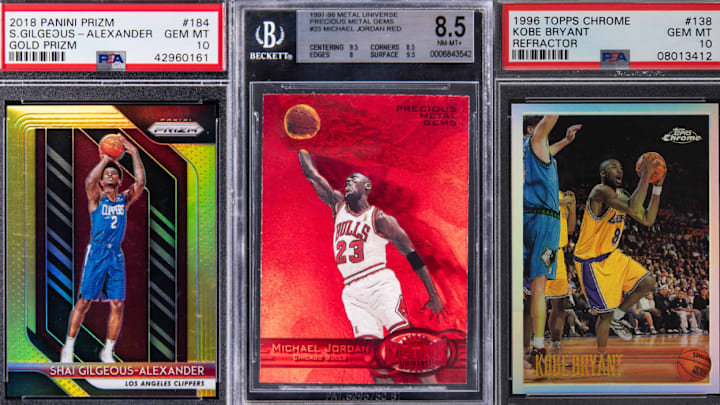
Have you ever looked at a card with a 9 grade and wondered why it wasn’t a perfect 10? Or maybe an 8? If so, this article is for you. I’ll break down the main criteria for grading cards, highlighting the factors that go into a card's grade, as well as one other aspect to watch out for with vintage cards. The point of the article is not consider the secondary market value of one brand versus another.
RELATED: Michael Jordan and Shohei Ohtani PSA 10 Rookies: A Can’t-Miss Live Break
The 4 Criteria for Card Grading
Like the four Cs of a diamond, card grades also work from a four-criteria system. The key determinants that make up a card’s grade are: Corners, Centering, Edges, and Surface. Beckett (BGS) is a card grading company that provides subgrades for the four main criteria on the label. This can help collectors understand the nuance of the total grade.

Corners
The corners of cards are a real challenge. Its the one part of the card that typically takes the biggest beating, especially for older cards. Traditional rectangular cards have sharp corners, which are prone to damage. Damage to the corners can sometimes happen quite easily and frequently. Due to this, cards with sharp corners are highly sought after by collectors.

Centering
Centering examines how perfectly centered the card is, both vertically and horizontally. Card companies have gotten much better at ensuring cards are printed and cut near center but they're still not perfect, which can lead to grade variance.
Centering standards differ for the front and back of a card. PSA says for a card to get a perfect 10 for centering, it must not exceed “approximately 55/45 percent on the front, and 75/25 percent on the reverse”. Meaning the front needs to be nearly perfect, but the back surface can be slightly off-center and still get a 10.

Beckett is even more strict when it comes to centering criteria for a Pristine 10. According to their website, they require perfect 50/50 all around centering on the front and 55/45 or better on the back. This slight difference in centering has led collectors to look for re-grade "crack and crossover" opportunities where they buy a BGS 9.5, crack it open, and send it into PSA expecting a 10.
Trying to answer one of the most commonly asked question when it comes to grading Pokemon cards:-
— P4C (@Ferza_P4C) June 15, 2022
Can BGS 9.5 crossover to PSA 10 GEM MINT?https://t.co/usHjNDOThi pic.twitter.com/pkDLok6s8w
RELATED: Hobby U: Upgrade your card grades?
Edges
Edges examine the card's perimeter independently of the corners for wear and tear. The edges are generally more resistant to damage, but any fraying or chipping will impact the subgrade and probably reduce the card's overall grade depending on severity.
Surface
Surface focuses on how perfectly clean the front and back faces of the card are. There are some surface elements that you can’t do anything about, like the wax spots that are all too common on 1986 Fleer Basketball cards, but some surface blemishes are fixable, like fingerprint marks.

Pro Tip: If you're looking to grade chromium-finish cards like Topps Chrome or Prizms, check the surfaces for dust and fingerprints. If you see any, be sure to wipe them clean with a microfiber cloth starting from the center of the card and pushing out toward the edges.
Other factors to consider for grading and investing
The above four are the main criteria that card grading companies like PSA and Beckett use, but one new entrant to the grading space, C3, includes “fading” as a fifth criteria. For modern chromium-finished cards this is a non-factor, but for older cards any faded coloring could have a big impact on eye appeal and value.
All the above are the key factors that go into card grading, but they aren't the only ones that factor into a card's value. Eye appeal and provenance, or past ownership, also can play a part. Before you send a card into be graded, make sure you do a thorough review yourself of the above criteria so that you know what to expect when the cards come back encased.
TOP TRENDING COLLECTIBLES ARTICLES:
 Add us as a preferred source on Google
Conor is a leading sports collectibles writer and market analyst with more than 100 published articles covering sports cards, Pokémon, auctions, investing trends, and hobby culture. A lifelong collector who entered the hobby in the early 1990s, Conor’s expertise centers on vintage and modern basketball cards, basketball icons, and iconic Boston sports memorabilia tied to legends like Larry Bird, Tom Brady, and David Ortiz.